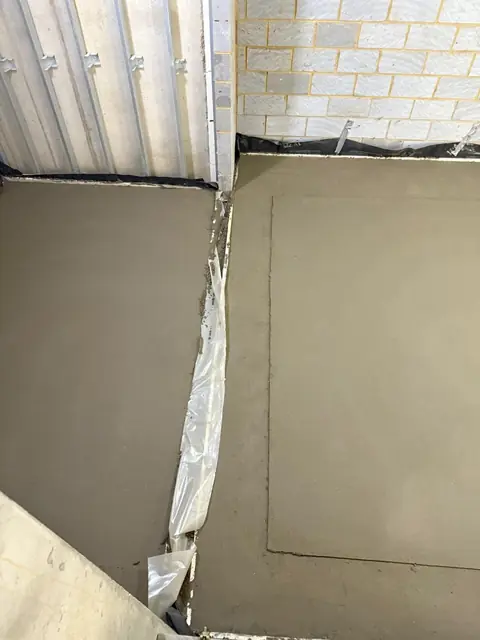
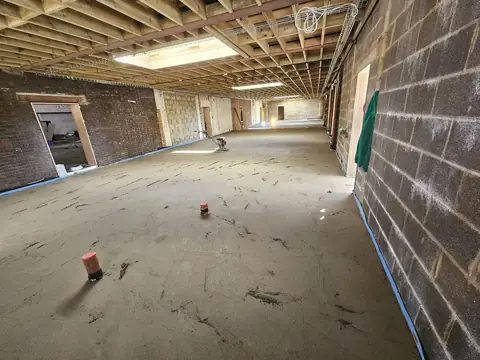
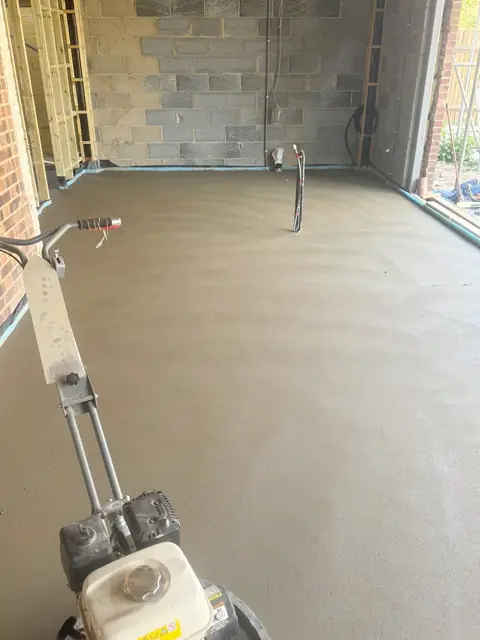
A standard domestic screed is designed for homes: furniture, footfall and the occasional appliance. Put the same screed in a busy shop, a school corridor or a warehouse and it will eventually crush, dust and break up where the traffic is heaviest. Higher strength screed is designed for exactly those floors. K & B Screeding lays it for shops, schools, warehouses and other busy floors.
We lay high strength sand and cement screeds for main contractors, developers and business owners across London and the Home Counties.
Why strength matters
Floor screeds are specified by compressive strength and by how well they resist surface wear. Heavily used floors put far more stress on the screed than a living room does:
- Point loads from racking legs, shelving, display units and machinery.
- Wheeled traffic from pallet trucks, trolleys, cleaning machines and wheelchairs.
- Concentrated footfall in entrances, corridors and around tills and lifts.
- Impact from dropped stock, tools and equipment.
A screed that is too weak for its use shows it quickly. The surface dusts and wears, edges crumble at joints and doorways, and the floor covering above starts to fail. Replacing it means closing the building.
How we achieve higher strength
Strength is designed into the mix, but it is won or lost on site.
- Mix design. We adjust the cement content and sand grading to meet the strength your specification calls for.
- Consistency. Every batch is mixed to the same recipe and consistency, so there are no weak areas.
- Compaction. This is where most high strength screeds fail. A semi-dry screed only reaches its designed strength when it is thoroughly compacted, and we give compaction proper time and attention on every bay.
- Finishing. The surface is closed and power floated to a dense, even finish that resists wear.
- Curing. The screed is protected from drying too fast so it gains strength evenly through its full depth.
Where the floor will be loaded very early, a bonded screed that works together with the slab below may be the better solution, and for very large open areas we can discuss a liquid screed.
Where higher strength screed is used
- Retail units, showrooms and shopping centres
- Schools, colleges and nurseries
- Offices, reception areas and lift lobbies
- Warehouses, storage and light industrial units
- Hospitality venues, kitchens and back of house areas
- Communal corridors and entrances in apartment buildings
- Plant rooms and service areas
For more on how we work on these projects, see our commercial screeding page.
Wearing surface or base for flooring?
Some high strength screeds are left exposed and sealed, while most are covered with a commercial floor finish such as safety vinyl, rubber, heavy duty carpet tiles, tiles or resin. The strength and finish required depend on which. Tell us what is going on top and we will design the screed accordingly.
Thickness, joints and levels
High strength screed follows the same thickness rules as other sand and cement screeds. Bonded screeds are thinnest because they act with the slab, while unbonded and floating screeds need more depth to carry load on their own. Commercial floating screeds are typically at least 75mm. Our screed thickness guide explains these figures.
Joints are carefully planned on commercial floors, where they must line up with structural joints and be protected at doorways and changes of finish. Levels are set to the surface regularity the floor finish demands, commonly SR2 for commercial floors.
Protecting a new commercial floor
A new screed is at its most vulnerable in the weeks after it is laid, when other trades are still working. Protecting it avoids expensive repairs before the floor finish ever goes down.
- Restrict traffic until the screed has gained enough strength, and keep heavy plant and pallet trucks off it.
- Protect walkways and working areas with boards or protection sheets once the screed can be covered safely.
- Do not store materials on the new floor, especially plasterboard, blocks or anything wet.
- Control drying with sensible ventilation so the screed does not dry too fast at the surface.
- Protect joints and edges at doorways, where trolleys and barrows do most damage.
We advise the site team on protection so the floor is handed over in the condition it was laid.
High strength screeding near you
We lay heavy duty screeds across London and the Home Counties from our base in Slough, including Uxbridge, Reading, the area around Heathrow and Milton Keynes.
“From start to finish, K & B Screeding Ltd demonstrated exceptional expertise and a commitment to customer satisfaction. I am extremely impressed with the service that they provide.”
Part of our screeding and floor screeding services, laid by our own team across London and the Home Counties.