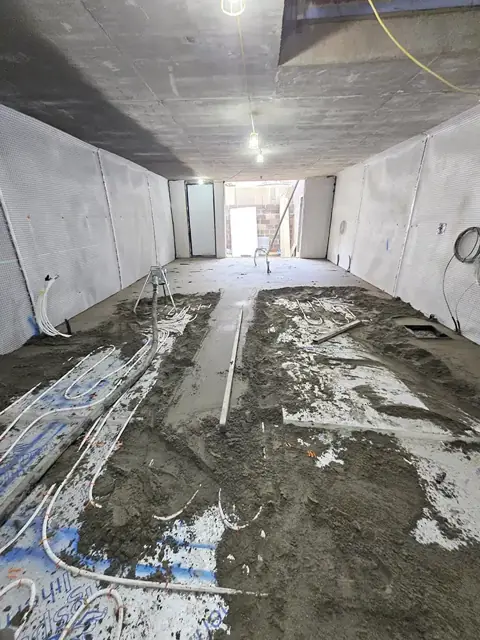
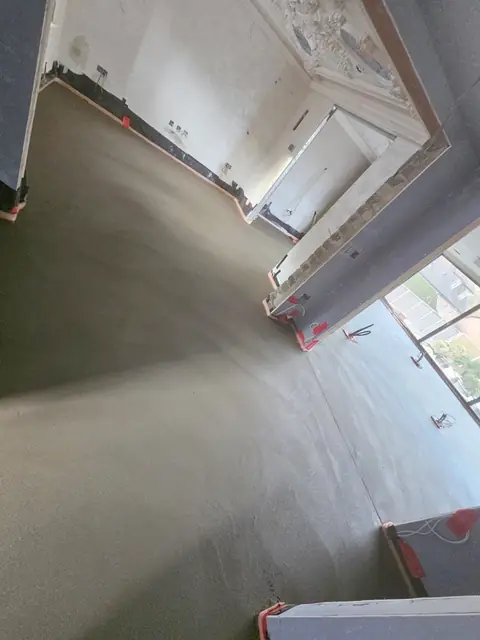
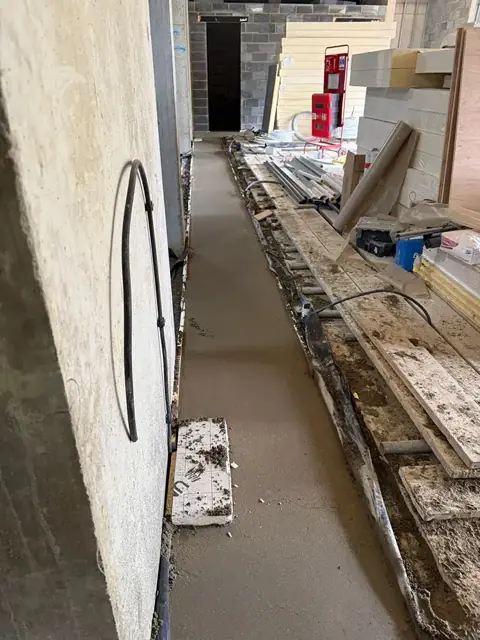
If your concrete or screed floor needs grinding and you want it done for you, this is the page for you. K & B Screeding grinds floors for homeowners, builders, flooring fitters and site managers across London and the Home Counties from our base in Slough.
To be clear from the start: we are a contractor, not a supplier. We do not sell floor grinders or hire them out, and we do not sell diamond tooling. We bring our own equipment, grind the floor and leave it ready for the next stage.
What concrete floor grinding does
A floor grinder has rotating heads fitted with diamond segments. As the heads turn under the weight of the machine, they cut away the top of the slab or screed a little at a time. That makes grinding good at a specific set of jobs:
- High spots and ridges. Trowel marks, bumps and lips at bay joints or old patches are ground down so thin finishes do not show them.
- Laitance. The weak, dusty skin that forms on concrete and some screeds as they cure is ground off to expose sound material that adhesives and primers can grip.
- Adhesive residue. Old carpet, vinyl and tile adhesive left behind after a floor is stripped can be taken back to a clean base.
- Paint and thin coatings. Floor paints, sealers and thin resin coatings are ground off so a new finish bonds to the slab, not to an old layer that may let go.
Grinding is one of several preparation methods we use. Our floor preparation page compares it with shot blasting, scarifying and crack repairs, and explains how we choose between them. This page covers grinding itself.
Can you grind a concrete floor level?
Grinding can make a floor flatter, but it cannot fix a floor that is badly out of level. It works well where the problem is local: a ridge, a hump, a lip between two bays, or a patch that sits proud of the rest. Taking those down is often all a floor needs before a thin finish goes on.
Where a floor dips, slopes across the room or steps between areas, grinding the high side down to meet the low side would mean removing a lot of material from a large area. That is slow, costly and can leave a screed too thin. In those cases the better answer is usually to grind off the high spots and contamination, then fill the low areas with a levelling compound, or lay a new screed where the difference is too great for compound.
We check the floor with a straightedge before quoting so you know which applies.
How much can be removed?
Grinding takes material off in thin layers, which makes it controllable and suits surface work rather than heavy removal. How much comes off in practice depends on the hardness of the concrete or screed, the diamonds fitted and the number of passes.
For a screed, there is a second limit: the screed itself. A screed laid over insulation or underfloor heating has a minimum depth, and grinding too much away can leave it thinner than it should be. Our screed thickness guide sets out typical depths. Where a floor needs more taken off than grinding can sensibly remove, we will say so and suggest scarifying, repair or replacement instead.
Grinding compared with other methods
| Method | Best for | Surface left | When we would choose it |
|---|---|---|---|
| Diamond grinding | High spots, laitance, adhesive, paint, thin coatings | Clean and flatter, lightly textured | Before levelling compound, resin or thin floor finishes |
| Shot blasting | Laitance and light coatings over large open areas | Clean, evenly textured profile | Before a bonded screed or resin on a large slab |
| Scarifying | Thick coatings and heavy build-up | Rough, heavily profiled | Where much more needs to come off than grinding can remove |
| Break out and relay | Weak, hollow or badly uneven screed | New base | Where the existing screed is not worth saving |
Swipe the table sideways to see every column.
Dust control
Concrete, screed and tiles all contain silica. The Health and Safety Executive says silica is a major constituent of construction materials such as bricks, tiles, concrete and mortar, and that tasks including cutting, drilling, grinding and polishing generate dust from them. The fine dust, known as respirable crystalline silica, is too fine to see. HSE states that heavy and prolonged exposure can cause lung cancer and other serious respiratory diseases, including silicosis and chronic obstructive pulmonary disease.
That is why we do not dry grind without extraction. Our grinding equipment is used with dust extraction, adjoining areas are protected, and we agree with you or the site manager which areas need to be closed off while we work.
How we grind a floor
- Survey. We look at the floor, identify any coatings, adhesive or contamination, check flatness with a straightedge and ask what is going down next.
- Recommend. We tell you whether grinding alone will do the job or whether the floor also needs repairs, levelling compound or a new screed.
- Quote. You receive a fixed price within 24 hours of us having the details, agreed before any work starts.
- Protect. Doors, walls and adjoining rooms are protected, and the dust extraction is set up.
- Grind. We grind the floor, taking down high spots and removing laitance, adhesive or coatings until we reach sound material.
- Clean and hand over. The floor is vacuumed and left clean, sound and ready for the next trade, with notes on anything we found underneath.
What happens after grinding
Grinding is rarely the last step. Once the surface is clean, cracks and hollow areas show up more clearly, and we can deal with them as screed repairs before the finish goes on. If a levelling layer or new screed is needed, we lay that too.
If the floor is a new screed that has been ground to remove laitance, it still has to be dry before floor coverings go down. Our guide on how long screed takes to dry explains testing.
Commercial, industrial and domestic floors
We grind floors in houses, flats and extensions as well as offices, retail units, warehouses and industrial units. On commercial projects we work around your programme and other trades, and supply method statements where needed. We cover the whole of London and towns such as Reading, Uxbridge and Maidenhead.
“This company was a delight to work with. Nothing was too much trouble. They were on the job on time every day. The employee was so obliging and polite too.”
Part of our screeding and floor screeding services, laid by our own team across London and the Home Counties.