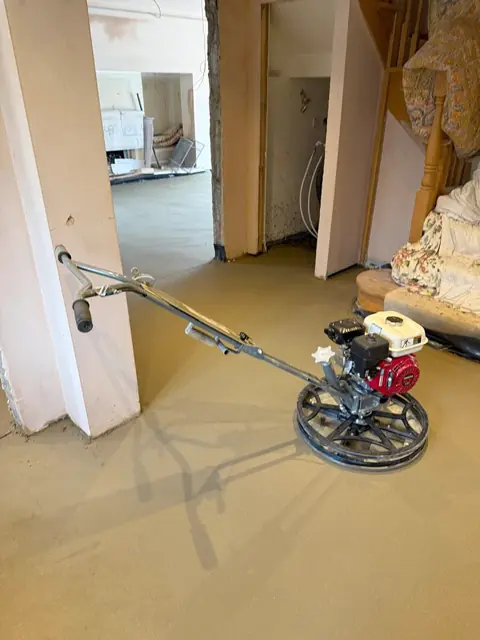
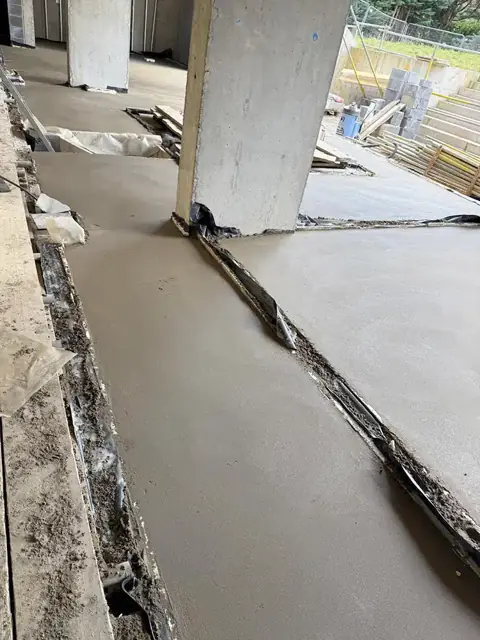
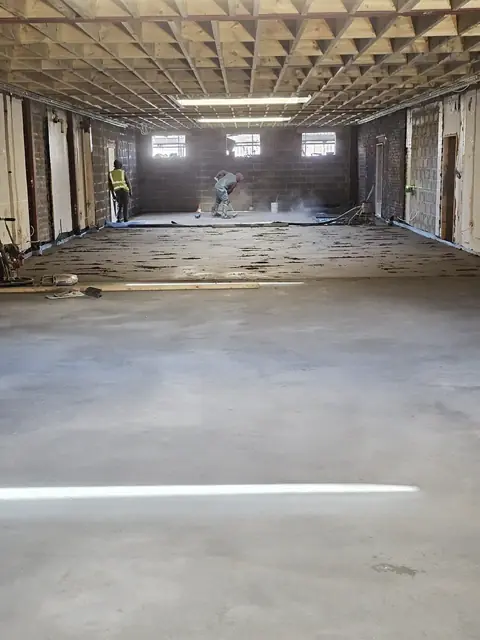
Sand and cement screed is the floor most people picture when they think of screeding. A carefully proportioned mix of sharp sand and cement, with just enough water to make it workable, is spread across the floor, compacted, ruled off to level and then trowelled or power floated to a close, even finish. It has been used on British building sites for generations, and it remains the right choice for a huge number of jobs. K & B Screeding lays it by hand, compacted and power floated.
Traditional screeds are one of our core specialisms, laid in homes, extensions and commercial buildings across London and the Home Counties, from single rooms to entire ground floors.
What goes into a traditional screed
A traditional screed is a semi-dry mix. It holds together when squeezed in the hand but is nowhere near runny, which is what allows it to be compacted into a dense, strong layer. The mix is usually somewhere between one part cement to three and one part cement to five parts sand, depending on the specification and the loading the floor will take.
Because it is mixed on site, the recipe can be adjusted for the job. Polypropylene fibres can be added to control shrinkage, as in our fibre reinforced screed. Additives can speed up drying, as in our quick drying screed. A richer, well compacted mix produces a higher strength screed for heavy traffic.
Why choose sand and cement screed
- Versatile. It can be bonded to concrete, laid unbonded on a membrane, or floated over insulation and underfloor heating.
- Practical on awkward sites. Small rooms, stairs, landings, steps and odd shapes are straightforward by hand.
- Suitable for wet areas. Unlike calcium sulphate screed, cement based screed is at home in bathrooms, wet rooms and utility areas.
- Takes load earlier. Once cured it is robust, and it tolerates site traffic well.
- Compatible. Cement based tile adhesives and levelling compounds work with it without special primers.
- Cost effective. On smaller jobs it often costs less than bringing in a pump.
How we lay a sand and cement screed
- Check the base. The slab or insulation must be sound, clean and correctly installed. Any damp proof membrane is checked for gaps.
- Set the levels. Datum levels are transferred across the room, and screed rails or levelling bays are set to the finished height.
- Mix and place. The screed is mixed to the right consistency and placed in manageable sections so it never starts to set before it is finished.
- Compact. This is the step that decides whether a screed lasts. Thorough compaction removes voids and gives the screed its strength.
- Rule off and finish. The surface is ruled off to level with a straightedge, then closed with a trowel or a power float.
- Cure. The screed is protected from rapid drying for the first few days so it gains strength evenly and does not crack.
On larger areas we use power floats to give a consistently tight surface, which you can see in many of the photos in our project gallery.
Thickness and joints
Sand and cement screed needs more depth than liquid screed when it is laid floating over insulation. Typical minimum thicknesses under BS 8204 are:
| Construction | Typical minimum thickness |
|---|---|
| Bonded to a concrete base | 25 to 40mm |
| Unbonded, on a membrane | 50mm |
| Floating, lightly loaded | 65mm |
| Floating, heavily loaded | 75mm |
Swipe the table sideways to see every column.
Larger floors are divided into bays with movement joints to control cracking, and joints are always carried through at doorways and where the building structure has joints. Our screed thickness guide explains how these figures are chosen.
Drying time
A traditional screed dries slowly. A widely used rule of thumb is around one day per millimetre for the first 40mm, and longer beyond that, in good conditions. A 65mm screed can therefore take well over two months before an impermeable floor finish goes down. If that does not fit your programme, a quick drying screed or a liquid screed may be better. Our guide on how long screed takes to dry explains the factors and testing.
Sand and cement screeding near you
We lay traditional screeds across London and the Home Counties from our base in Slough. We have dedicated pages for sand screed in Slough, sand screed in Milton Keynes and sand screed in Cambridge, and our coverage also includes Reading and High Wycombe.
Sand & Cement Screed prices in 2026
Published 2026 UK figures put sand and cement screed at about £18 to £25 per m², supplied and laid (MyJobQuote, August 2026). MyJobQuote does not say whether these figures include VAT. Depth, area, access and preparation move the figure either way, so we fix your price in writing within 24 hours. See our floor screeding cost guide or the screed calculator.
“I used K & B for a screeding job at the beginning of the year (Jan 2023), extremely competitive quotation and first class delivery, on time and on budget.”
Part of our screeding and floor screeding services, laid by our own team across London and the Home Counties.