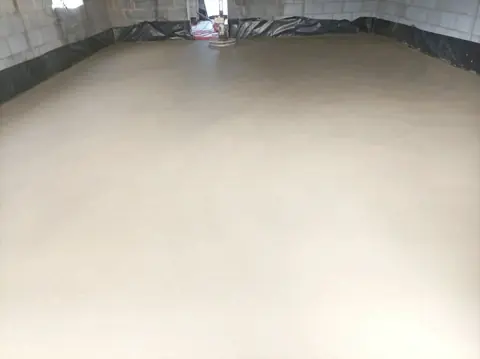
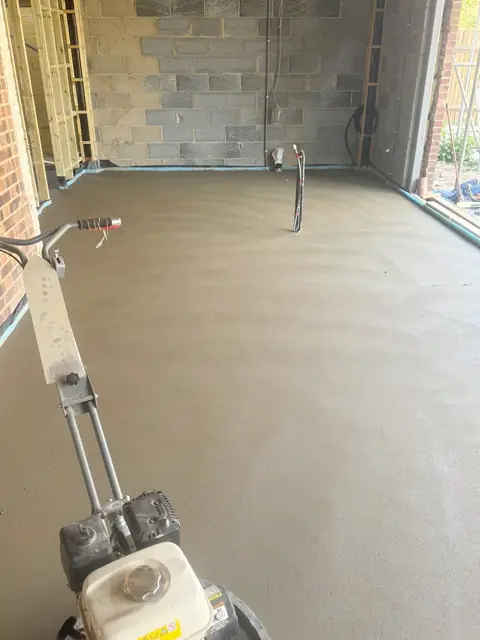
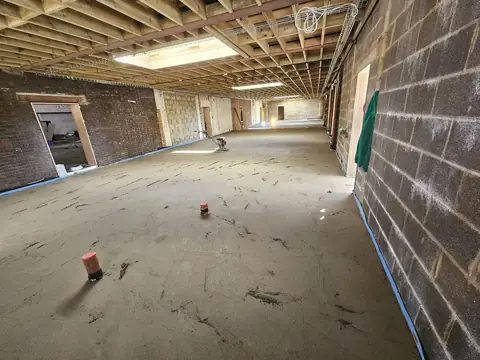
Most floors that need screeding are not next to the road. A rear extension sits behind the house, a loft or upper flat is two or three storeys up, and a basement is below ground with one stair in. Screed pumping solves the access problem: the pump or mixer stays at the kerb or on the driveway, and the screed travels to the floor through a hose. K & B Screeding pumps and lays screed for homeowners, builders, developers and main contractors across London and the Home Counties from our base in Slough.
This page is about getting screed to the floor. If you are still choosing the material, our liquid screed page explains flowing screed itself, and our sand and cement screed page covers the traditional mix. Both can be pumped.
We supply and lay, we do not hire out pumps
If you searched for screed pump hire, it is worth saying plainly: we do not hire out screed pumps, with or without an operator. We supply the screed, bring the pump to site, pump it and lay the floor with our own team. You get one price for the finished floor rather than a day rate for a machine.
For a sense of scale, our floor screeding cost guide quotes trade2base (June 2026) putting screed pump hire at about £300 to £600 per day. That is before the screed, the labour, the preparation and the finishing. On a supply and lay job the pump is one line in a fixed quotation.
Two ways of pumping screed
The method depends on the screed.
Liquid screed arrives ready mixed and is fed into a line pump, which pushes the fluid screed along the hose to the floor, where it is spread and dappled to level. Turbosol's PRO H CL, a trailer pump built for self-levelling anhydrite and cement screeds, is listed with a delivery distance of 100 m and a delivery height of 60 m.
Sand and cement screed is semi-dry, so it will not flow like a liquid. It is pumped with a mixer pump that mixes a batch and then blows it along the hose with compressed air. Turbosol lists its Transmat 27.45 mixer pump for semi-dry floor screeds with a conveying distance of 180 m horizontally and 120 m vertically. At the other end the screed is spread, compacted and finished by hand, exactly as if it had been barrowed in.
Those are maker's figures for particular machines in ideal conditions. On a real job the length of the hose route, the number of bends, the height and the mix all affect what is sensible, and we plan each route when we quote.
| Liquid screed pumping | Sand and cement screed pumping | |
|---|---|---|
| Material | Ready mixed flowing screed | Semi-dry sand and cement, mixed on site |
| Type of pump | Line pump fed with fluid screed | Mixer pump using compressed air |
| What happens at the floor | Spread and dappled, levels itself | Spread, compacted and finished by hand |
| Suits | Large open floors, underfloor heating, new build plots | Rooms needing early load, wet rooms, awkward shapes |
| Main planning point | Sealed edges and a steady supply of loads | Space by the road for the mixer pump and sand |
Swipe the table sideways to see every column.
Where screed pumping helps
- Rear extensions. The hose runs from the road through the house, down a side passage or over the garden to the extension. On a terrace with no side access, it usually goes through the hallway.
- Upper floors and flats. Loft conversions, first floor extensions and upper storey flats are pumped by running the hose up the stairs or in through a window, so nothing is carried up by hand.
- Basements. Screed can be pumped down a lightwell or a stair instead of being lowered bucket by bucket.
- Large floors. On apartment schemes, offices and units, a pump places far more screed in a day than a barrow team. Our commercial screeding page covers how we work with site teams on phasing and pump positions.
- Restricted streets. Where the pump cannot park outside, a longer hose run from the nearest legal spot is often the answer.
How we plan and pump a screed
- Survey and quotation. We confirm the area, depth and build-up, look at where the pump can stand and walk the hose route, then send a fixed quotation within 24 hours.
- Parking and permissions. We check whether the pump needs a parking suspension or other council permission, and tell you what is needed and when.
- Preparation. Insulation, membrane and edge strip are checked or fitted, every gap is sealed and depth markers are set. We can prepare the full insulation and membrane build-up ourselves.
- Protecting the route. Floors, stair treads and door frames along the hose route are covered before the hose goes in.
- Pumping and laying. The screed is pumped to the room and laid to the marked levels, either dappled for liquid screed or compacted and finished for sand and cement.
- Clean down and handover. The hose is cleared, the route is cleaned and you get drying and protection advice for the new floor.
Access, parking and London streets
In London and the older towns around it, parking and access usually shape the job more than the floor itself. Terraced streets, controlled parking zones and upper storey flats above shops all need planning. Our London page explains how we arrange parking suspensions where a council requires them. In places such as Windsor, with tight streets and small front gardens, we agree where the mixer or pump will stand before the day.
The same thinking applies to a typical semi: the pump parks on the drive and the hose runs down the side of the house, as we describe for liquid screed in Slough.
When pumping is not worth it
A pump and its set up are fixed costs, so on a single small room, a landing or a short run of steps it can cost more than it saves. Those jobs are often quicker by barrow and bucket with a sand and cement mix. Our guide to liquid screed vs sand and cement screed sets out where each makes sense. We will tell you when we quote if pumping is not the sensible choice.
“This company was a delight to work with. Nothing was too much trouble. They were on the job on time every day. The employee was so obliging and polite too.”
Part of our screeding and floor screeding services, laid by our own team across London and the Home Counties.