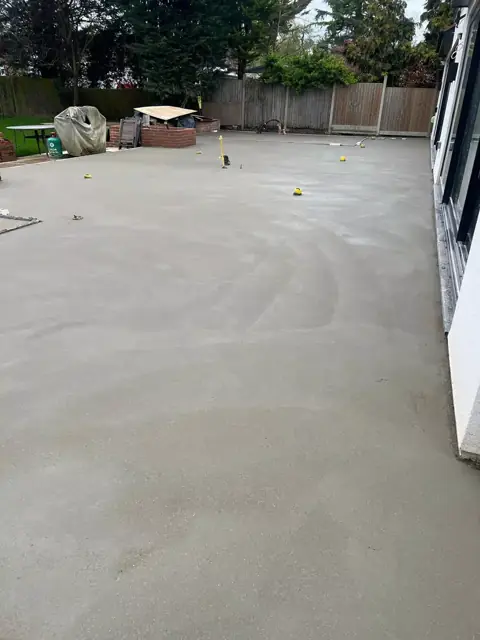
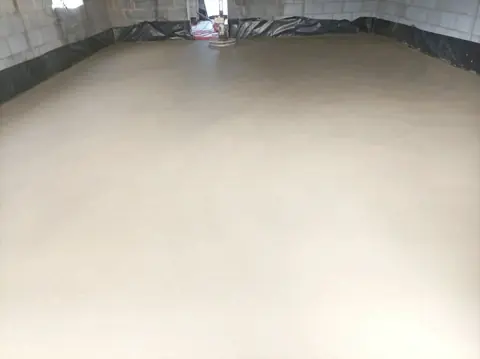
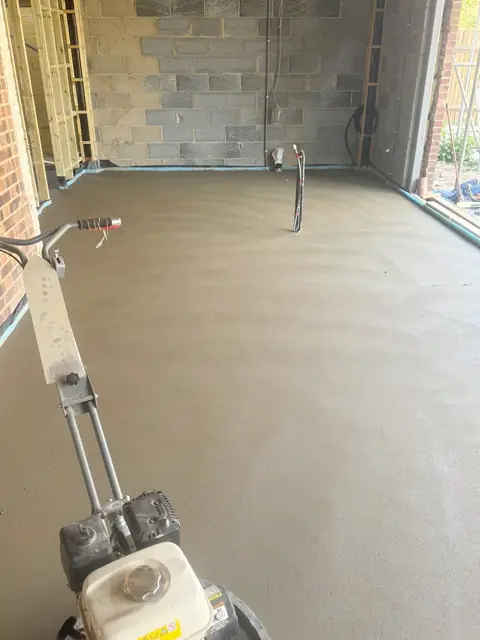
We lay both liquid screed and traditional sand and cement screed every week, so we have no reason to push one over the other. Each has clear strengths, and the right choice depends on the size of the area, whether underfloor heating is going in, the floor finish, the programme and the budget.
The short answer
- Choose liquid screed for large, open areas, new builds and extensions, and especially over underfloor heating.
- Choose sand and cement screed for small or awkward areas, wet rooms and bathrooms, floors that need to take load early, and jobs where a pump is not practical.
Side by side
| Liquid screed | Sand and cement screed | |
|---|---|---|
| How it is laid | Pumped and self-levelling | Hand laid, compacted and finished |
| Speed of laying | Very fast, large areas in a day | Slower, laid in sections |
| Typical depth floating | From about 35mm domestic, 40mm commercial | From 65mm domestic, 75mm commercial |
| Flatness | SR1 to SR2 readily achievable | SR2 typical with good workmanship |
| Over underfloor heating | Excellent, full encapsulation | Good if well compacted |
| Walk on | Usually 24 to 48 hours | Usually 24 to 48 hours |
| Drying | Can be force dried with heating | Slow, around 1 day per mm to 40mm |
| Wet areas | Not for permanently wet areas (calcium sulphate) | Suitable |
| Movement joints | Far fewer, larger bays | More joints needed |
| Before flooring | Laitance sanded off, primer needed for tiles | Usually ready once dry |
| Small jobs | Often uneconomic | Cost effective |
Swipe the table sideways to see every column.
Where liquid screed wins
Underfloor heating. Liquid screed flows around every pipe with no air pockets, so heat transfers quickly and evenly. It can be laid thinner over the pipes, so the floor warms up faster and responds better, which suits heat pumps. See underfloor heating screed.
Speed on large areas. A pump can place hundreds of square metres in a day. On developments and large extensions that saves days of labour.
Flatness. The self-levelling action gives a very flat floor, which suits large format tiles, LVT and engineered wood with little or no levelling compound.
Fewer cracks and joints. Calcium sulphate screeds shrink very little and can be laid in large bays, so there are fewer joints to detail and less risk of cracking.
Thinner and lighter. Less depth means less weight and more build-up height for insulation, which matters in extensions and conversions.
More detail is on our liquid screed page.
Where sand and cement wins
Small and awkward areas. Single rooms, landings, steps, stairs and odd shapes are easy by hand, and bringing in a pump for a small volume is often uneconomic.
Wet areas. Cement based screed is suitable for bathrooms, wet rooms and utility areas. Calcium sulphate screeds are not suited to permanently wet conditions.
Early loading. Sand and cement screed tolerates site traffic and can be loaded sooner, which suits some commercial and phased projects.
Compatibility. Cement based tile adhesives and levelling compounds bond to it without special primers.
Flexibility. The mix can be adjusted on site, with fibres for crack control or rapid drying additives when time is short.
More detail is on our sand and cement screed page.
Drying time compared
Both dry at roughly similar rates per millimetre, but liquid screed is usually laid thinner, and calcium sulphate screed can be force dried using underfloor heating after about a week. In practice a liquid screed over underfloor heating is often ready for flooring sooner. If time is critical with a traditional mix, a quick drying screed closes the gap. Our guide on how long screed takes to dry goes into detail.
Cost compared
Per square metre, costs vary with area, depth and access. As a general pattern, liquid screed tends to be cost effective on larger areas, where its speed and reduced depth offset the cost of the material and pump. Sand and cement is often cheaper on small or fragmented areas. Our floor screeding cost guide explains what affects the price.
Things to check before choosing liquid screed
- The insulation and membrane must be well sealed, because liquid screed will find any gap.
- The pump needs a route from the road to the room. Long hose runs are usually fine.
- Calcium sulphate screed is not for permanently wet areas without a suitable system.
- Your tiler or flooring installer should know the screed type so they use the right primer and adhesive.
Our recommendation
For most extensions and new builds with underfloor heating, we recommend liquid screed. For bathrooms, small rooms, garage conversions and jobs where the floor must take load early, we usually recommend sand and cement. Where a project has both, we can use each in the right place. Tell us about your floor and we will recommend the right option, and explain why.
Get a price for either screed
We can price both options for the same floor so you can compare like for like. Send us the floor area in m², the depth you have to work with, what is going on top and the site postcode. We call back the same day and give you a fixed written price within 24 hours. Ask for a quotation or call 07466 650936.