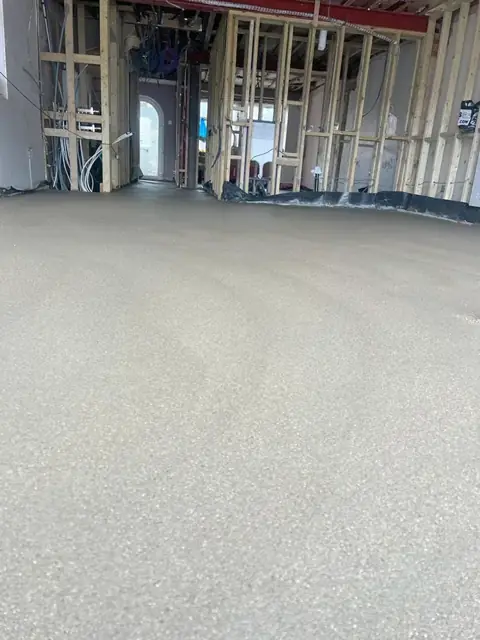
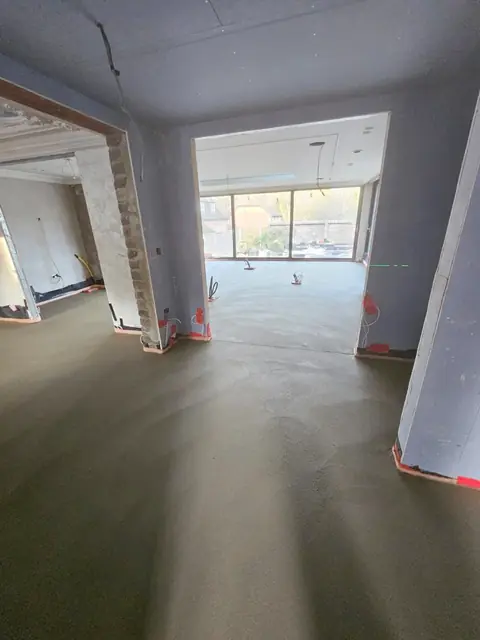
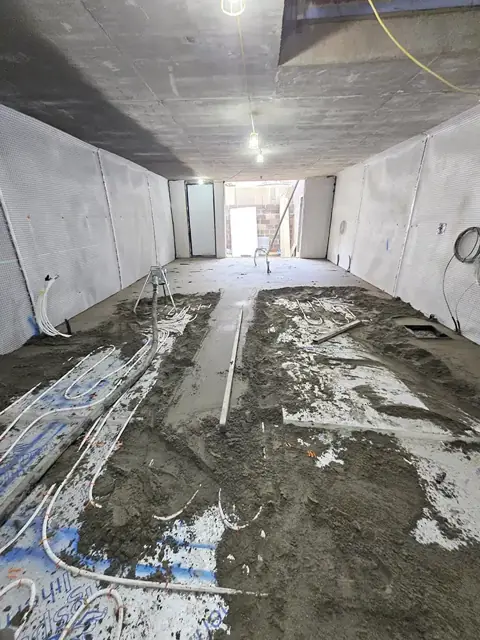
Floor levelling is the final step between a structural floor and a beautiful finished one. A screed or concrete slab can be perfectly sound yet still have enough unevenness to spoil a new floor. Sheet vinyl shows every trowel mark, LVT planks rock and click, large tiles lip at the edges, and engineered boards bounce over hollows. A thin layer of levelling compound puts that right. K & B Screeding levels floors for LVT, tiles, vinyl and wood, a job often called subfloor levelling.
We carry out floor levelling across London and the Home Counties, both as part of our own screeding work and as a separate service for homeowners, builders and flooring contractors.
Screed or levelling compound?
This is the first question, and the answer depends on how uneven the floor is.
- Levelling compound is a thin, self levelling material applied over an existing sound screed or slab. Most are laid from about 2mm up to around 10mm, and some are designed for deeper sections. It corrects minor unevenness and gives a smooth, flat surface.
- A new screed is needed when the floor is significantly out of level, when there are big steps between rooms, when the existing screed is weak or damaged, or when a full new build-up is required.
Using levelling compound to fix a problem that needs a screed is a false economy. Deep pours of compound can crack, debond and cost more than a proper screed. We will always tell you which is right for your floor. For new floors, a liquid screed often gives such a flat finish that very little levelling is needed afterwards.
Surface regularity
Floor flatness is measured with a 2 metre straightedge. The British Standard for screeds, BS 8204, sets three classes of surface regularity:
| Class | Maximum gap under a 2m straightedge | Typical use |
|---|---|---|
| SR1 | 3mm | High standard floors, thin sheet finishes |
| SR2 | 5mm | Normal standard for most floors |
| SR3 | 10mm | Utility standard, thick or tolerant finishes |
Swipe the table sideways to see every column.
Levelling compound is the most reliable way to take a floor to SR1, which many thin floor finishes demand.
How we level a floor
- Assess. We check the level of the floor, how sound the base is, and whether there is moisture that needs dealing with first.
- Prepare. The surface must be clean and sound. Dust, weak laitance and old adhesive are removed by floor preparation, and cracks and hollow areas are repaired. See screed repairs.
- Prime. The correct primer is applied for the base, whether that is sand and cement screed, calcium sulphate screed, concrete, timber or old tiles. Priming controls absorption and ensures a good bond.
- Level. The compound is mixed to the right consistency, poured and spread to the required depth, then spiked to release trapped air.
- Protect. The floor is left to set and dry before foot traffic and flooring, following the product's guidance.
Floors we level for
- Luxury vinyl tiles and planks
- Sheet vinyl and safety flooring
- Large format porcelain and stone tiles
- Engineered wood and laminate
- Rubber, linoleum and commercial carpet tiles
- Resin and decorative finishes
Levelling over different bases
Every base needs a slightly different approach. Calcium sulphate screeds need their laitance removed and a compatible primer. Concrete and sand and cement screeds need to be sound and free of contamination. Timber floors need to be rigid and are often overboarded first. Old ceramic tiles can sometimes be levelled over after thorough cleaning and priming. We check your floor and choose the products accordingly.
Common levelling mistakes we see
Levelling compound is simple to buy and easy to get wrong. The most common problems we are asked to put right are:
- No primer, or the wrong primer for the base, so the compound cracks or debonds.
- Laying over dust or laitance, which stops the compound bonding to the floor.
- Pouring too deep, trying to correct a floor that really needed a new screed.
- Leaving trapped air, which shows as pinholes and weak spots in the finished surface.
- Laying flooring too soon, before the compound and the screed below are dry.
Getting the preparation and product right first time is cheaper than removing a failed levelling compound later.
Floor levelling near you
We level floors across London and the Home Counties from our base in Slough, including Windsor, Reading, Northampton and throughout London.
“From start to finish, K & B Screeding Ltd demonstrated exceptional expertise and a commitment to customer satisfaction. I am extremely impressed with the service that they provide.”
Part of our screeding and floor screeding services, laid by our own team across London and the Home Counties.