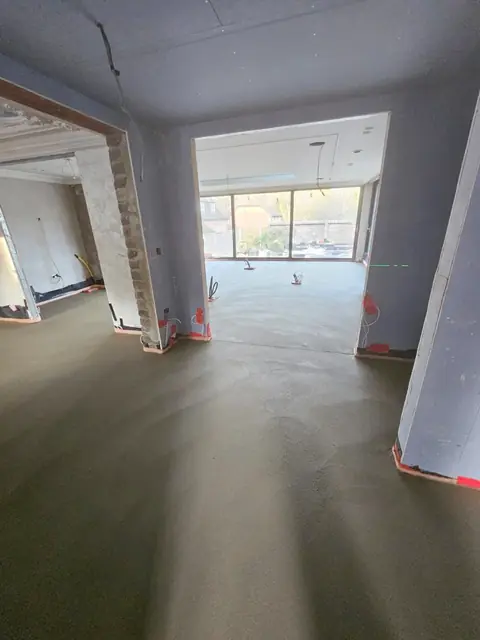
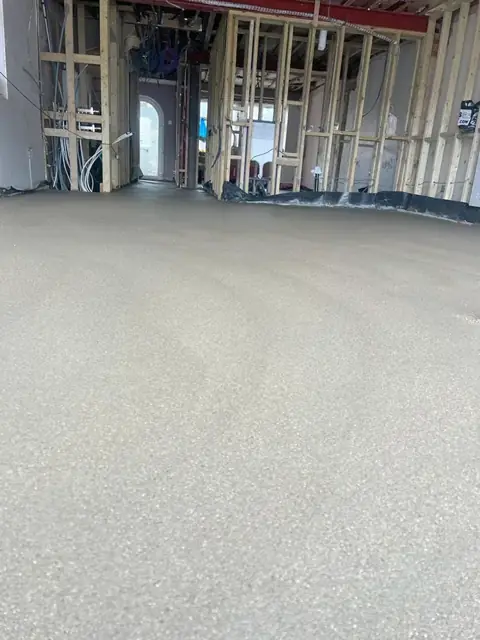
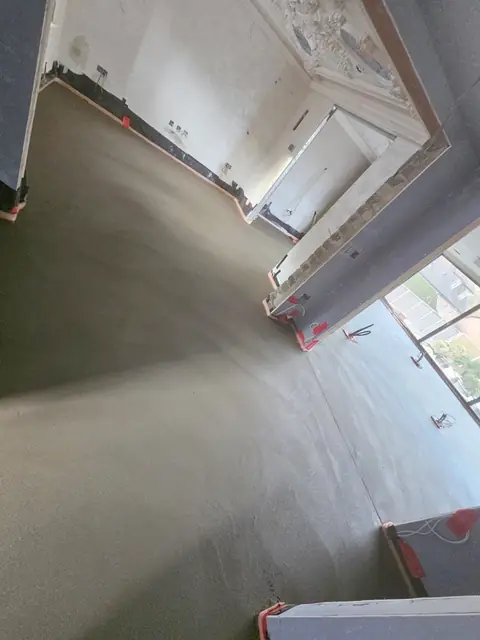
Three products get confused more than any others in our trade. A latex compound and a self levelling compound are both thin smoothing layers poured over a floor that already exists. A screed is the floor itself, laid at full depth over a slab, insulation or underfloor heating pipes. Picking the wrong one is expensive: a compound poured where a screed was needed can crack and debond, and a screed laid where a 3mm skim would do costs far more than it should.
The figures below come from UK manufacturers' product pages and the Mineral Products Association's summary of BS 8204. On a real job, the product's own data sheet always wins.
The short answer
Use a latex compound when the base is awkward: plywood overboarding, firmly bonded old tiles, or old adhesive residues, and the floor only needs a few millimetres to make it smooth.
Use a water mix self levelling compound when the base is a sound screed or concrete slab that is rough, patched or slightly uneven.
Lay a new screed when there is no floor, when the existing screed is weak, hollow or cracked through, or when the floor is so far out of level that you would be pouring compound in thick layers to fix it.
Side by side comparison
| Latex compound | Water mix self levelling compound | New screed | |
|---|---|---|---|
| What it is | Two part: cement based powder mixed with a latex liquid | Powder mixed with water on site | Sand and cement, or a flowing calcium sulphate or cement screed |
| Typical depth | A few mm; one latex product is stated up to 12mm neat and 30mm with aggregate | Commonly 2mm to 10mm or 20mm; deep section products go further | 25mm to 40mm bonded; from about 35mm (liquid) or 65mm (sand and cement) floating in homes |
| Purpose | Smoothing awkward bases | Smoothing sound screed and concrete | Forming the floor, covering insulation and heating pipes |
| Walk on | From about 1 to 2 hours (product data) | From about 60 to 90 minutes (product data) | Usually 24 to 48 hours |
| Floor coverings | From about 3 to 4 hours for rapid products | From about 3 to 12 hours, depending on product and depth | Weeks, roughly a day per mm for the first 40mm |
| Fixes damp? | No | No | No; a membrane is a separate item |
| Our service page | Latex screed | Floor levelling | Floor screeding |
Swipe the table sideways to see every column.
The walk on and floor covering times are taken from the product pages listed in the sources at the end. Cold rooms, poor ventilation and thicker sections slow every product down.
What a latex compound is and where it works
Short answer: a latex compound is a two part smoothing compound for bases that a plain water mix may not grip, such as plywood, old tiles and old adhesive.
Latex compounds come as a bag of powder and a container of latex liquid, mixed together on site. ARDEX describes its ARDITEX NA as a rapid setting levelling and smoothing compound with adhesion to "almost all substrates without priming", and lists ceramic and thermoplastic tiles, old adhesive residues, flooring grade plywood and mechanically prepared steel among its bases. The same page states that all calcium sulphate based materials need priming first, which is why we never pour a cement based compound straight onto an anhydrite screed.
F. Ball's two component Stopgap 1200 is listed for 2mm to 30mm, walk on from 60 minutes and floor coverings from 4 hours, and is described as suitable direct to adhesive residues including bitumen and carpet tackifiers.
Latex suits:
- Plywood overboarding on suspended timber floors, to hide joints and screw heads under thin vinyl.
- Old quarry and ceramic tiles that are still firmly bonded, once loose or hollow tiles are removed.
- Floors with old adhesive where the manufacturer allows it, which saves grinding every trace off.
Our latex screed page explains how we prepare and prime these bases.
What a water mix self levelling compound is and where it works
Short answer: a water mix compound smooths a sound, clean screed or slab, usually in a layer a few millimetres thick, ready for vinyl, LVT, carpet or wood.
Most smoothing compounds are mixed with water only. F. Ball's figures give a sense of the range:
| F. Ball product | Stated thickness | Walk on | Floor coverings from |
|---|---|---|---|
| Stopgap 700, fibre modified, for plywood and flexing bases | 2mm to 10mm | 60 minutes | 3 hours |
| Stopgap 300, heavy duty | 2mm to 20mm | 90 minutes at 20°C | 6 hours on absorbent bases |
| Stopgap Green Bag, general purpose | 3mm to 20mm | 90 minutes at 20°C | 12 to 24 hours at 3mm, depending on the liquid and primer used |
| Stopgap 600, deep section base compound | 5mm to 75mm | 90 minutes | 6 hours |
Swipe the table sideways to see every column.
Depth ranges vary widely, so "self levelling compound" does not mean one thing, and deep section products exist, which is why we say most compounds are laid from about 2mm up to around 10mm, with some products deeper. A deep section compound is a specialist product with its own primer and preparation, not a reason to pour a general purpose bag 40mm thick.
See floor levelling and self levelling screed for how we use them.
When the floor needs a new screed
Short answer: if the floor is weak, hollow, missing, or out of level by more than a compound is designed to correct, it needs a screed.
A screed forms the floor. The Mineral Products Association's data sheet on screeds, which summarises BS 8204-1, gives these depths for cement and sand screeds:
| Construction | Minimum | What the data sheet adds |
|---|---|---|
| Bonded to the slab | 25mm | 40mm should normally be specified |
| Unbonded, on a membrane | 50mm | 70mm should be specified |
| Floating, over insulation | 75mm | 65mm is normally considered satisfactory for housing |
Swipe the table sideways to see every column.
Flowing screeds can be thinner. On our liquid screed work, floating screeds start from about 35mm in homes and 40mm in commercial buildings, with at least 25mm of cover over heating pipes. Our screed thickness guide covers the full picture.
Choose a screed when:
- There is no floor yet, as in an extension or a floor over new insulation.
- Underfloor heating is going in. Pipes need a full depth screed over them, not compound. See underfloor heating screed.
- The existing screed is weak or hollow. Compound bonds to the surface it is poured on. If that surface is crumbling or debonded, the compound fails with it.
- There are large steps or slopes between rooms that would need more depth than the compound's data sheet allows.
How to decide: a quick checklist
- Is the base sound? Tap it for hollow spots and scratch it with a key. If it powders or sounds hollow, repair or replace it first. See screed repairs.
- How flat is it now? Lay a 2 metre straightedge in several directions and measure the biggest gap. A few millimetres points to a compound; tens of millimetres points to a screed.
- What is the base made of? Plywood, old tiles and adhesive residues point towards a latex or specialist compound. Calcium sulphate screeds need their laitance removed and a primer whatever goes on top.
- Is it dry? None of the three products cures damp. Moisture is tested with a hygrometer before flooring.
- What is the finish and programme? Thin vinyl and LVT show every defect and usually need a smoothing layer. Compounds take flooring within hours; a screed takes weeks.
Drying times compared
Short answer: compounds take flooring in hours, screeds in weeks.
The rapid latex and water mix products above quote floor coverings from 3 to 12 hours, depending on product, depth and conditions. A screed is different. Our working rule for cement and calcium sulphate screeds is about one day per millimetre for the first 40mm, then slower, so a 50mm screed often needs eight to nine weeks in good conditions before a moisture sensitive finish goes down. Our guide on how long screed takes to dry explains testing and how to help it along.
This is why compounds are often laid on top of a new screed: the screed provides the structure and depth, then, once it is dry, a thin compound provides the smooth SR1 finish that sheet vinyl and LVT need.
What drives the cost of each
Short answer: compounds are priced on area, depth and preparation; screeds on area, depth, type and access.
We have not found reliable published UK prices for latex or self levelling compound per square metre, so we do not quote averages here. What moves the price:
- Preparation. Grinding off old adhesive, paint or laitance, and filling cracks, often costs more than the compound. See floor preparation and concrete floor grinding.
- Depth. Every extra millimetre is more material. A floor needing 15mm across the whole area costs several times one needing 3mm.
- Primer. Each base has its own primer, and some bases need two coats.
- Product. Two part latex and fibre modified products cost more per bag than general purpose water mix compounds.
- Area and access. Small rooms carry the same set up time as larger ones.
For screeds, published 2026 figures put sand and cement at about £18 to £25 per m² and liquid screed at about £24 to £31 per m², supplied and laid. Our floor screeding cost guide has the detail and sources.
When each one fails
Short answer: most failures come from the base, not the product.
Latex compound
- Springy floorboards. Latex does not stop movement. Boards must be fixed and overboarded with flooring grade plywood first.
- Unprimed calcium sulphate. Even products sold as primer free on most bases need a primer here.
- Loose tiles left in. The compound is only as secure as the tile it sits on.
Self levelling compound
- No primer, or the wrong one. The compound dries too fast, cracks or debonds.
- Dust and laitance. The compound bonds to the dust, not the floor.
- Too deep. Pouring a general purpose compound beyond its stated depth to fix a floor that needed a screed.
- Trapped air. Pinholes and weak spots where the compound was not spiked.
New screed
- Too thin for its construction, especially floating screeds.
- Poor compaction in sand and cement, leaving a weak, hollow layer.
- Curling. The MPA notes that curling and hollowness are likely at joints, cracks and perimeters of unbonded screeds.
- Flooring too soon, before the screed has been tested dry.
Not sure which your floor needs?
We check the floor with a straightedge and tell you whether it needs a compound, latex or a new screed. Send us the floor area in m², the depth you have to work with, what is going on top and the site postcode. We call back the same day and give you a fixed written price within 24 hours. Ask for a quotation or call 07466 650936.
Sources
- ARDEX UK: ARDITEX NA product page
- ARDEX UK: latex based levelling and smoothing compounds
- F. Ball: Stopgap 1200 high performance smoothing compound
- F. Ball: Stopgap 700 fibre modified smoothing compound
- F. Ball: Stopgap 300 heavy duty smoothing compound
- F. Ball: Stopgap Green Bag general purpose smoothing compound
- F. Ball: Stopgap 600 deep section base compound
- Mineral Products Association: Mortar data sheet 22, Screeds
- MyJobQuote: floor screeding cost guide, updated August 2026