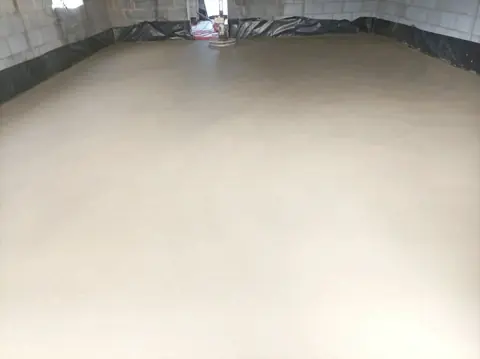
When people talk about liquid screed, flow screed or pumped screed in the UK, they usually mean an anhydrite screed. "Anhydrite" refers to the binder: anhydrous calcium sulphate, used in place of the cement in a traditional screed. The screed is mixed at the plant, delivered by truck and pumped onto the floor, where it levels itself.
We pour anhydrite screed on extensions, new builds and commercial floors across London and the Home Counties. This guide explains what makes it different, so you can decide whether it suits your floor and brief your flooring installer properly.
Anhydrite, calcium sulphate, flow screed: are they the same?
Mostly, yes. The names overlap:
- Anhydrite screed and calcium sulphate screed describe the same family of binder. Some products use synthetic anhydrite, others natural anhydrite or alpha hemihydrate.
- Flow screed, liquid screed and pumped screed describe how it is laid. Most flow screeds in homes are calcium sulphate, but cement based flowing screeds also exist.
If your specification says "CA" followed by a strength, such as CA-C25-F5, it is a calcium sulphate screed. A cement screed is marked "CT".
How anhydrite screed differs from cement screed
| Anhydrite (calcium sulphate) flow screed | Sand and cement screed | |
|---|---|---|
| How it is laid | Pumped, self levelling | Hand laid and compacted |
| Typical floating depth | From about 35mm domestic, 40mm commercial | From 65mm domestic, 75mm commercial |
| Shrinkage | Very low | Higher, needs more joints |
| Bay sizes | Large, often 40m² or more without joints | Smaller bays with movement joints |
| Surface after drying | Thin laitance that must be removed | No laitance removal normally needed |
| Wet areas | Not for permanently wet areas | Suitable |
| Early heating | Usually from about seven days | Usually after at least 21 days |
Swipe the table sideways to see every column.
For a fuller comparison, see our guide to liquid screed vs sand and cement screed.
Where anhydrite screed works well
Anhydrite screed suits open, well prepared floors: ground floor extensions, new build plots, barn and loft conversions, apartment floors and commercial units. It is particularly good over wet underfloor heating, because it flows around every pipe with no air pockets and can be laid thinner, so the floor warms up faster.
It is less suited to rooms that stay wet, such as walk-in showers without a tanking system, to floors that must take load within a day or two, and to very small jobs where a pump and a minimum load are not worth the cost.
Preparation before the pour
Because the screed is fluid, preparation decides whether the job succeeds:
- Insulation laid flat, fully supported and tightly jointed.
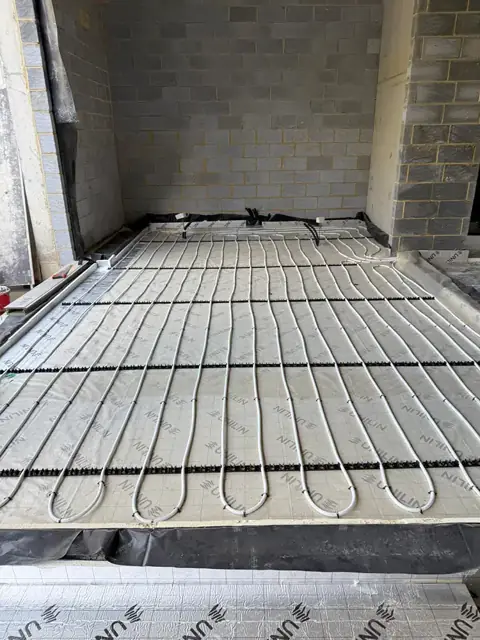
- Polythene slip membrane lapped, taped and turned up at the walls, so the screed cannot leak into board joints.
- Edge strip fixed around every wall, column and upstand, so the screed can expand.
- Heating pipes clipped firmly, pressure tested and filled with water so they cannot float.
- Depth markers set across the floor so the finished thickness is right everywhere.
We can install this build-up ourselves through our insulation and membranes service.
Drying and heating
Anhydrite screed is usually walkable within 24 to 48 hours. Drying before floor coverings is slower: a widely used rule of thumb is about one day per millimetre for the first 40mm in good conditions, and slower beyond that. The big advantage is that calcium sulphate screed can usually be force dried with the underfloor heating from about seven days after the pour, following the manufacturer's heating schedule. Our guide on how long screed takes to dry explains how to test that a floor is ready.
Moisture testing matters with anhydrite. Many flooring manufacturers set a lower moisture limit for calcium sulphate screeds than for cement screeds, so always check the limit for your chosen finish before laying it.
Laitance and floor finishes
As anhydrite screed dries, a thin, weak surface layer called laitance forms. It must be removed, usually by light sanding and vacuuming, once the screed is dry enough, and before any adhesive or levelling compound goes down. Leaving it in place is one of the most common causes of tiles and vinyl coming loose.
Tiles also need care. Cement based tile adhesives can react with calcium sulphate, so the screed should be primed with the product the adhesive manufacturer specifies, or a gypsum compatible adhesive used. Tell your tiler the screed is anhydrite before they start.
Get a price for an anhydrite screed
If your drawings call for a calcium sulphate or anhydrite screed, we can price it to the specified grade. Send us the floor area in m², the depth you have to work with, what is going on top and the site postcode. We call back the same day and give you a fixed written price within 24 hours. Ask for a quotation or call 07466 650936.