
Specifying calcium sulphate for Hillingdon apartments
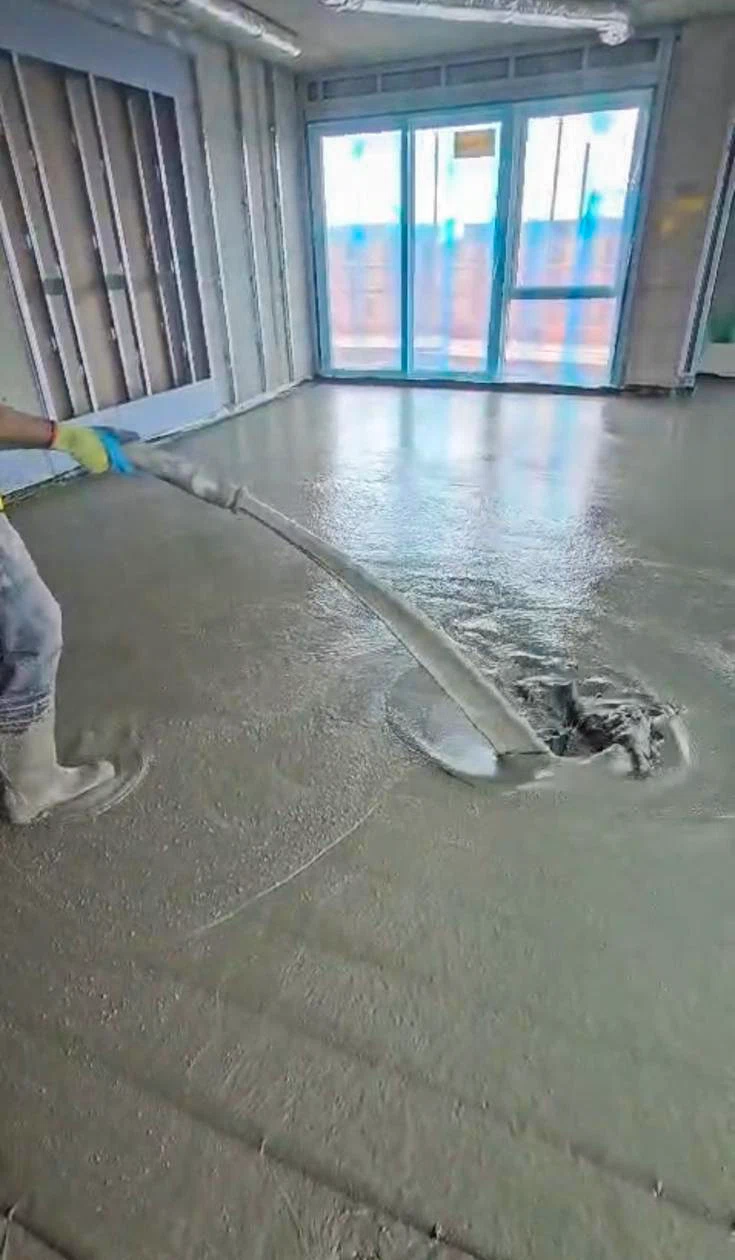
Flats like the new ones at The Old Vinyl Factory and around Hayes are where this material comes into its own. It moves so little while curing that a whole apartment can go down in broad bays with hardly any joints, and it runs fully over acoustic layers and heating pipes. A new purpose-built block, with one wide floor per flat, is exactly this kind of build.
The specification will name a grade. The letters CA mean calcium sulphate; C is the crushing strength and F the bending strength, both in N/mm2, as set by the European standard for screed materials:
CA-C20-F4, for lightly used rooms in a home. CA-C25-F5, the middle grade, used in most homes, flats and offices. CA-C30-F6: floors that take heavier use.
Whatever grade the engineer writes is what goes in. Now and then a drawing names an alpha hemihydrate product, picked because it dries sooner or can be laid thinner, and its own data sheet sets the depth and drying times. If the grade on a drawing looks light for how a room will be used, such as a domestic grade on an office floor, we raise it before the pour rather than after.
We draw up the bays and joints with you ahead of pouring day. Rather than run a joint across the middle of an open living room, we put them at door thresholds and where one heating zone meets the next. For the background, read our guide anhydrite screed explained, and for cement screeds in the same building see the sand and cement page.
Laitance and moisture checks on Hillingdon floors
As any calcium sulphate floor dries, a thin, crumbly film called laitance rises to the top. Tile adhesive, LVT adhesive and levelling compound all grip that skin rather than the screed underneath, so it must be sanded off. After sanding, the surface is sealed with a primer meant for calcium sulphate; an ordinary cement primer will not do.
On a Hayes flat, the moisture reading carries more weight than it would with cement. Plenty of flooring makers allow a calcium sulphate floor less moisture than a cement one, so counting weeks tells you little. The flooring waits until a hygrometer says the slab is ready. Where a Hayes flat has heating pipes in the floor, gentle heat from about day 7 normally speeds the drying along.
Blocks going up in Hayes tend to have little slack in the programme, and 8% of Hillingdon's homes date from 2015 onwards. The flooring contractor gets our drying and laitance notes on paper, so they know what to check.
There is one place it never goes: anywhere that might get wet. Wet rooms, walk-in showers and plant rooms that could leak take a cement based flowing screed instead. When a floor needs repair rather than a new pour, see our screed repairs service.
Anhydrite & Flow Screed prices in Hillingdon
Liquid flowing screed (which includes anhydrite): £24 to £31 per m² supplied and laid (MyJobQuote, August 2026), so £960 to £1,240 for 40 m². MyJobQuote does not say whether these figures include VAT. See our floor screeding cost guide or screed calculator.
Who lays your anhydrite and flow screed in Hillingdon
K & B Screeding’s own team, led by director Donatas Bardisevicius. Founded 2019, company 12298780.
See what customers say in our Google reviews and on our testimonials page.
Anhydrite & Flow Screed from Slough to Hillingdon
As the crow flies, our yard in Slough is about 8.4 miles from Hillingdon, which lies to the east. Postcodes here include UB8, UB3, HA5 and UB9, and Harrow (5.6 miles), Ealing (6.1 miles), Hounslow (6.4 miles) and Slough (6.6 miles) are close by.
More on anhydrite screed, part of our screeding services.
