
Apartment floors at Horlicks Quarter and across Slough
Flats in new Slough blocks suit calcium sulphate screed for a few reasons. It shrinks very little as it cures, so a whole flat can often be poured as one bay with few or no joints, and it is placed through a hose, which suits the upper floors of a block. Over acoustic or thermal insulation it gives a flat, dense base for the finishes that follow.
The specification will name a designation. CA-C20-F4 suits a home floor that sees light traffic, CA-C30-F6 is kept for heavy use, and CA-C25-F5 sits between them as the grade for typical houses, flats and offices. The C number is the compressive strength and the F number the flexural strength, measured in N/mm2. In a block of flats, CA-C25-F5 is the grade that usually fits, while corridors or commercial space on the ground floor may call for more.
Now and then the drawings name an alpha hemihydrate screed rather than a CA grade. Designers pick those when quicker drying or a shallower layer is needed, and the maker's product sheet then sets the depth and drying time, not the usual rules of thumb.
Before any pour we plan bay sizes and joint positions, particularly across doorways and where heating zones meet, and our own team prepares the build-up beneath. Mixed-use schemes in the Heart of Slough raise the same questions of grade and layout. Our plain guide to anhydrite goes further into what the material is.
Finishing calcium sulphate floors in Slough flats
Hard does not mean ready to cover. Its surface carries laitance, a fine, weak skin that forms as the screed dries, and that has to be sanded away so adhesives bond to sound material. After sanding, the floor is primed with a product made for calcium sulphate, because the wrong primer, or a cement based adhesive straight onto the screed, can fail at the bond.
Moisture is the second check. Flooring manufacturers often set a tighter dampness limit on calcium sulphate than on cement screed, so a hygrometer reading is taken and held against the figure your chosen finish allows. Where a flat has underfloor heating, running it from about day 7 can usually speed the drying along.
Wet areas need a different answer. Left damp, calcium sulphate weakens, so a wet room, walk-in level shower or plant room should get a cement based flowing screed or a sand and cement floor laid by hand in Slough instead. If an older base needs work before any new screed, see our floor preparation service.
Anhydrite & Flow Screed prices in Slough
Liquid flowing screed (which includes anhydrite): £24 to £31 per m² supplied and laid (MyJobQuote, August 2026), so £960 to £1,240 for 40 m². MyJobQuote does not say whether these figures include VAT. See our floor screeding cost guide or screed calculator.
Who lays your anhydrite and flow screed in Slough
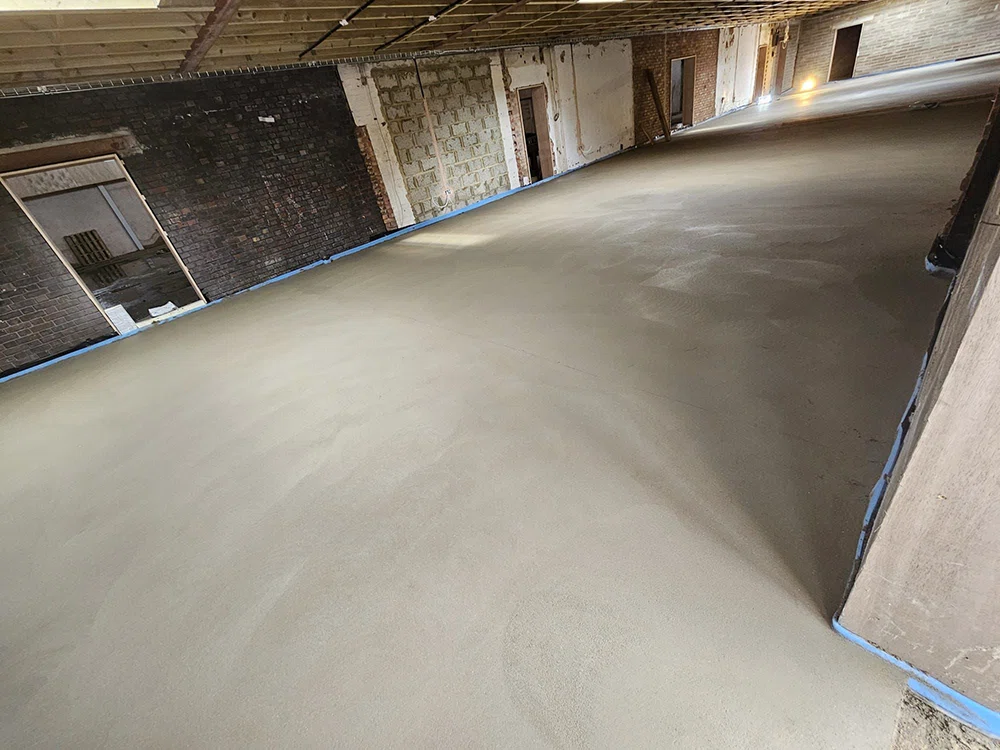
K & B Screeding’s own team, led by director Donatas Bardisevicius. Founded 2019, company 12298780.
See what customers say in our Google reviews and on our testimonials page.
Anhydrite & Flow Screed across Slough
Our yard is on Lynch Hill Lane in Britwell, in the SL2 part of Slough, so every Slough postcode (SL1, SL3 and SL2) is on our doorstep. The closest towns around it are Windsor (2.1 miles), Maidenhead (5.6 miles), Egham (5.7 miles) and Staines-upon-Thames (6.3 miles).
More on anhydrite screed, part of our screeding services.
