
Calcium sulphate grades on High Wycombe apartment floors
The letters and numbers on a calcium sulphate screed specification fix its strength. The two numbers in it are strengths in N/mm2, compressive first and flexural second. CA-C20-F4 therefore means 20 N/mm2 in compression and 4 N/mm2 in bending, enough for domestic floors that see light traffic. CA-C25-F5 is what you will see on most specifications for homes, apartments and offices, while floors under heavier use step up to CA-C30-F6.
On a High Wycombe block of flats, the engineer or architect usually picks the grade, and we deliver exactly what they picked. If none is given, we suggest one that fits the use, the finish and any heating in the build-up.
Alpha hemihydrate products are a separate family, each with its own data sheet. Choose them when the screed must dry sooner or be laid thinner, which can help in a refurbishment where existing doors and lift thresholds fix the floor height.
Shrinkage is very low, so bays can be large with few joints, and we plan where bays and joints fall before the pour, allowing for doorways and changes in floor shape. On an apartment floor the layout also follows any structural joints below and each flat's heating zones, so cracks do not open where the slab moves. Read our anhydrite screed guide for more on the material, and the underfloor heating screed page for its use over pipes.
Moisture testing a High Wycombe anhydrite screed
Anhydrite asks more than cement screed does before a floor covering can go on. There are three steps.
Step one is the laitance, a weak skin that rises to the surface as the screed settles; after drying it is sanded away so the adhesive grips sound material.
Step two is moisture. Take a hygrometer reading and check it against the figure on the flooring or adhesive data sheet. A reading that would pass on a sand and cement floor can fail on anhydrite, because plenty of manufacturers allow calcium sulphate less moisture. Where the floor has heating pipes, running them from about 7 days can usually push the drying along.
Step three is a primer designed for calcium sulphate, put on before any cement based adhesive or compound.
Wet areas are off limits. In a High Wycombe bathroom, shower room or utility, we lay either traditional sand and cement screed or a flowing cement based mix instead. If the sanded floor then needs to be flatter for LVT, our floor levelling page covers that.
Anhydrite & Flow Screed prices in High Wycombe
Liquid flowing screed (which includes anhydrite): £24 to £31 per m² supplied and laid (MyJobQuote, August 2026), so £960 to £1,240 for 40 m². MyJobQuote does not say whether these figures include VAT. See our floor screeding cost guide or screed calculator.
Who lays your anhydrite and flow screed in High Wycombe
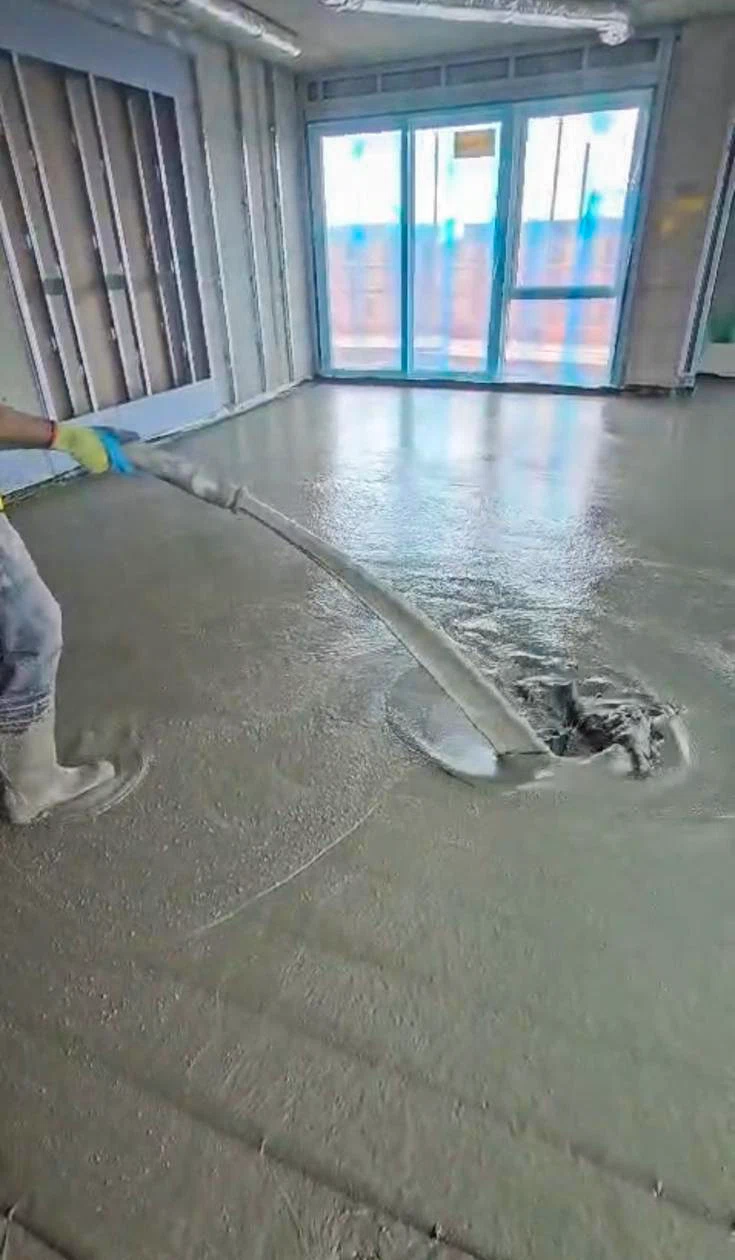
K & B Screeding’s own team, led by director Donatas Bardisevicius. Founded 2019, company 12298780.
See what customers say in our Google reviews and on our testimonials page.
Anhydrite & Flow Screed from Slough to High Wycombe
As the crow flies, our yard in Slough is about 8.1 miles from High Wycombe, which lies to the north-west. Postcodes here include HP11, HP12 and HP13, and Marlow (4.1 miles), Beaconsfield (4.7 miles), Amersham (6.9 miles) and Maidenhead (7.4 miles) are close by.
More on anhydrite screed, part of our screeding services.
