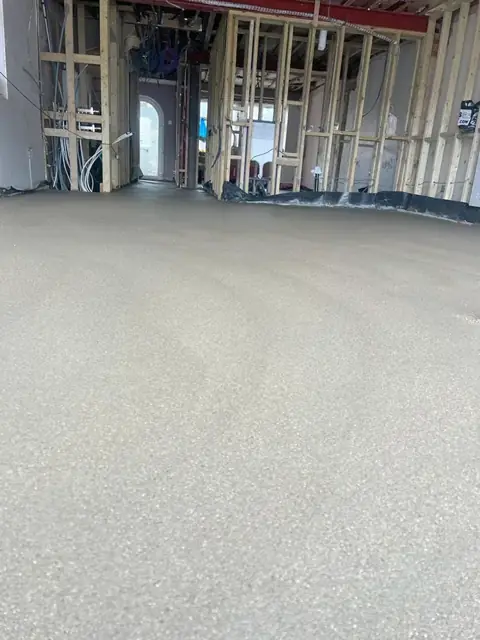
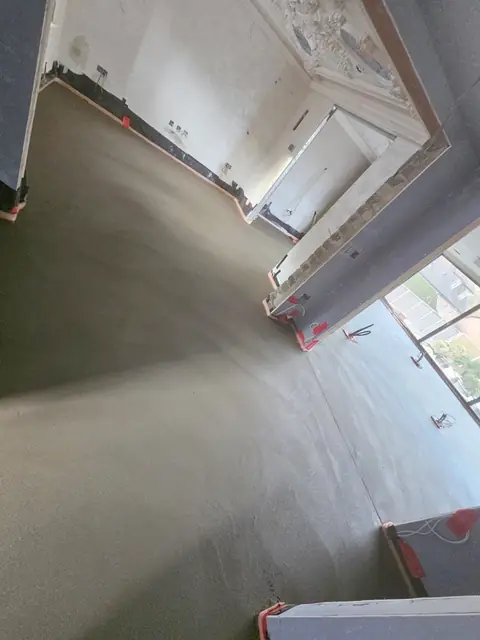
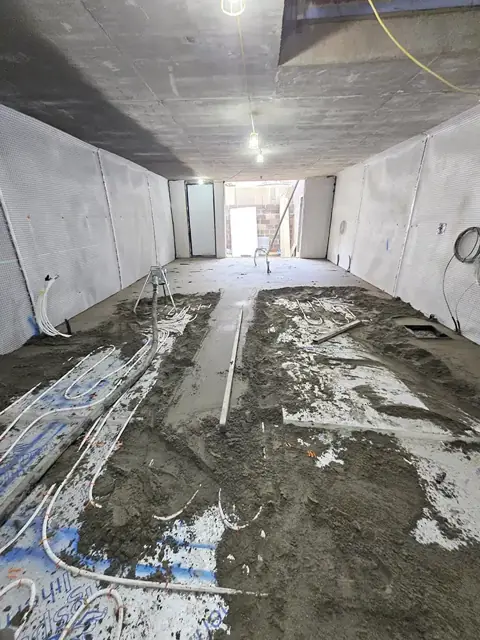
Ask a flooring fitter what goes under new vinyl in an old kitchen and the answer is often "latex it first". Latex screed, also called latex floor screed or latex screeding, is not a screed in the structural sense. It is a two part levelling compound, a cement based powder mixed with a latex liquid instead of water, poured a few millimetres thick to give a smooth, flat surface for the floor covering. K & B Screeding lays it as part of preparing floors for new coverings.
We lay latex screed across London and the Home Counties for homeowners, builders and flooring contractors, preparing the base and choosing the compound and primer ourselves.
What makes latex different
Most levelling compounds are mixed with water. A latex compound comes as two parts, a bag of powder and a container of latex liquid, mixed together on site. The trade reaches for it on awkward bases where a plain water mix may not grip.
Manufacturers' own data shows how broad that grip is. One widely used latex compound lists adhesion to "almost all substrates without priming", including old adhesive residues, bitumen, flooring grade plywood, ceramic and thermoplastic tiles and steel, although it still requires calcium sulphate screeds to be primed. Another two component compound lists ceramic and quarry tiles and old adhesive residues among its suitable bases.
Sound concrete or screed that only needs smoothing may suit a water mix product, covered on our floor levelling page.
Where latex screed is used
- Overboarded timber floors. Suspended timber floorboards move too much to take compound directly. Once they are overboarded with flooring grade plywood, fixed down firmly, a latex compound laid over the plywood gives a smooth surface and hides the board joints and screw heads that would otherwise show through thin vinyl.
- Old quarry and ceramic tiles. Firmly bonded tiles in older kitchens and hallways can often stay. After thorough cleaning, with any loose or hollow tiles removed and filled, a suitable compound bonds to them and smooths over the grout lines.
- Uneven concrete. Older slabs with shallow dips, trowel marks and patched areas can be brought back to a smooth, flat surface in one thin pass.
- Floors with old adhesive. Some two part compounds are designed to go over sound old adhesive residues, which saves stripping every trace back to bare concrete.
The finishes that benefit most are thin, flexible coverings: sheet vinyl, LVT, safety flooring, linoleum, rubber and carpet. Every imperfection in the base shows through vinyl and LVT.
Typical latex screed depths
Latex compounds are made for thin work. The table below uses figures from UK manufacturers' product pages for two part compounds and one fibre modified water mix product made for flexible bases such as plywood.
| Product type (from manufacturer data) | Stated application thickness | Walk on | Floor coverings from |
|---|---|---|---|
| Rapid setting latex compound | 3mm to 12mm neat, up to 30mm with added coarse aggregate | 2 hours | 4 hours (3 hours for ceramic tiles) |
| Latex levelling compound | Coverage quoted at 3mm | 2 hours | 12 hours for most floor coverings |
| Two component high performance compound | 2mm to 30mm | From 60 minutes | From 4 hours |
| Two component high flow compound | 2mm to 10mm | 90 minutes | 12 hours |
| Fibre modified water mix for flexible bases such as plywood | 2mm to 10mm | 60 minutes | 3 hours minimum |
Swipe the table sideways to see every column.
These are the manufacturers' figures. Cold rooms, poor ventilation and thicker sections slow things down, and we follow the data sheet for the product used. Where a floor needs building up much more than a compound allows, a new screed is the right answer, and our screed thickness guide explains typical screed depths.
How we lay latex screed
- Survey the floor. We check flatness with a straightedge, look for movement in timber floors, tap tiles for hollow spots and check for damp.
- Prepare the base. Loose tiles and weak material come out, dust and contamination are removed, and plywood overboarding is checked for firm fixing. Heavier work, such as grinding back old coatings, is part of our floor preparation service.
- Repair defects. Cracks, holes and hollow areas are filled before any compound goes down. Larger defects in the screed below are handled as screed repairs.
- Prime. We apply the primer the manufacturer specifies for that base, and we always prime calcium sulphate screeds.
- Mix and pour. The powder and latex liquid are mixed to the manufacturer's ratio, poured and spread to the planned depth, then spiked to release trapped air.
- Hand over. We tell you or your fitter when the floor can be walked on and when flooring can go down for the product used.
Primers and why they matter
Even compounds sold as bonding without primer on many bases have exceptions. Calcium sulphate (anhydrite) screeds are the common one: they need their laitance removed and a compatible primer before a cement based compound goes on. Very absorbent bases can also draw liquid out of the mix too quickly and weaken the bond. We read the data sheet for each base and product, and prime wherever the manufacturer asks for it.
When latex screed is not the answer
Latex is a smoothing layer, not a structural fix. It will not stop springy floorboards moving, cure damp or hold down loose tiles, and it is the wrong choice when a floor is badly out of level or has large steps between rooms. Those floors need repair, overboarding or a new screed first, and we will say so at the survey.
Moisture is the other check. Floor covering manufacturers set limits on how damp the base can be, and a new or recently wet screed may need more drying time before any compound or flooring goes down. Our guide on how long screed takes to dry explains why.
Latex screed prices
Latex screed cost depends on the job more than the material. The main factors are:
- Floor area, since small rooms carry the same set up time as larger ones.
- Depth, because deeper layers use more compound.
- Preparation, such as removing loose tiles, cleaning old adhesive or checking overboarding.
- Primer, which depends on the base.
- Access, including stairs, upper floors and working around fitted units.
We quote within 24 hours after seeing the floor or photos and measurements, and the price is fixed before work starts. Areas we cover include London, Reading, Maidenhead, Uxbridge and High Wycombe.
“From start to finish, K & B Screeding Ltd demonstrated exceptional expertise and a commitment to customer satisfaction. I am extremely impressed with the service that they provide.”
Part of our screeding and floor screeding services, laid by our own team across London and the Home Counties.