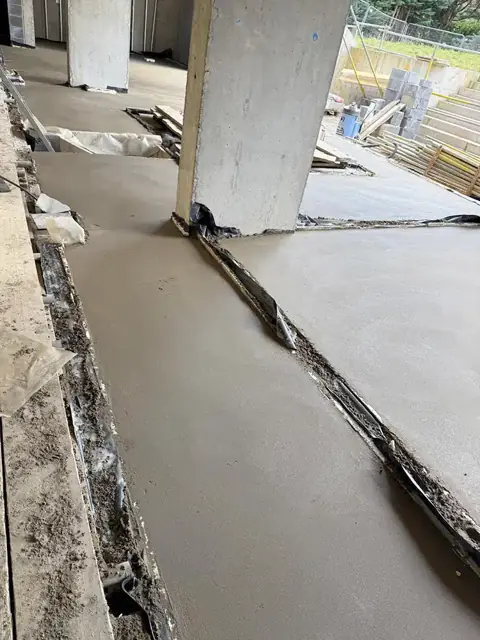
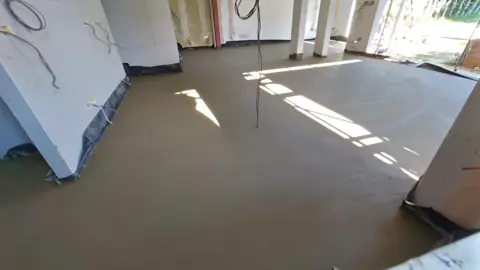
Liquid screed has changed how floors are built in the UK. Instead of mixing, spreading and compacting a semi-dry mix by hand, the material arrives ready mixed and is pumped through a hose onto the prepared floor. It flows into every corner, around every pipe and up to every edge strip, and then settles to a level surface. On a well prepared job K & B Screeding can cover a whole ground floor, or several hundred square metres of a commercial building, in a single visit.
We install liquid screed for homeowners, builders, developers and main contractors across London and the Home Counties, working from our base in Slough. If you are comparing options, our guide to liquid screed vs sand and cement screed sets out the differences honestly, because liquid is not the right answer for every floor.
What liquid screed is
Most liquid screeds used in homes are based on calcium sulphate, often called anhydrite screed, although cement based flowing screeds are also available. Both are made to a controlled recipe at the plant, so the mix is consistent from the first load to the last. That consistency is one of the main reasons liquid screed performs so predictably.
Because the material is fluid, it does not rely on a screeder's hand compaction to reach its strength. It fills voids naturally and bonds tightly around anything it encases, which makes it a natural partner for underfloor heating screed systems.
Why choose liquid screed
- Speed. Large areas are poured and levelled in one day, and the floor is usually walkable within 24 to 48 hours.
- Flatness. The self-levelling action makes SR1 and SR2 surface regularity readily achievable, which suits large format tiles, LVT and engineered boards.
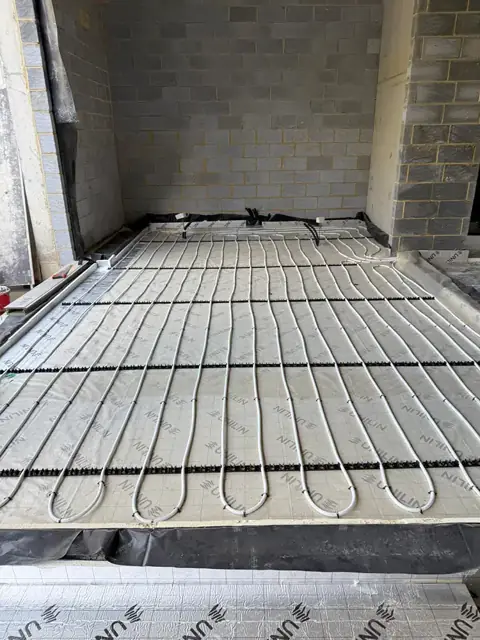
- Heating performance. It encapsulates underfloor heating pipes completely, with no air pockets, so heat transfers quickly and evenly.
- Thinner sections. Liquid screed can often be laid thinner than a traditional floating screed, which saves build height and weight.
- Fewer joints. Calcium sulphate screeds can be laid in much larger bays than sand and cement, with fewer movement joints to detail.
- Low shrinkage. The risk of curling and shrinkage cracking is low when the floor is prepared and cured correctly.
Where liquid screed works best
Liquid screed is at its best in open, well prepared spaces: new build ground floors, rear and side extensions, barn and loft conversions, open plan kitchens, and commercial units, offices and communal areas in residential developments. It is especially effective wherever underfloor heating is going in.
It is less suited to small, awkward jobs where the volume does not justify a pump, to areas that will be permanently wet, and to floors that need to take load before the screed has dried. In those cases a sand and cement screed or a quick drying screed may be the better choice, and we will tell you so.
How we install liquid screed
- Survey and quotation. We confirm areas, depths, the insulation build-up and whether underfloor heating is going in, then quote within 24 hours.
- Preparation. Insulation boards are checked and joints taped, a polythene slip membrane is laid and lapped, edge strip is fixed around every wall and upstand, and any gaps are sealed so the screed cannot leak away.
- Heating pipes. Where underfloor heating is fitted, pipes must be securely clipped and are often filled with water so they cannot float as the screed flows around them.
- Levels. We set datum levels across the floor using depth markers, so the finished thickness is exactly as specified.
- Pour. The screed is pumped in and worked with a dappling bar to release air and help it settle to level.
- Protection. Once poured, the area is closed off for the first day or two, then ventilated to help it dry.
Preparation matters more with liquid screed than with any other floor, because the material will find any gap. Most failures we are asked to fix come from poorly sealed edges or floating insulation rather than from the screed itself.
Depth and surface regularity
Typical minimum depths depend on the product and the build-up, and the manufacturer's guidance always takes priority. As a general guide:
| Build-up | Typical minimum depth |
|---|---|
| Floating over insulation, domestic | 35mm |
| Floating over insulation, commercial | 40mm |
| Over underfloor heating pipes | 25mm cover above the pipe |
| Bonded or unbonded on concrete | 25 to 30mm |
Swipe the table sideways to see every column.
For a fuller explanation, see our screed thickness guide.
Drying and floor finishes
A common rule of thumb for calcium sulphate screed is about one day per millimetre for the first 40mm, and longer beyond that, in good drying conditions. Heat, ventilation and humidity all change this. Where underfloor heating is fitted, the system can usually be used to help dry the screed after about a week, following the manufacturer's heating-up schedule.
Calcium sulphate screeds form a thin surface layer called laitance, which must be removed by light sanding before most floor finishes go down. Tiles need a compatible primer and adhesive. We explain what your flooring installer will need, and our guide on how long screed takes to dry covers moisture testing in more detail.
Liquid screed across our area
Searching for "liquid screed near me" from London or the Home Counties? We pour liquid screed across the whole area from our base in Slough. Close to home we cover liquid screed in Slough and the surrounding Berkshire towns, as well as the area around Heathrow and Hillingdon. We also take on extensions and new build plots throughout London.
Liquid Screed prices in 2026
Published 2026 UK figures put liquid screed at about £24 to £31 per m², supplied and laid (MyJobQuote, August 2026). MyJobQuote does not say whether these figures include VAT. Depth, area, access and preparation move the figure either way, so we fix your price in writing within 24 hours. See our floor screeding cost guide or the screed calculator.
“This company was a delight to work with. Nothing was too much trouble. They were on the job on time every day. The employee was so obliging and polite too.”
Part of our screeding and floor screeding services, laid by our own team across London and the Home Counties.