
Extensions in Furze Platt, Pinkneys Green and Cox Green
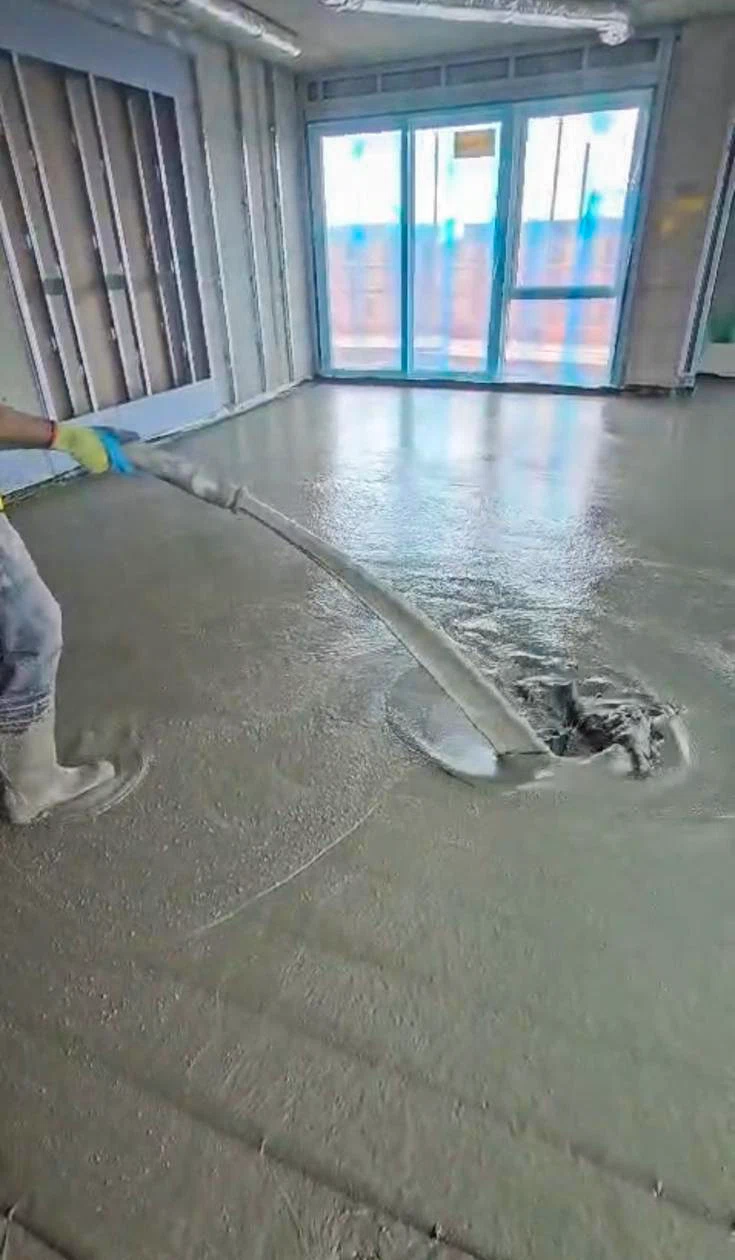
A kitchen extension usually ends up as one broad room running the width of the house. That is where a pumped, self-levelling screed makes most sense. One pour fills the room from wall to wall, the material finds its own level to SR1 or SR2 without much coaxing, and its low shrinkage means far fewer joints than a trowelled floor would need. Big porcelain tiles and long engineered boards depend on that kind of flat, unbroken base.
When the new room is heated, a liquid screed runs around the pipes with no voids, which helps the heating warm up quickly and evenly. That pairing of extension and heated floor is the main reason the suburbs suit a pumped pour.
Newer homes are another good match. 21% of Maidenhead's homes were built from 2000 onwards, and a newer ground floor is usually built on insulation, the base a flowing screed is laid over.
Depth helps too. Floating over insulation in a home, a pumped screed can be as shallow as about 35mm where sand and cement wants around 65mm, and that saving makes it easier to line up with the old kitchen once the extension opens into it. The binder can be calcium sulphate or cement, depending on which rooms the floor runs through. Pumped and hand-laid screed compared weighs the two in full. Heated floors have their own rules, set out under underfloor heating screed in Maidenhead.
Getting the hose into Maidenhead flats and terraces
Flats make up 26% of Maidenhead's homes, and upper floors are where pumping pays off. Carrying sand and cement up several flights is slow and heavy, while a hose can be run from the pump outside, through the entrance and up to the flat. Let us know which storey the flat is on, the way in from the street, and whatever hours or access limits the managing agent imposes.
Where a house has no off-street parking, the mixer may have to park on the road, so parking restrictions and permits need sorting before the day. On a suburban drive it is simpler: the pump stands at the front and the hose runs through the house or round the side to the extension.
The room has to be prepared before the pour. That means edge strip fixed round the perimeter, every joint in the membrane taped down over the insulation, and a dam across each doorway to hold the screed in. We check it all on arrival.
Firm underfoot is still a long way from dry enough for flooring. Drying takes roughly one day for each millimetre up to 40mm and longer beyond, so test before any covering goes down; how long screed takes to dry has the detail. If your project is in Marlow instead, see pumped screed for Marlow.
Liquid Screed prices in Maidenhead
Liquid screed: £24 to £31 per m² supplied and laid (MyJobQuote, August 2026), so £960 to £1,240 for 40 m². MyJobQuote does not say whether these figures include VAT. See our floor screeding cost guide or screed calculator.
Who lays your liquid screed in Maidenhead
K & B Screeding’s own team, led by director Donatas Bardisevicius. Founded 2019, company 12298780.
See what customers say in our Google reviews and on our testimonials page.
Liquid Screed from Slough to Maidenhead
As the crow flies, our yard in Slough is about 3.3 miles from Maidenhead, which lies to the west-south-west. Postcodes here include SL6, and Marlow (4.2 miles), Slough (5.6 miles), Windsor (5.6 miles) and Beaconsfield (6.9 miles) are close by.
More on liquid screed, part of our screeding services.
