
Where pumped screed pays off in Woodley houses
A flowing screed is at its most useful on a big, uninterrupted floor. Once the wall between kitchen and dining room has gone and a rear extension has been added, a Woodley semi can have a ground floor that runs the full depth of the house. A pumped pour finds its own level along that length, getting to SR1 or SR2 surface regularity without a struggle, and since the material barely shrinks, it needs far fewer joints than a hand-laid floor.
Newer homes suit it too. Of Woodley's housing, 9% dates from 2015 or later, and a fresh ground floor of insulation and membrane is an easy base for a flowing screed. The Bulmershe estate, completed in 2013 and 2014, includes flats as well as houses, and on upper floors pumping saves a great deal of effort, because nothing has to be carried up the stairs.
It also goes in thinner. In a Woodley semi the floating liquid layer can be as little as about 35mm, against roughly 65mm for a sand and cement equivalent, so the new kitchen floor has a better chance of meeting the doorway into the older rooms at the same height.
Calcium sulphate and cement based liquid screeds both exist and both get used; for the calcium sulphate kind and its grades, head to our Woodley anhydrite page. If you are still choosing a method, this comparison of liquid and sand and cement screeds sets out the trade-offs.
Getting the hose into a Woodley home
Nothing heavy comes into the house. The pump and mixer sit on the driveway or the road, and only the hose comes indoors, along the hallway, round into the kitchen-diner or up the stairs to a flat. That route needs clearing and protecting before we start. If the mixer has to stand on the road rather than a driveway, mention parking restrictions when you ask for a price.
We bring our own equipment. Our screed pumping is part of the service, and we do not hire pumps out on their own.
Before anything is poured, we go round the room on arrival. Every wall needs edge strip, the insulation needs a membrane over it with taped joints, and each doorway needs a dam to hold the screed in the pour area. A gap in that membrane lets liquid screed run underneath the insulation, so the check is worth the few minutes.
Once it is down, doors and windows stay shut for a day or two so draughts do not dry the surface too fast; after that, open up and ventilate. It will take people walking across it once 24 to 48 hours have passed. Heavy loads, stacked materials and barrows should wait longer, and the flooring waits for a moisture test.
Liquid Screed prices in Woodley
Liquid screed: £24 to £31 per m² supplied and laid (MyJobQuote, August 2026), so £960 to £1,240 for 40 m². MyJobQuote does not say whether these figures include VAT. See our floor screeding cost guide or screed calculator.
Who lays your liquid screed in Woodley
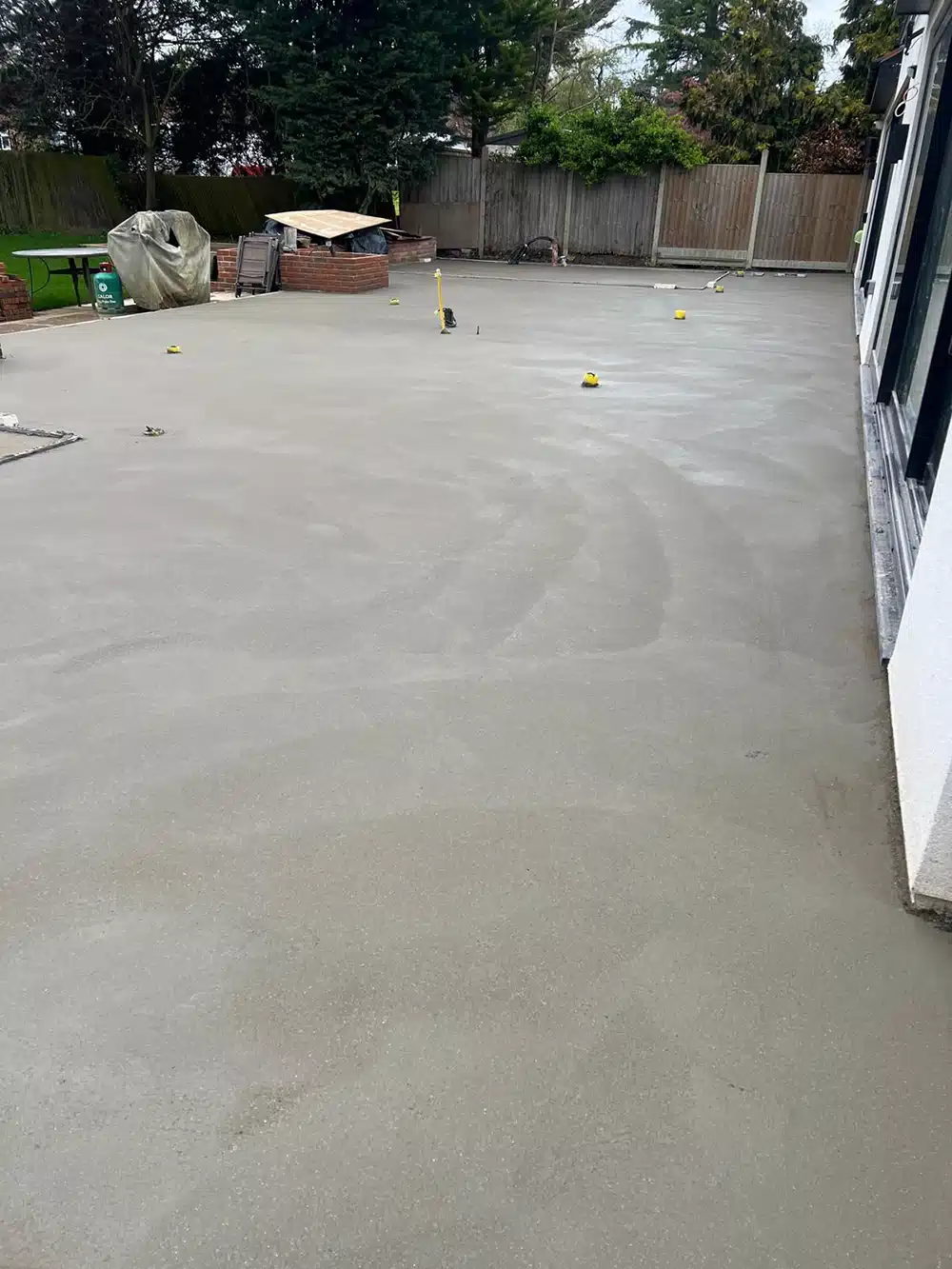
K & B Screeding’s own team, led by director Donatas Bardisevicius. Founded 2019, company 12298780.
See what customers say in our Google reviews and on our testimonials page.
Liquid Screed from Slough to Woodley
Woodley is about 12.5 miles west-south-west of our Slough base as the crow flies, with postcodes including RG5 and RG41. The nearest towns to it are Reading (2.9 miles), Wokingham (4.4 miles), Henley-on-Thames (5.8 miles) and Bracknell (7.1 miles).
More on liquid screed, part of our screeding services.
