
Replacing worn original floors in Woodley's post-war houses
Replacing worn original floors is one of the common jobs on homes of this age. A post-war floor may have sunk, cracked or crumbled at the surface, or it may simply sit too low to take a modern build-up with insulation. Either way, the fix tends to be the same: break it out, put down insulation and a membrane, then lay a fresh screed on top.
Sand and cement is well suited here for a few reasons. It is mixed on site to suit each room and depth, so a single hallway or a back room can be done without ordering a full truckload. It gives a cement substrate, which some adhesives and tile systems prefer. Put in the same spot as a calcium sulphate screed, it will carry load earlier. And because it is laid by hand, it copes with awkward shapes, steps and small rooms.
The depth is set by the base it sits on. Laid floating on insulation in a house, it needs 65mm at the least, and a commercial building needs 75mm. Where a sound concrete base is there to stick to with a bonding agent, the screed can come down to 25 to 40mm, and our bonded screed service explains when that works. Mixing in fibres cuts the risk of cracking for an extra £1 to £3 per m².
Only 6% of Woodley's homes were built between 1919 and 1944, so older houses are relatively few. Where an older suspended timber floor is being converted to a solid floor, the same method applies.
Wet rooms, garages and falls across Woodley
In a Woodley bathroom being turned into a wet room, sand and cement is the material to use. Water in the shower has to run off to the drain, and a trowelled screed can be graded to exactly that fall. A shower floor stays wet for years, and that rules out calcium sulphate, so the tanking goes onto a cement screed.
Converting the garage on a post-war semi is the other common case. Garage slabs tend to sit below the house floor, and some slope down towards the door. The garage conversion screed guide show how insulation and fresh screed bring that slab up to the house floor.
The catch on a Woodley renovation is the wait. A 65mm hand-laid floor holds its water far longer than a thinner liquid pour, drying at roughly one millimetre a day over its first 40mm and more slowly below that. A rapid drying additive can help when the programme is tight, and the flooring date should be set with drying in mind.
Where a floor needs only a thin correction rather than a full screed, levelling compound over the existing floor may be enough. For the same service just to the west, see sand and cement screed in Reading.
Sand and Cement Screed prices in Woodley
Sand and cement screed: £18 to £25 per m² supplied and laid (MyJobQuote, August 2026), so £450 to £630 for 25 m². MyJobQuote does not say whether these figures include VAT. See our floor screeding cost guide or screed calculator.
Who lays your sand and cement screed in Woodley
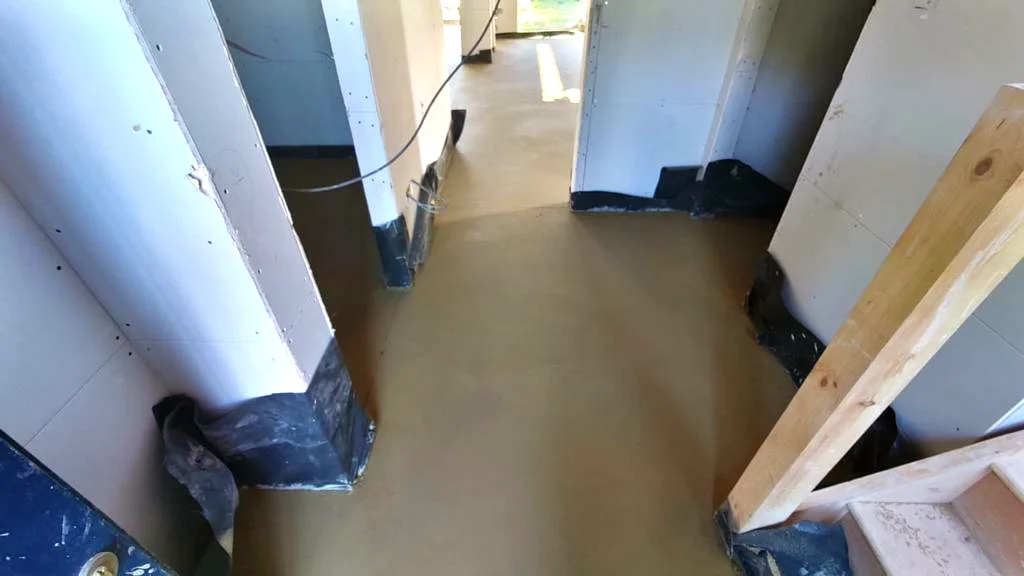
K & B Screeding’s own team, led by director Donatas Bardisevicius. Founded 2019, company 12298780.
See what customers say in our Google reviews and on our testimonials page.
Sand and Cement Screed from Slough to Woodley
Woodley is about 12.5 miles west-south-west of our Slough base as the crow flies, with postcodes including RG5 and RG41. The nearest towns to it are Reading (2.9 miles), Wokingham (4.4 miles), Henley-on-Thames (5.8 miles) and Bracknell (7.1 miles).
More on sand & cement screed, part of our screeding services.
