
Replacing Victorian ground floors around Boyn Hill
The Great Western Railway brought Maidenhead a wave of Victorian building in red brick, and plenty of those houses stand around Boyn Hill and on the older streets near the centre. Their ground floors often need replacing. A floor of that age may be uneven or damp, and a new kitchen or open-plan living space needs something far more reliable underneath.
In most cases the old floor comes out entirely and a new one is built in its place. Our team excavates, lays insulation and a damp proof membrane, and finishes with a floating sand and cement screed, normally 65mm deep in a home. Where a sound concrete slab is already in place and only the top is damaged, a bonded screed of 25 to 40mm can be laid directly onto it after proper preparation. Getting the slab ready for it is part of our floor preparation work.
Laying by hand makes sense in Boyn Hill's Victorian rooms. Victorian rooms are often small, doorways narrow and levels vary from front room to back, so a mix made in batches on site lets each area be finished to its own height. There is no need for a pump to reach a house with no parking outside.
Houses built between the wars, 9% of Maidenhead's homes, can raise the same questions once their floors are lifted. Depths for both floating and bonded floors are listed in how thick a screed should be.
Wet rooms, garages and heavy use in Maidenhead
Anywhere that water is involved, a cement screed is the right base. For a level-entry shower or wet room, the slope to the drain is built into the screed itself and formed with the trowel as we go. Those are rooms where calcium sulphate must not go.
Garages are the next case. Converting one into living space means bringing its floor up to the level of the house over insulation and a membrane; screeding a converted garage shows each layer.
Some floors need to take a load early, such as a utility room with heavy appliances or a workshop. For those we can lay a high strength screed, and mixing in fibres to resist cracking costs around £1 to £3 more per m².
The cost of a traditional screed is drying time. Reckon on roughly 24 hours of drying for each millimetre of the first 40mm and longer per millimetre after that, which leaves a 65mm floor several weeks short of any covering. Book the fitter with that in mind, or ask about a fast drying mix. As for cost, 2026 UK published pricing starts at £18 per m² and tops out at £25.
Sand and Cement Screed prices in Maidenhead
Sand and cement screed: £18 to £25 per m² supplied and laid (MyJobQuote, August 2026), so £450 to £630 for 25 m². MyJobQuote does not say whether these figures include VAT. See our floor screeding cost guide or screed calculator.
Who lays your sand and cement screed in Maidenhead
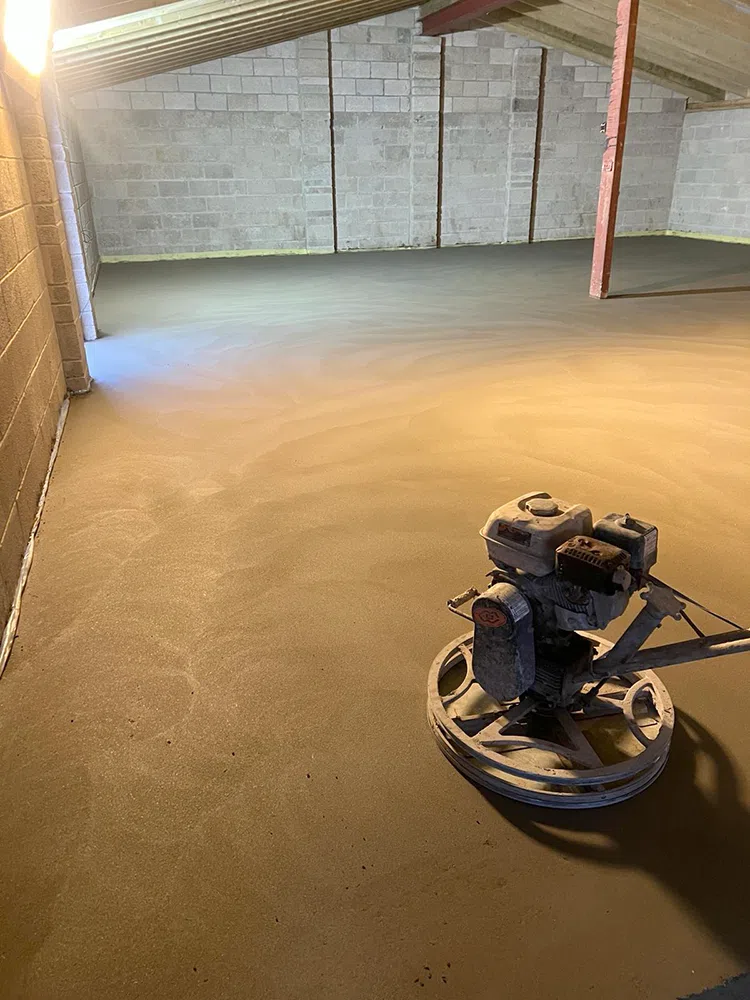
K & B Screeding’s own team, led by director Donatas Bardisevicius. Founded 2019, company 12298780.
See what customers say in our Google reviews and on our testimonials page.
Sand and Cement Screed from Slough to Maidenhead
As the crow flies, our yard in Slough is about 3.3 miles from Maidenhead, which lies to the west-south-west. Postcodes here include SL6, and Marlow (4.2 miles), Slough (5.6 miles), Windsor (5.6 miles) and Beaconsfield (6.9 miles) are close by.
More on sand & cement screed, part of our screeding services.
