
Relaying Victorian ground floors near Peascod Street
Terraced houses make up 27% of Windsor's homes, and in the older streets near the centre the ground floor is often the weakest part of the house. A solid floor laid without a damp proof membrane lets moisture through, which spoils new flooring and can mark the walls. A suspended timber floor may be tired, draughty or at a level that no longer suits the kitchen.
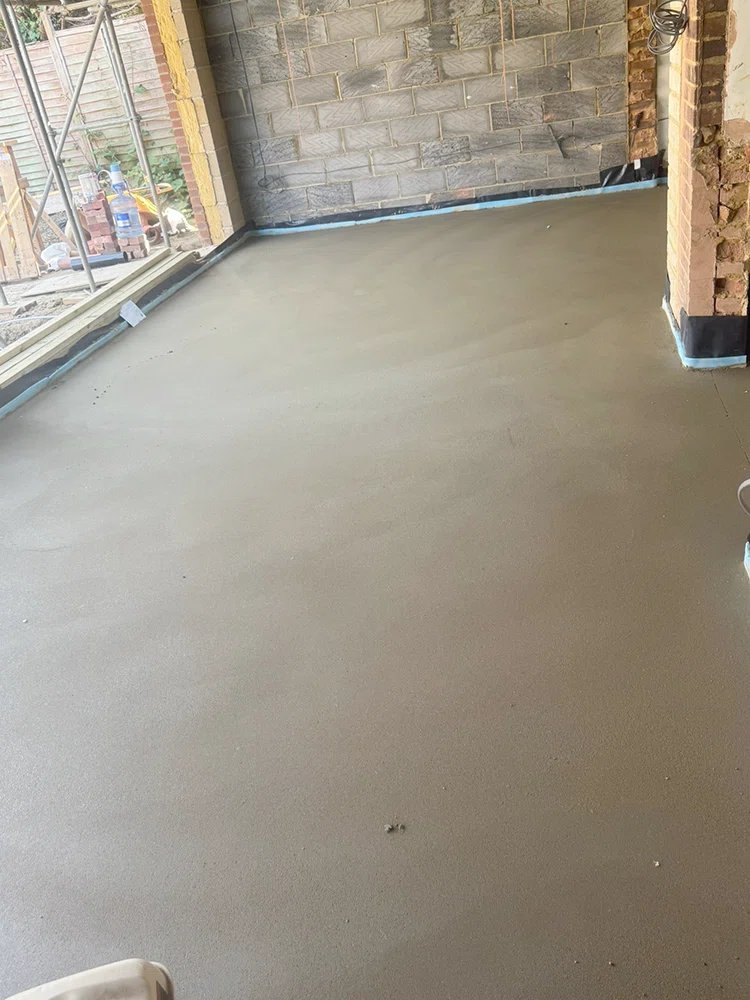
A full renovation usually replaces the lot. Out comes the old floor, and the ground is dug down deep enough to fit everything that goes back in. A membrane goes down to stop rising damp, insulation goes on top of that, then an edge strip around the walls, and finally the screed. Over insulation in a terrace like this, the sand and cement is laid 65mm thick. If you want us to provide the layers underneath, see our insulation and membrane supply page.
There are practical reasons why a hand-laid screed fits these terraces. We mix it on site, batch by batch for each room, so a narrow Victorian hall and a small back room need no pump parked outside. Because it is finished by hand, it works into alcoves, around chimney breasts and through awkward doorways. It can also take early load, so trades can get back into the house sooner.
The depth of the whole build-up is set by the door thresholds and the height of the neighbouring rooms, so we measure those first. You can see how the layers stack up in our guide to screed thickness.
Wet rooms, bonded screeds and Windsor workshops
A walk-in shower, like a wet room, needs a floor that falls towards the drain. Sand and cement can be formed to those falls accurately, and as a cement based screed it copes with water where a calcium sulphate screed can weaken. The tiler tanks the screed before tiling.
If height is short and the concrete underneath is sound, we can bond 25 to 40mm of screed directly to the prepared slab. On 2026 published figures, bonded screed costs between £12 and £18 a square metre. See our bonded screed page for how the base is prepared.
On commercial floors the floating depth rises to 75mm. Workshops and units on the Vansittart Estate and at Fairacres Industrial Estate may need a new screed when a tenant changes, and sand and cement can be modified with fibres, which add around £1 to £3 per m², or rapid drying additives when the programme is tight.
The trade-off is drying. Sand and cement loses moisture at about one day for each millimetre up to 40mm and more slowly past that depth, which leaves a 65mm floor weeks away from taking tiles or wood. Plan for that wait from day one and the job runs smoothly. The same service in Egham is covered under sand and cement screeding in Egham.
Sand and Cement Screed prices in Windsor
Sand and cement screed: £18 to £25 per m² supplied and laid (MyJobQuote, August 2026), so £450 to £630 for 25 m². MyJobQuote does not say whether these figures include VAT. See our floor screeding cost guide or screed calculator.
Who lays your sand and cement screed in Windsor
K & B Screeding’s own team, led by director Donatas Bardisevicius. Founded 2019, company 12298780.
See what customers say in our Google reviews and on our testimonials page.
Sand and Cement Screed from Slough to Windsor
Windsor is about 3.9 miles south-south-east of our Slough base as the crow flies, with postcodes including SL4 and TW19. The nearest towns to it are Slough (2.1 miles), Egham (4.3 miles), Staines-upon-Thames (5.3 miles) and Maidenhead (5.6 miles).
More on sand & cement screed, part of our screeding services.
