
Dig-out and relay in Marlow's pre-1919 houses
Without a membrane, an old floor lets damp rise; without insulation, it stays cold. Either way, tiles, wood or vinyl laid on top will fail in time. The answer that lasts is to lift the floor, prepare a new base and rebuild it in layers: insulation, then a damp proof membrane, then fresh screed.
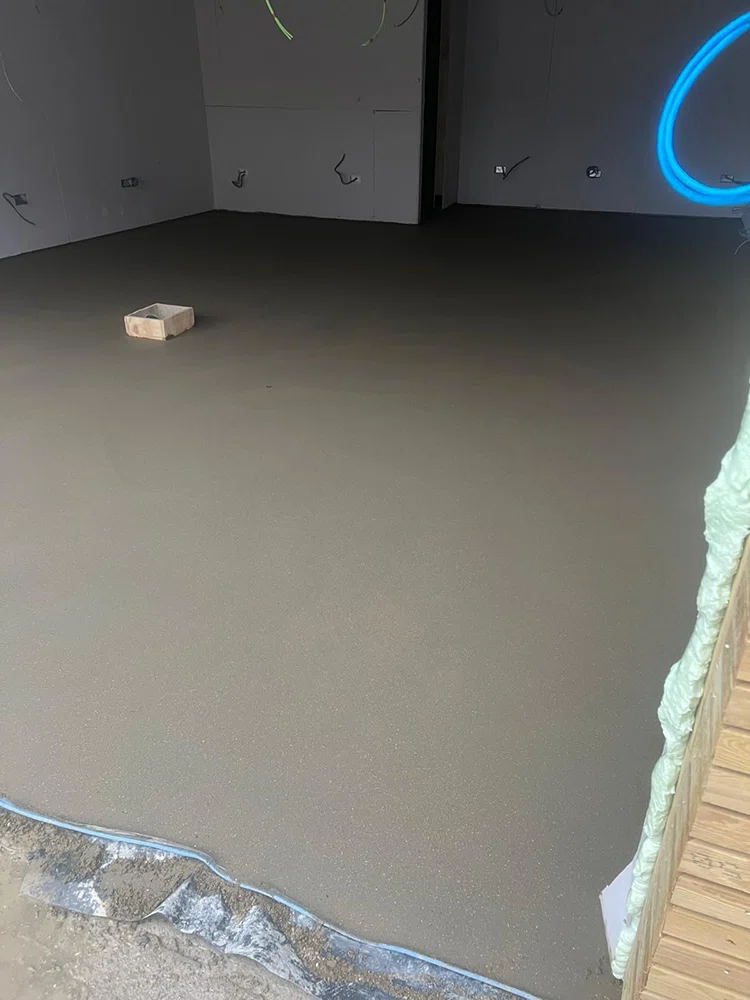
For that rebuild we normally turn to sand and cement. Rooms in Marlow's older houses tend to be small, reached through narrow doors and passages, and a screed wheeled in by barrow and laid one room at a time handles that well. Each area can have its own depth, so a floor that falls away from front to back can be brought level, and the surface is compacted and floated hard and even.
A house floor floating on insulation is screeded to about 65mm. Where a sound slab stays and only a thin layer is wanted, we bond 25 to 40mm of screed directly to the concrete. Our screed thickness guide explains which depth goes with which build-up, and the groundwork before the screed is handled by our floor preparation service.
Terraced houses account for 29% of Marlow's homes, and getting into a terrace often means going through the house. Tell us how we get to the room, and the barrow run and protection will be planned around it.
Marlow wet rooms, garages and heavier floors
Some rooms want cement screed whatever goes elsewhere in the house. Step-free showers need the floor to slope gently to the drain; screed laid by hand is easily shaped like that. Since calcium sulphate cannot be used where floors may get wet, bathrooms, wet rooms and utility spaces stay with sand and cement.
Converting a garage is another obvious use. A garage floor is usually set lower than the house itself, so once insulation and a membrane are down, the screed brings it up to match the ground floor. Read how to screed a converted garage for the full sequence.
Where a floor has to carry load early, sand and cement can be made stronger or quicker drying, and our high strength screed suits floors facing heavier traffic.
Build the programme around slower drying and keep the room aired once the screed has set. Drying at about one millimetre a day through the first 40mm means a 65mm floor waits several weeks before wood or vinyl. On a tight programme, a faster drying mix shortens that wait, and once a moisture test is passed, tiles are generally more forgiving than wood.
Sand and Cement Screed prices in Marlow
Sand and cement screed: £18 to £25 per m² supplied and laid (MyJobQuote, August 2026), so £450 to £630 for 25 m². MyJobQuote does not say whether these figures include VAT. See our floor screeding cost guide or screed calculator.
Who lays your sand and cement screed in Marlow
K & B Screeding’s own team, led by director Donatas Bardisevicius. Founded 2019, company 12298780.
See what customers say in our Google reviews and on our testimonials page.
Sand and Cement Screed from Slough to Marlow
On the map, Marlow sits west-north-west of Slough, about 6.3 miles from our base in a straight line (postcodes including SL7 and SL6), next to High Wycombe (4.1 miles), Maidenhead (4.2 miles), Henley-on-Thames (6 miles) and Beaconsfield (6.3 miles).
More on sand & cement screed, part of our screeding services.
