
Replacing old solid floors in Beaconsfield Old Town
Older houses make up a real part of the town. Census figures show 9% of Beaconsfield's homes date from before 1919 and a further 13% from between the wars. Solid ground floors of that age have often cracked, sunk at the edges or lost whatever damp protection they had, and new flooring laid straight over them will fail.
The usual cure is to dig the old floor out and rebuild it properly: compacted sub-base, damp proof membrane, insulation, then a new screed. For a dug-out floor in an older Beaconsfield house, the new screed floats over the insulation at about 65mm deep. If the slab below is solid and just its surface is tired, a bonded layer 25 to 40mm thick can be stuck straight to it. How we settle on each depth is set out in the guide to screed thickness.
Sand and cement is mixed on site, so each batch suits the room and the depth. It is compacted by hand and finished level, which makes it well suited to houses where rooms are small, walls are out of square and a doorway might be the only way in. There is no pump to position and no hose to route through a period hallway.
In a house of real age, check first whether the original floor can be kept. Sometimes a local screed repair is the more respectful answer than a full replacement.
Wet rooms, garages and small spaces in Beaconsfield
A Beaconsfield shower room or wet room is normally done in sand and cement, because calcium sulphate does not belong anywhere that could get wet. That cement base is formed to falls so water heads for the drain. The screed is shaped by hand, which a self-levelling product cannot do.
Garage conversions come up too. When a garage becomes a study or bedroom, its floor is normally raised to meet the house floor, insulated, covered with a membrane and finished with a new screed. Each layer is covered in our write-up on garage conversion floors.
What you give up with this method is speed. Drying is the slow part of a 65mm hand-laid floor, well behind a thin liquid screed: allow roughly a day for every millimetre of the first 40mm, and it slows after that. If the builder's programme cannot wait, a fast drying screed mix cuts the delay, and fibres, at an extra £1 to £3 per m², help stop cracks in awkward shapes like an L-shaped room or a long, narrow hallway.
Sand and Cement Screed prices in Beaconsfield
Sand and cement screed: £18 to £25 per m² supplied and laid (MyJobQuote, August 2026), so £450 to £630 for 25 m². MyJobQuote does not say whether these figures include VAT. See our floor screeding cost guide or screed calculator.
Who lays your sand and cement screed in Beaconsfield
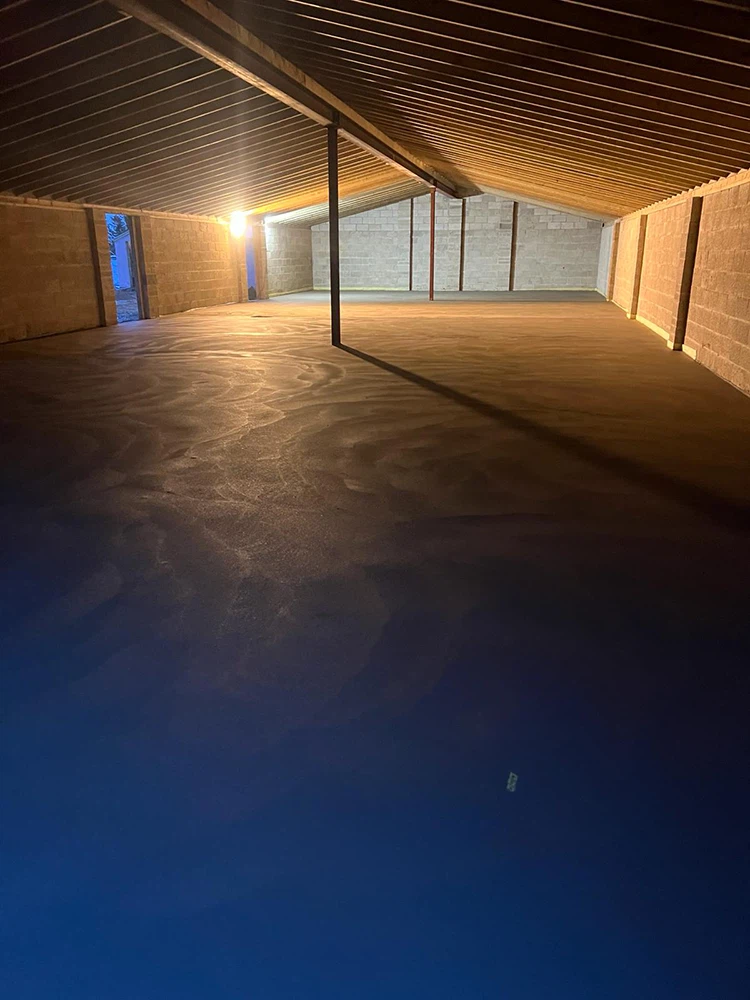
K & B Screeding’s own team, led by director Donatas Bardisevicius. Founded 2019, company 12298780.
See what customers say in our Google reviews and on our testimonials page.
Sand and Cement Screed from Slough to Beaconsfield
Beaconsfield is about 5.4 miles north of our Slough base as the crow flies, with postcodes including HP9 and HP10. The nearest towns to it are High Wycombe (4.7 miles), Amersham (4.9 miles), Chorleywood (6.2 miles) and Marlow (6.3 miles).
More on sand & cement screed, part of our screeding services.
