
Pipe cover and depth in Beaconsfield heated floors
The screed is what turns a grid of pipes into a warm floor. It spreads the heat sideways and stores it, so the depth above the pipes controls both strength and comfort.
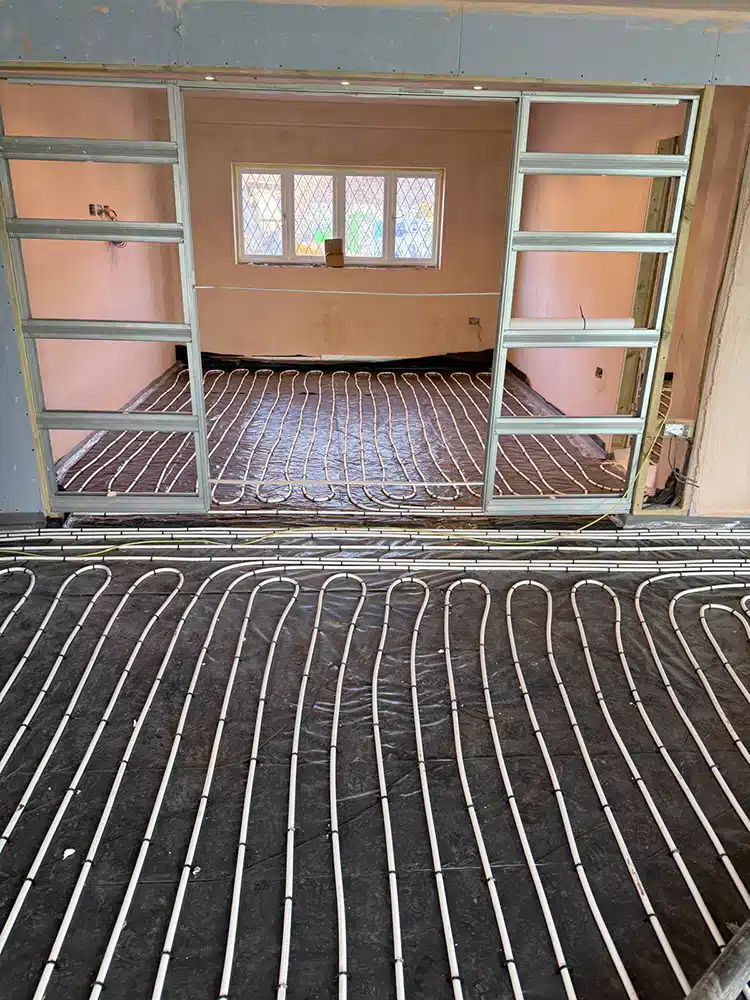
Over the pipes, a liquid screed must have at least 25mm of cover, so the finished floor normally ends up 45 to 50mm deep. It flows around every pipe and clip, leaving no air pockets to slow the heat down, and it warms up quickly. Hand-laid sand and cement wants roughly 45mm of cover and has to be packed down around them, which makes for a thicker, heavier floor.
On a large Beaconsfield ground floor with heating throughout, that difference in depth adds up across the whole area. It is one reason pumped liquid screed over heating suits big refurbishments of this kind.
What sits under the pipes matters just as much. Below the pipes, insulation keeps the warmth from escaping downwards, a membrane keeps the screed off the insulation, and edge strip on the walls gives the floor room to grow as it heats. All three get looked at before we pour, and any that are missing we can supply as part of screed preparation and insulation. Ask for the pipes to be pressure tested and kept pressurised while we pour, so a damaged pipe shows up straight away.
One thing we do not do is fit the heating itself. K & B lays the screed; a heating engineer designs and installs the system.
Retrofitting heating in Beaconsfield's post-war houses
Across Beaconsfield, 38% of houses and flats went up between 1945 and 1972. Adding underfloor heating to a house of that age normally means lifting the old ground floor, because there is rarely spare height to build a heated floor on top without losing a step at every door.
Floor height is the tight point. Insulation, pipes and screed all need depth, so the thinner build-up of liquid screed helps. Where the room must be laid by hand, such as a small shower room laid to falls, a hand-laid sand and cement screed still works over pipes with the right cover.
Then comes the heat-up. A calcium sulphate floor can normally take its first warmth after about 7 days; with sand and cement the wait is 21 days at least. Either way, the first warm-up should rise a little at a time and follow the screed maker's schedule. Hurrying that stage is how floors crack, as the drying time guide sets out. Tell your heating engineer the screed type and pour date so commissioning can be planned around it.
Programming a whole-house heated floor in Beaconsfield
Large detached houses set the scale of projects in Beaconsfield, and a whole-house refurbishment with underfloor heating across the ground floor runs to a programme of its own. The screed sits in the middle of it, between the pipework and the finished floor, so the dates either side matter as much as the pour.
Before pour day, every zone has to be ready together or the pour is split. That means insulation, membrane and edge strip down throughout, the heating engineer's loops fixed and tested, manifolds in place and doorways dammed where one pour stops and the next starts. On a big ground floor we agree the pour areas in advance, with joints at doorways and where one heating zone meets another.
After the pour, the house can usually be walked on in 24 to 48 hours, but nothing heavy goes on it for a while. Plasterers, joiners and kitchen fitters can follow, with the floor protected.
Then comes the long part. Once the screed allows, the heating engineer commissions each zone slowly, and the floor still has to pass moisture tests, at several points on a large area, before engineered wood or stone goes down, and on calcium sulphate the laitance is sanded off and the floor primed first.
The flooring order should be the last date fixed. Booking the fitter before the screed has even been poured is an easy way for the whole programme to slip.
Underfloor heating screed prices in Beaconsfield
Liquid screed over underfloor heating: £20 to £35 per m² supplied and laid (trade2base, June 2026), so £700 to £1,230 for 35 m². trade2base gives these figures excluding VAT. See our liquid screed cost per m² guide, the floor screeding cost guide or the screed calculator.
Who lays your underfloor heating screed in Beaconsfield
K & B Screeding’s own team, led by director Donatas Bardisevicius. Founded 2019, company 12298780.
See what customers say in our Google reviews and on our testimonials page.
Underfloor heating screed from Slough to Beaconsfield
Beaconsfield is about 5.4 miles north of our Slough base as the crow flies, with postcodes including HP9 and HP10. The nearest towns to it are High Wycombe (4.7 miles), Amersham (4.9 miles), Chorleywood (6.2 miles) and Marlow (6.3 miles).
If the screed lorry has to stand on the road in Beaconsfield, a bay suspension can be requested from Buckinghamshire Council (parking suspension); we will say on the quote if it is needed. New floors in Beaconsfield extensions usually need building regulations approval, with Part L insulation rules in England; Buckinghamshire Council Building Control is the council building control service.
More on underfloor heating screed, part of our screeding services. For every screed we lay locally, see floor screeding in Beaconsfield.
Further reading: screed thickness guide and underfloor heating on a concrete floor.