
Fitting heated floors into older Henley-on-Thames houses
Retrofitting underfloor heating into an old house is mainly a question of millimetres. Off Bell Street and Friday Street, cottages and terraces mostly have no damp proof membrane, so heating one means taking the old floor out and fitting membrane, insulation, pipes and screed into whatever depth lies between the ground and the thresholds already there.
The screed layer is where choices save depth. Pour liquid and it must rise 25mm or more above the loops, so the layer comes to roughly 45 to 50mm. Go with sand and cement and you need about 45mm above the loops alone, a thicker floor overall. Where every millimetre counts, a flowing screed often lets more insulation fit beneath it, and that helps the heating work properly.
Full encapsulation matters too. Poured liquid wraps itself round each pipe without trapping air, so warmth moves evenly through the floor and a room heats up sooner. Sand and cement can still be used, especially where a cement substrate is wanted, but it must be compacted firmly around the pipes.
In newer homes the build-up is usually designed in from the start. 6% of Henley's homes were built from 2015 onwards, and houses that recent are usually designed with insulated ground floors. For calcium sulphate screed specified by grade, see anhydrite flow screed in Henley-on-Thames, and for pumped options in general, liquid screed for Henley homes.
Heat-up and commissioning for Henley-on-Thames extensions
A heated screed must not be rushed. Gentle warmth can usually go into calcium sulphate a week or so in, from day 7. Leave a sand and cement floor cold for a minimum of 21 days. Whichever you have, the first warm-up begins cool and climbs a step at a time. You get the warm-up schedule on paper, so your heating engineer and floor fitter are reading from one sheet.
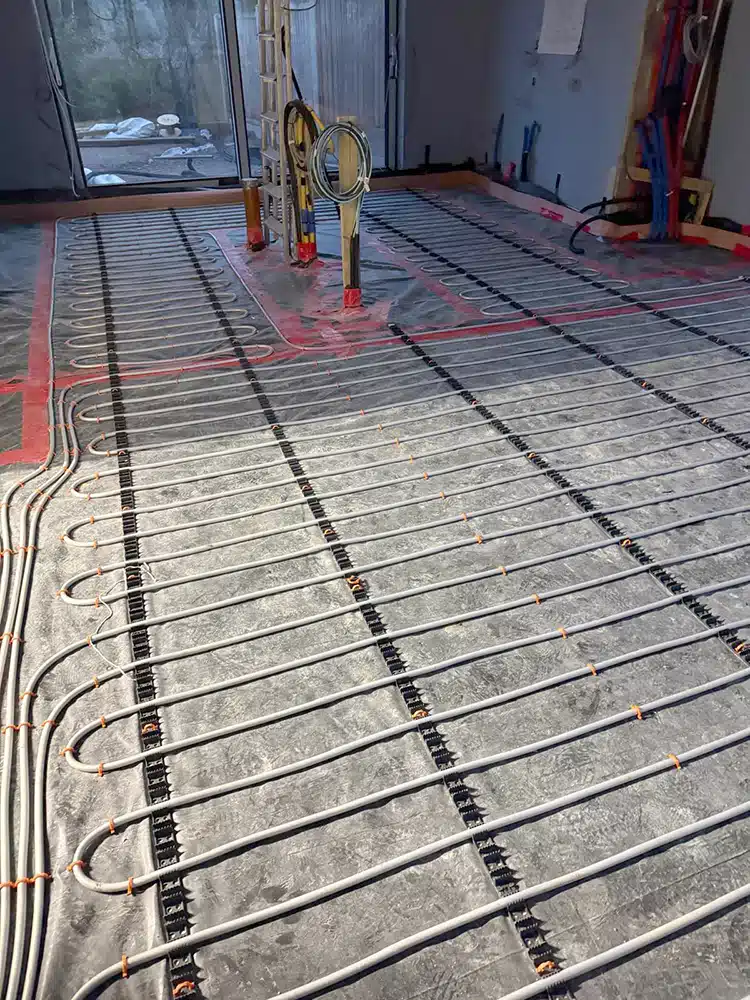
When our team arrives at your Henley extension, we expect the loops clipped and pressure tested, with membrane and edge strip already fitted. Garden rooms and rear extensions follow this order whatever their size. If the insulation or membrane still needs supplying, our insulation and membrane work can take that on. We do not fit heating pipes ourselves, so get your heating engineer booked in ahead of us.
Finishes need the same care. Tiles, LVT and engineered wood all want a flat, dry base, and most makers set a moisture limit the screed has to reach before they go down. Gentle heating helps drying once the system is safely commissioned. Our guide on drying times for screed gives typical waits.
Underfloor Heating Screed prices in Henley-on-Thames
Liquid screed over underfloor heating: £20 to £35 per m² supplied and laid (trade2base, June 2026), so £700 to £1,230 for 35 m². trade2base gives these figures excluding VAT. See our floor screeding cost guide or screed calculator.
Who lays your underfloor heating screed in Henley-on-Thames
K & B Screeding’s own team, led by director Donatas Bardisevicius. Founded 2019, company 12298780.
See what customers say in our Google reviews and on our testimonials page.
Underfloor Heating Screed from Slough to Henley-on-Thames
On the map, Henley-on-Thames sits west of Slough, about 11.2 miles from our base in a straight line (postcodes including RG9), next to Woodley (5.8 miles), Marlow (6 miles), Reading (6.5 miles) and Maidenhead (8 miles).
More on underfloor heating screed, part of our screeding services.
