
Heated extensions on Tilehurst and Caversham semis
Semi-detached houses are 28% of Reading's homes, and the classic project is a kitchen extension across the back with heating in the floor. The new floor has to hold insulation, the pipe system and the screed, and still arrive at the same height as the floor it joins. That makes depth the first thing to settle.
Pour liquid and the pipes want 25mm or more on top, giving roughly 45 to 50mm of screed in total. With sand and cement, cover of about 45mm is needed and the build-up is deeper. On a new extension slab that difference is easy to plan for. Where the level is dictated by an existing threshold, it may decide the screed.
Retrofitting heating into the original house is harder. Floor height is usually the limit, and taking out an old solid floor to rebuild it is often the only way to find room for insulation, pipes and screed. In the Victorian terraces of Newtown and Katesgrove, where old floors often lack a damp proof membrane, that rebuild solves two problems at once.
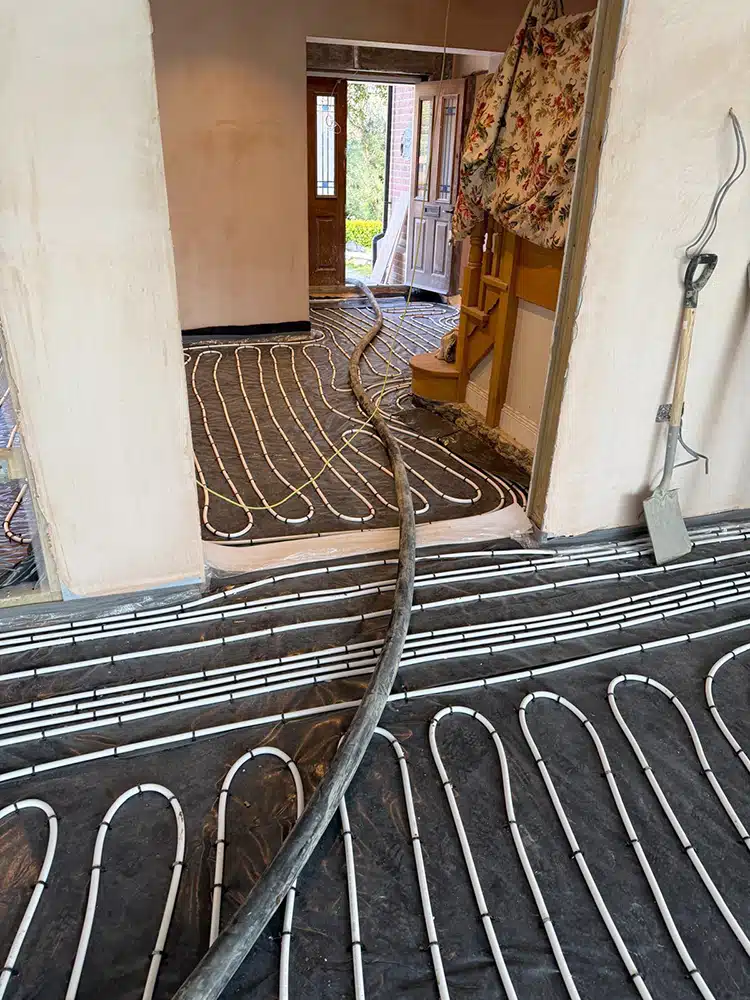
Whichever screed is used, it must fully encapsulate the pipes. Voids around them trap air, slow the heat and leave cold spots. A flowing screed fills round them by itself, and a sand and cement one is compacted carefully over them. See our insulation and membrane work for the layers underneath.
Switching on the heating in a Reading floor
A new screed and a new heating system should be introduced slowly. Heating a young floor too fast can crack it and cause tiles or wood to fail later.
Heat can normally go into a calcium sulphate floor after about 7 days, and it then helps the drying along. A sand and cement floor needs at least 21 days before any heat goes in. From there the flow temperature is stepped up over several days, kept at its peak, then eased back before the floor covering is fitted. Commissioning is your heating engineer's job; we give them a written schedule that matches the screed you have.
Homes from 1973 to 1999 make up 26% of Reading's housing. If one of those gets a new kitchen with heating in the floor, depth is again the limit, and a liquid screed with its 25mm minimum cover is usually the way to make the build-up fit.
A flat, well-laid screed takes tiles, LVT and engineered wood without much more work. For more on the pour itself, see liquid screed in Reading, or underfloor heating screed in Wokingham for a project in the next town.
Underfloor Heating Screed prices in Reading
Liquid screed over underfloor heating: £20 to £35 per m² supplied and laid (trade2base, June 2026), so £700 to £1,230 for 35 m². trade2base gives these figures excluding VAT. See our floor screeding cost guide or screed calculator.
Who lays your underfloor heating screed in Reading
K & B Screeding’s own team, led by director Donatas Bardisevicius. Founded 2019, company 12298780.
See what customers say in our Google reviews and on our testimonials page.
Underfloor Heating Screed from Slough to Reading
As the crow flies, our yard in Slough is about 15.2 miles from Reading, which lies to the west-south-west. Postcodes here include RG1, RG31, RG4 and RG30, and Woodley (2.9 miles), Henley-on-Thames (6.5 miles), Wokingham (6.8 miles) and Crowthorne (9.8 miles) are close by.
More on underfloor heating screed, part of our screeding services.