
Heated extensions and remodels in Yateley semis
A third of Yateley's homes, 33%, are semi-detached, and extending a semi often turns the kitchen, dining and living areas into a single room. Once that happens, radiators are fighting glazing and kitchen units for wall space, which is a good argument for putting the heat in the floor.
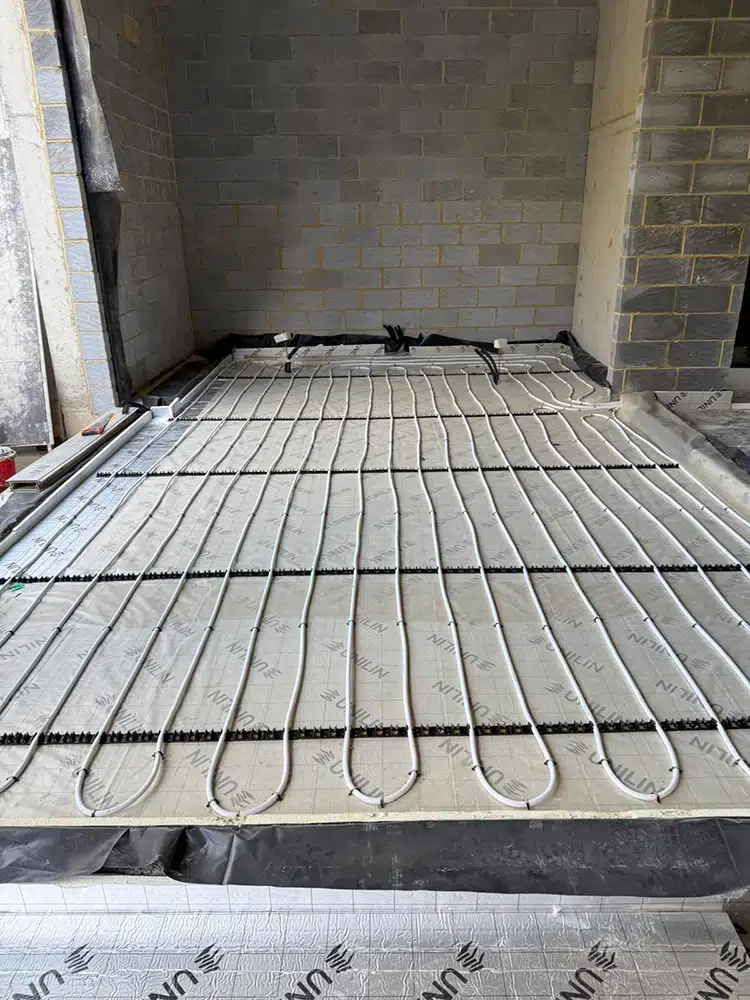
Over the pipes, the screed has three tasks: keep them in place, spread their warmth evenly, and give tiles, LVT or engineered wood a flat surface. To manage that it needs sufficient depth above the pipes and contact with every one of them.
A liquid screed must sit 25mm or more proud of the pipes, and the floor normally finishes around 45 to 50mm deep. Because it flows, it surrounds them completely without leaving air gaps. How the pump gets to your room is explained on our Yateley liquid screed page.
Sand and cement demands about 45mm over them, which adds to the overall depth. It is still a good choice for a heated floor, especially a small room or one that needs a cement base, though the heating must stay off longer before it can be used.
The layers beneath matter just as much. Insulation keeps heat from draining down, the membrane keeps a flowing screed out of the joints between insulation boards, and a perimeter strip lets the floor grow slightly as it warms. We check those layers, or supply them, through our insulation and membrane preparation.
Retrofitting heating into older Yateley floors
Putting pipes into a room that already exists takes more working out than planning them into a new extension. The finished floor still has to meet the doors and the rest of the house, so insulation, pipes and screed must all squeeze into the depth there is. In practice that usually means breaking out the old screed, and in many remodels it turns out hollow or crumbling in any case.
When depth is short, the slimmer layer of liquid screed over the pipes helps, and often the extension and the existing room can be poured together so one level runs straight through.
Commissioning follows. At about 7 days old, calcium sulphate can generally take heat. Sand and cement sits unheated for 21 days or more. From there the temperature is brought up slowly, a step at a time, and kept steady for a spell before flooring goes down. The warm-up speeds drying but does not replace a moisture test, as our guide to screed drying times explains. Write down the dates and temperatures as you go, because a flooring maker may ask to see them. We do the same for heated floor screed in Camberley.
Underfloor Heating Screed prices in Yateley
Liquid screed over underfloor heating: £20 to £35 per m² supplied and laid (trade2base, June 2026), so £700 to £1,230 for 35 m². trade2base gives these figures excluding VAT. See our floor screeding cost guide or screed calculator.
Who lays your underfloor heating screed in Yateley
K & B Screeding’s own team, led by director Donatas Bardisevicius. Founded 2019, company 12298780.
See what customers say in our Google reviews and on our testimonials page.
Underfloor Heating Screed from Slough to Yateley
As the crow flies, our yard in Slough is about 15.2 miles from Yateley, which lies to the south-south-west. Postcodes here include GU46 and GU17, and Sandhurst (0.8 miles), Crowthorne (2.3 miles), Camberley (3.2 miles) and Frimley (3.8 miles) are close by.
More on underfloor heating screed, part of our screeding services.