
Retrofitting underfloor heating in older Camberley houses
A retrofit is the harder version of this job, because the finished floor has to meet existing doors, thresholds and stairs. In Camberley that applies to a lot of houses: 29% of homes were built between 1973 and 1999, and the Old Dean dates from the 1950s and 1960s. When an old solid floor is broken out, there is depth to put insulation, pipes and screed back in. When it stays, every millimetre counts.
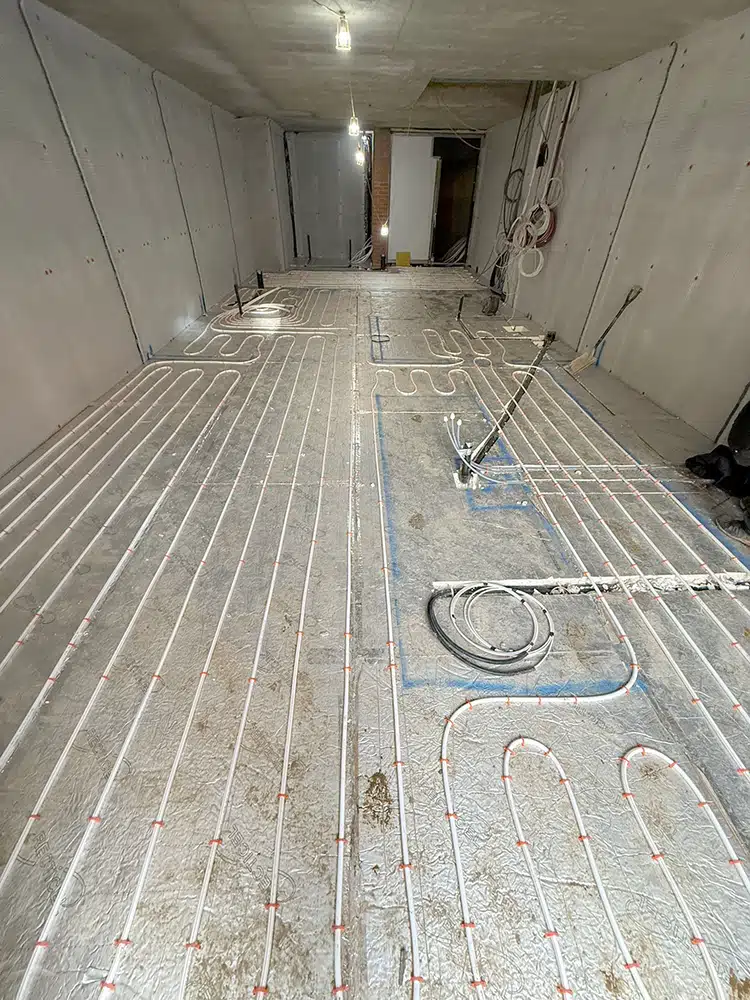
Cover over the pipes is where floor height is won or lost. Pumped screed has to sit 25mm or more over the pipes, landing most Camberley floors at 45 to 50mm in total. A hand-laid mix wants roughly 45mm above them, so the build-up ends up thicker. Where height is tight, that difference often decides the product. Where the room is small, or the floor needs a cement substrate, sand and cement can still be the right call.
How well the pipes are wrapped counts as much as the depth. Any gap left around a pipe holds air, and that air holds back the warmth on its way up to your feet. A liquid screed flows around the pipes by itself, while a hand-laid screed is compacted carefully around them.
On the morning of the pour we check, or bring, the insulation boards, the membrane and the edge strip, and make sure every pipe is clipped tight enough not to float up. For the depth rules in full, see our screed thickness guide, and for the pumped option read about liquid screed across Camberley.
Switching the heating on in a Camberley extension
Single storey extensions are one of the common projects on Camberley's 1970s to 1990s houses, and a heated floor is a natural fit for one. Only 5% of homes here were built since 2015, so most heated screeds go into an existing house rather than a new plot. The sequence after the pour is the same either way.
The screed has to cure before heat goes through it. On calcium sulphate the system can normally come on after around 7 days. With sand and cement, leave it off for 21 days or more. The first warm-up is slow, with the water kept cool at first and nudged up a little at a time over several days, held at temperature, then let down again. Whack the thermostat straight to maximum and the new floor can crack or curl. Our written schedule stays with you, so the engineer and the family both know each step.
The heating can also help drying, which is useful on a calcium sulphate floor when the flooring fitter is waiting. A moisture test still decides when finishes go down.
We are screeders, not heating fitters, so your engineer or builder supplies and lays the pipework. If you have a project in a nearby town too, we lay underfloor heating screed in Farnborough and in Bracknell.
Underfloor Heating Screed prices in Camberley
Liquid screed over underfloor heating: £20 to £35 per m² supplied and laid (trade2base, June 2026), so £700 to £1,230 for 35 m². trade2base gives these figures excluding VAT. See our floor screeding cost guide or screed calculator.
Who lays your underfloor heating screed in Camberley
K & B Screeding’s own team, led by director Donatas Bardisevicius. Founded 2019, company 12298780.
See what customers say in our Google reviews and on our testimonials page.
Underfloor Heating Screed from Slough to Camberley
Camberley is about 14 miles south-south-west of our Slough base as the crow flies, with postcodes including GU15. The nearest towns to it are Frimley (1.7 miles), Sandhurst (2.6 miles), Crowthorne (3 miles) and Yateley (3.2 miles).
More on underfloor heating screed, part of our screeding services.