
Pipe cover for heated extensions in Aldershot
Without the right screed, wet underfloor heating will not perform. That layer locks the pipes in place, carries their warmth across the room and gives the finish something flat to sit on. Misjudge the depth over the pipes and you get cracking, or a floor that heats slowly and patchily.
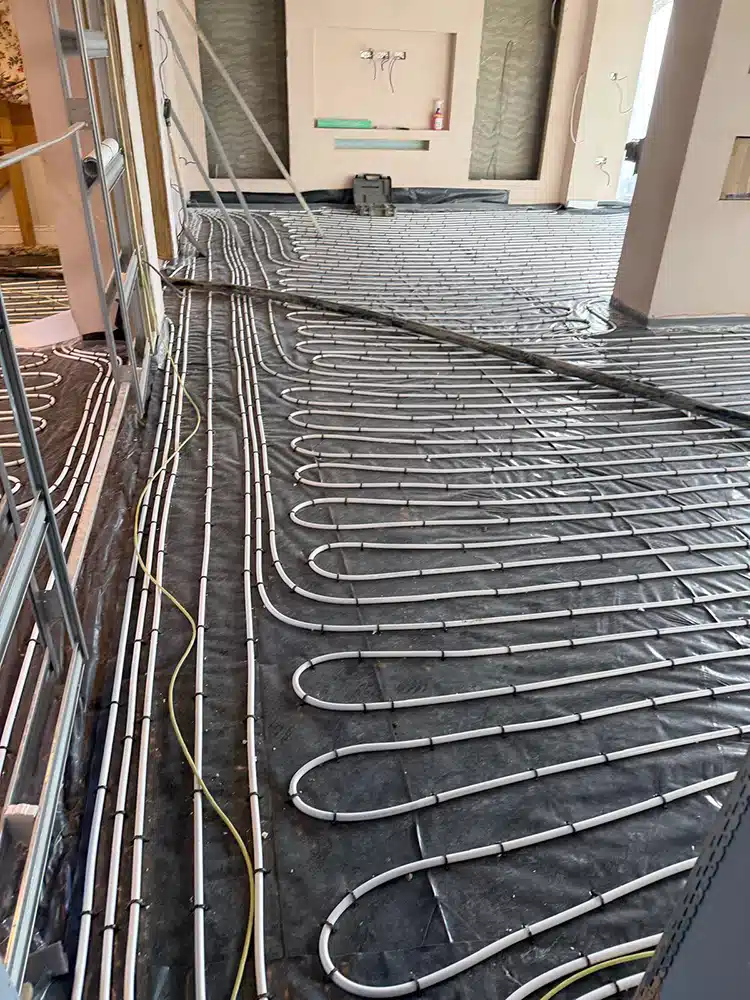
Liquid screed needs 25mm or more of cover, normally 45 to 50mm in total. With sand and cement, plan on roughly 45mm over them. A flowing screed surrounds the pipes with no air pockets, and its thinner section warms up faster, which is why it is usually chosen for new heated floors. Rooms that could get wet, or that need a cement base, are still a job for the traditional mix.
On a rear extension to a semi, the other constraint is height. The new warm floor must line up with the old kitchen floor, or you end up with a step between them. We work that out from the insulation thickness, pipe size and screed depth before the pour, and confirm the build-up with you. Our screed thickness guide for heated floors has the figures.
Homes built between 1973 and 1999 make up 21% of the town, and putting heat into any existing ground floor usually means digging out to make room for insulation and pipes. Where the depth is very tight, a thin liquid screed keeps the finished level down.
Wellesley homes and the first heat-up
On new build housing such as the streets at Wellesley, underfloor heating is often designed in from the start, with insulation, membrane and pipes laid across whole ground floors ready for a flowing screed. Where historic buildings like the Cambridge Military Hospital are being converted to homes, a heated floor may have to fit within the existing structure, which puts the depth under pressure again.
Whichever screed goes down, the heating must not be turned up to full straight away. A calcium sulphate screed can usually have heat introduced from about 7 days. Sand and cement makes you wait longer, 21 days at the least. Whatever the mix, the first firing uses a low flow temperature, stepped up over several days so drying is even and cracks do not open. The heating engineer writes the warm-up plan for the system; we give you written notes on what the screed itself needs.
On the day we pour, the pipes need to be clipped firmly, tested and still holding pressure, and edge strip should run round every wall. We look over the insulation and membrane underneath too, and can provide either if it is not there. For the pour itself, see our liquid screed page for Aldershot.
Underfloor Heating Screed prices in Aldershot
Liquid screed over underfloor heating: £20 to £35 per m² supplied and laid (trade2base, June 2026), so £700 to £1,230 for 35 m². trade2base gives these figures excluding VAT. See our floor screeding cost guide or screed calculator.
Who lays your underfloor heating screed in Aldershot
K & B Screeding’s own team, led by director Donatas Bardisevicius. Founded 2019, company 12298780.
See what customers say in our Google reviews and on our testimonials page.
Underfloor Heating Screed from Slough to Aldershot
As the crow flies, our yard in Slough is about 20.1 miles from Aldershot, which lies to the south-south-west. Postcodes here include GU11 and GU12, and Farnborough (2.8 miles), Farnham (2.9 miles), Fleet (4.1 miles) and Frimley (4.6 miles) are close by.
More on underfloor heating screed, part of our screeding services.
