
Fitting heated floors into Onslow Village and similar homes
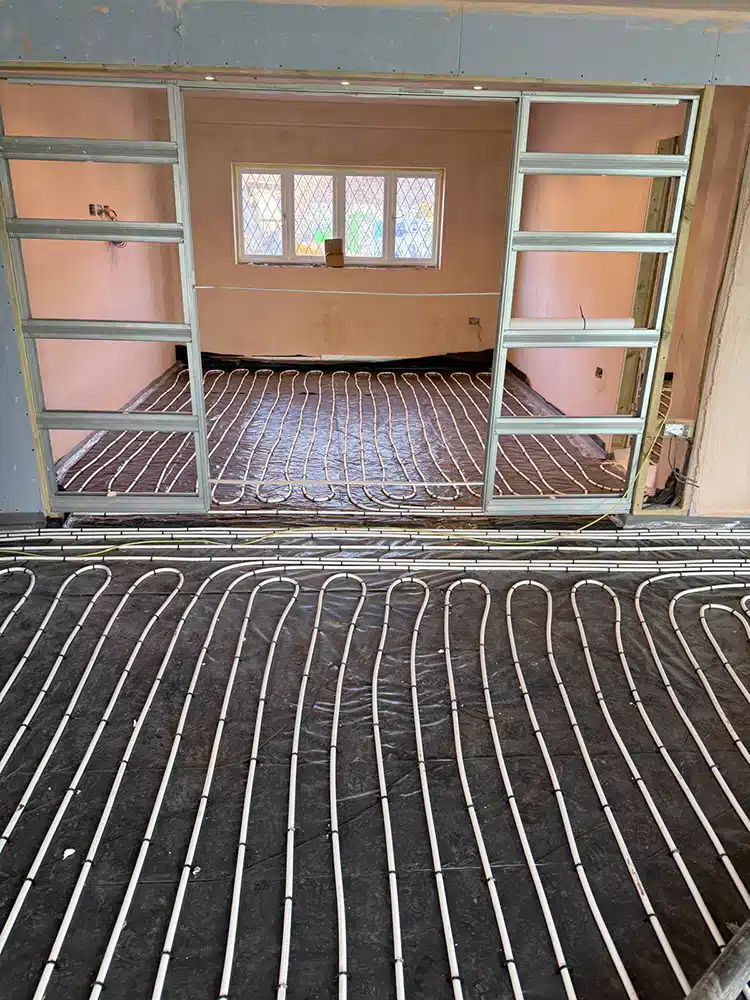
Around 19% of Guildford homes were built between 1919 and 1944, including the 1920s houses of Onslow Village. Adding underfloor heating to a home of that age usually means taking up the old ground floor and rebuilding it. Height is what limits you. Doors, stairs and thresholds stay where they are, so the insulation, pipes and screed all have to squeeze into the depth that already exists.
Pipe cover is the part that cannot be squeezed. Liquid needs 25mm or more on top of the pipes, about 45 to 50mm overall. Sand and cement needs roughly 45mm on top, so its build-up is thicker. On a tight retrofit, liquid screed is often the only way to fit everything in without raising the floor.
Getting the screed tight round every pipe counts for as much as the depth. Any air pocket left beside a pipe spreads the heat unevenly, and the floor above can crack. A pumped screed finds its way round them by itself. Sand and cement has to be worked in carefully by hand, with extra attention around bends and manifolds where gaps are most likely.
Underneath, we either supply the insulation, edge strip and membrane or check the ones already down, and your installer should have laid and pressure tested the pipes before we arrive. Everything below the pipes is covered by our insulation and membrane work.
Heat-up schedules for Guildford extensions and flats
A new screed and new heating should not be switched on together. With calcium sulphate, the heating can normally come on after about 7 days and then helps it dry. Sand and cement should stay unheated for 21 days or longer. Whichever it is, the temperature climbs in small steps with a hold at each, and never jumps to maximum. Rushing this step is a common cause of cracked heated floors, and the damage often only shows once tiles start to lift.
Semis are Guildford's most common house type, and a heated floor often goes into a rear extension on one that becomes a kitchen with tiles or LVT underfoot. Those finishes need a flat, dry base, and our liquid screed page for Guildford explains how flatness is achieved. If a joint between the extension and the old room is uneven after the pour, levelling compound at the join can blend it.
Engineered wood needs particular care, because moisture left in the screed can move the boards once the heat comes on. We hand over written commissioning guidance, and your heating engineer follows it when setting the controls.
Underfloor Heating Screed prices in Guildford
Liquid screed over underfloor heating: £20 to £35 per m² supplied and laid (trade2base, June 2026), so £700 to £1,230 for 35 m². trade2base gives these figures excluding VAT. See our floor screeding cost guide or screed calculator.
Who lays your underfloor heating screed in Guildford
K & B Screeding’s own team, led by director Donatas Bardisevicius. Founded 2019, company 12298780.
See what customers say in our Google reviews and on our testimonials page.
Underfloor Heating Screed from Slough to Guildford
As the crow flies, our yard in Slough is about 20.4 miles from Guildford, which lies to the south. Postcodes here include GU1, GU4, GU2 and GU3, and Godalming (4.1 miles), Woking (5.5 miles), Aldershot (8.1 miles) and Farnborough (8.5 miles) are close by.
More on underfloor heating screed, part of our screeding services.
