
Heated extensions on Dorking's Deepdene and Denbies land
About 21% of Dorking's homes date from 1919 to 1944, the years when the Deepdene, Pippbrook and Denbies estates were broken up and built on. Houses from that period are well placed for a rear extension, and a heated floor in a new kitchen or family room is now the usual plan.
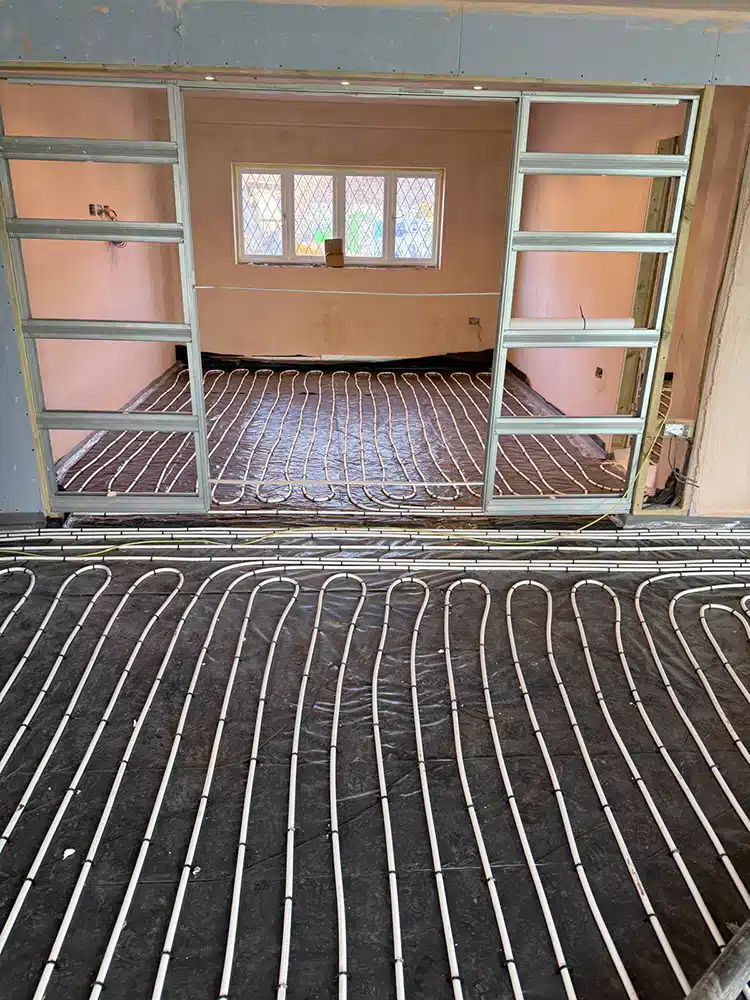
In a new extension there is room to get the build-up right from the start. Insulation goes down first, then an edge strip around the walls, then the pipes, fixed by the heating installer and pressure tested. The screed follows. Pour liquid screed and the minimum over the pipes is 25mm, giving a total depth of around 45 to 50mm. A hand-laid sand and cement screed needs nearer 45mm over the pipes instead, so the floor is thicker and carries more weight.
Because liquid screed wraps each pipe completely and leaves no trapped air, the extension warms up quicker and the heat spreads more evenly across it. That is why liquid screed over heating pipes is the common choice in extensions. Hand-laid cement screed is still the pick for a room that will get wet, or anywhere else a cement base is called for.
Where the new extension meets the old house, the floor levels rarely match exactly. Planning the depths so both meet at one finished level saves work later. If a small step or dip remains, levelling the join between old and new is done before the floor finish goes down.
Retrofitting heating in older Dorking houses and garden rooms
Adding heating to a Victorian ground floor is harder, because the height is fixed by doors, stairs and thresholds. Around Rose Hill and Tower Hill, where original floors often lack a membrane, a renovation usually involves digging the floor out anyway, and that creates the depth for insulation, pipes and screed. Where excavation is not possible, a liquid screed at minimum cover keeps the build-up as low as it can safely go.
Treat a garden room at the bottom of a Dorking garden just like an extension. Check that the base is a sound slab and that the building will be weathertight before the pour, and make sure insulation runs under the whole floor.
The heat-up is where floors are spoiled. With calcium sulphate you can start bringing the heating in at about 7 days, but a sand and cement floor has to wait 21 days at least. Either way, commissioning starts at a low flow temperature and rises gradually over days, never straight to full heat. We give the schedule in writing.
For a liquid pour over underfloor heating, published 2026 rates come to £20 to £35 for every square metre. For the drying side, see how long screed takes to dry.
Underfloor Heating Screed prices in Dorking
Liquid screed over underfloor heating: £20 to £35 per m² supplied and laid (trade2base, June 2026), so £700 to £1,230 for 35 m². trade2base gives these figures excluding VAT. See our floor screeding cost guide or screed calculator.
Who lays your underfloor heating screed in Dorking
K & B Screeding’s own team, led by director Donatas Bardisevicius. Founded 2019, company 12298780.
See what customers say in our Google reviews and on our testimonials page.
Underfloor Heating Screed from Slough to Dorking
As the crow flies, our yard in Slough is about 24.8 miles from Dorking, which lies to the south-east. Postcodes here include RH4 and RH5, and Leatherhead (4.4 miles), Reigate (5.4 miles), Redhill (6.9 miles) and Epsom (7.5 miles) are close by.
More on underfloor heating screed, part of our screeding services.