
Fitting heated floors into Ewell's 1930s houses
Most of Ewell's housing was built long before underfloor heating was a consideration, so adding it means finding height. In an interwar semi the existing floor level is fixed by the thresholds, the back door and the bottom stair, and the heated build-up has to fit between the slab and that finished level.
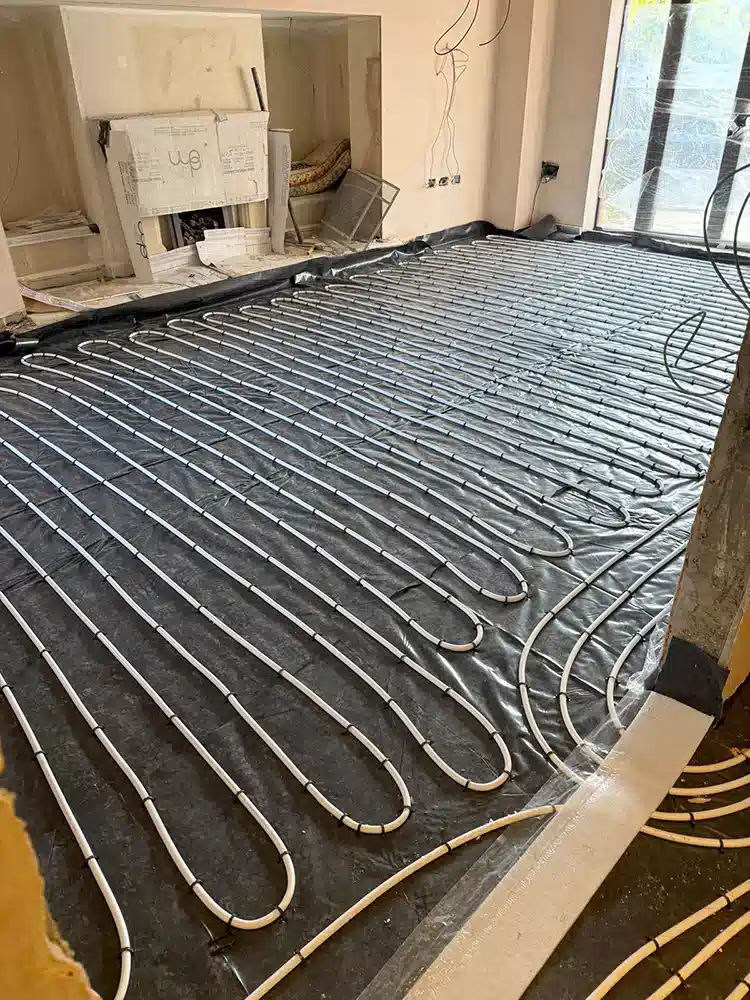
That build-up is insulation, a membrane, the pipes on their clips or rails, and the screed. The screed depth is where the choice of material makes a difference. Pumped screed must sit at least 25mm above the pipes, which normally works out at 45 to 50mm overall. With a hand-laid mix the pipes want about 45mm on top, making the whole build-up deeper. Where a retrofit is tight, the thinner liquid build-up can decide whether heating fits at all without lowering the slab.
The screed also has to wrap the pipes completely. Air pockets around pipes slow the heat and can leave weak spots above them. A flowing screed fills round the pipes naturally, which is one reason liquid screed over heating pipes is the usual choice in a kitchen extension. Sand and cement works too, but it has to be compacted carefully around and over each run.
In Ewell, 32% of homes are detached, and bigger houses such as those on Ewell Downs allow larger ground floor rebuilds. On a rebuild the slab can be lowered to take a full depth of insulation and screed, which avoids a compromise on either. Our guide to screed depths lists the usual figure for each kind of floor.
When the heating can go on in Ewell
The floor has to cure before the heating is used, and the timing depends on the screed. On calcium sulphate, the heating can normally come on from around day 7. A sand and cement floor has to wait a minimum of 21 days.
Start low and bring it up slowly. Your heating engineer sets the commissioning schedule, but the principle does not change: a few degrees at a time over days, not hours, holding at the working temperature before letting it cool gradually. Rushing this can crack the screed and damage the finish laid on top.
Heating also helps drying. Once commissioning has started, the heat drives moisture out, and the screed is tested before tiles, LVT or engineered wood go down.
Ahead of pouring we look over the insulation boards, the membrane and the perimeter edge strip, and if your builder has not fitted them we can supply insulation and membranes ourselves. The pipes should be filled and pressure tested so a leak shows before they are buried.
For budgeting, published 2026 figures put an underfloor heating liquid screed at £20 to £35 per m².
Underfloor Heating Screed prices in Ewell
Liquid screed over underfloor heating: £20 to £35 per m² supplied and laid (trade2base, June 2026), so £700 to £1,230 for 35 m². trade2base gives these figures excluding VAT. See our floor screeding cost guide or screed calculator.
Who lays your underfloor heating screed in Ewell
K & B Screeding’s own team, led by director Donatas Bardisevicius. Founded 2019, company 12298780.
See what customers say in our Google reviews and on our testimonials page.
Underfloor Heating Screed from Slough to Ewell
As the crow flies, our yard in Slough is about 21.2 miles from Ewell, which lies to the south-east. Postcodes here include KT17 and KT19, and Epsom (1.4 miles), Kingston upon Thames (3.2 miles), Sutton (3.6 miles) and Merton (4.5 miles) are close by.
More on underfloor heating screed, part of our screeding services.