
Heated extensions on Kingston upon Thames houses
Detached houses are 13% of Kingston's homes, and together with the borough's semis they form the housing where a heated rear extension or a knocked-through kitchen is likeliest. The new room in a Kingston extension usually gets underfloor heating, and its floor must meet the original house flush at the threshold.
Cover over the pipes fixes the depth. Liquid screed wants 25mm or more above them, so the finished layer comes to 45 to 50mm. Sand and cement needs roughly 45mm above the pipes, so its layer is deeper again. Add the insulation and the whole Kingston build-up has to be settled before the extension slab is cast, or the finished floor will sit proud of the house or fall short of it.
Flowing screed is the common pick over heating because it wraps each pipe completely, leaving no trapped air, so warmth spreads evenly and the room heats up quicker. A hand-laid cement screed still has its place, for instance where the new room may get wet.
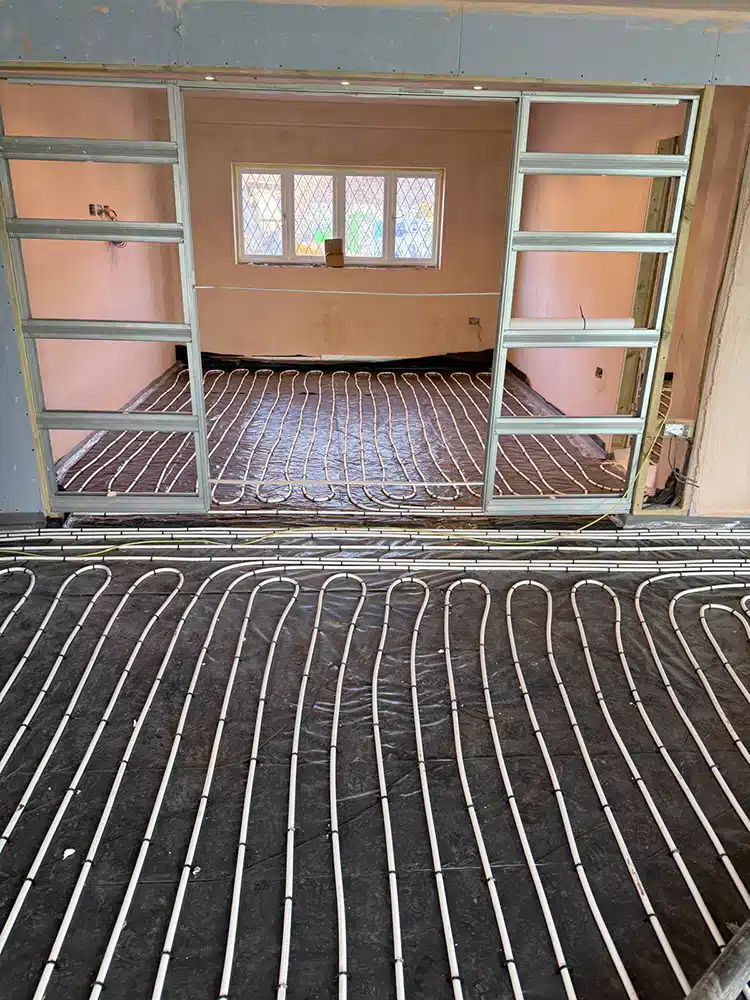
Before any screed arrives at a Kingston extension, we check the insulation, membrane and edge strip, and confirm the installer has pressure tested the pipes, since nothing under the screed can be reached afterwards. Our insulation and membrane layers service covers the boards and sheeting, and pumped liquid screed for extensions suits most new heated floors.
Retrofits in interwar Kingston upon Thames homes
Interwar housing, built between 1919 and 1944, accounts for 34% of Kingston's homes, and fitting wet heating into one of those houses is a different puzzle from an extension. Existing doors, stair nosings and thresholds pin the floor height, so the old floor normally has to be lifted to make space for insulation, pipes and screed. A liquid screed, needing less depth over the pipes, is generally how a Kingston retrofit stays inside that space. If even that will not fit, a slimmer high-performance insulation board may help, and your heating installer can talk through low-profile systems.
Warming the floor up properly matters just as much. Calcium sulphate can normally take heat from about 7 days, beginning low and stepping up gently. Sand and cement must be left at least 21 days before the heating runs. A slow start lets a Kingston floor dry evenly and lowers the chance of cracks, and the written schedule lets your heating engineer and flooring fitter book their dates.
Drying times by depth are in our screed drying guide, and the neighbouring borough has its own page for underfloor heating screed in Richmond upon Thames.
Underfloor Heating Screed prices in Kingston upon Thames
Liquid screed over underfloor heating: £20 to £35 per m² supplied and laid (trade2base, June 2026), so £700 to £1,230 for 35 m². trade2base gives these figures excluding VAT. See our floor screeding cost guide or screed calculator.
Who lays your underfloor heating screed in Kingston upon Thames
K & B Screeding’s own team, led by director Donatas Bardisevicius. Founded 2019, company 12298780.
See what customers say in our Google reviews and on our testimonials page.
Underfloor Heating Screed from Slough to Kingston upon Thames
As the crow flies, our yard in Slough is about 18.4 miles from Kingston upon Thames, which lies to the east-south-east. Postcodes here include KT5, KT9, KT3 and KT2, and Ewell (3.2 miles), Merton (3.4 miles), Richmond upon Thames (4 miles) and Epsom (4.1 miles) are close by.
More on underfloor heating screed, part of our screeding services.
