
Heated extensions on Leatherhead's inter-war houses
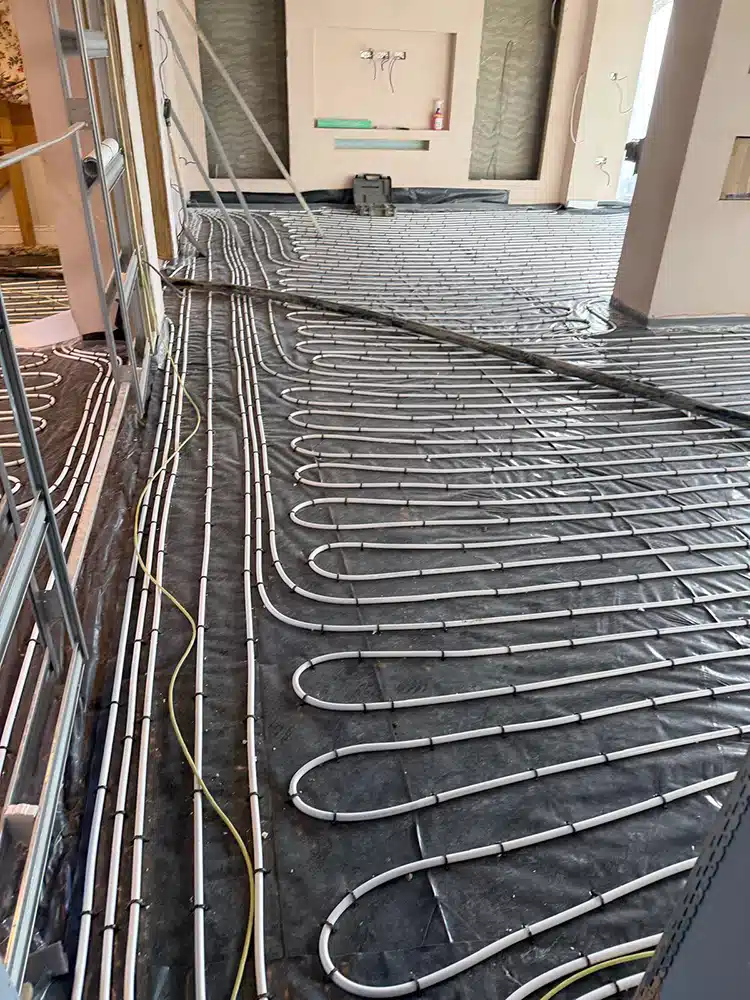
Homes built from 1919 to 1944 make up 15% of Leatherhead's housing, and a typical project on an inter-war house is a rear extension with underfloor heating in the screed. The new part of the floor is built to current standards, with insulation, a membrane and pipes. The old part, a few steps away, may be a solid floor with nothing beneath it.
That difference causes two problems. The first is level. The new build-up, including insulation and screed, has to finish at exactly the height of the existing floor, or there will be a step or a ramp at the old back wall. Working the depths out before the slab is cast saves a lot of trouble later.
The second is behaviour. A heated floor expands and contracts, while the old floor beside it does not. A movement joint or edge strip at the junction stops the new screed cracking against the old. The flooring then needs to bridge that line properly.
For the screed itself, liquid needs at least 25mm of cover over the pipes, with a total of about 45 to 50mm. A hand-laid sand and cement screed wants roughly 45mm above them. Liquid encapsulates the pipes completely and suits open-plan rooms; read about pumped liquid screed in Leatherhead for how it is laid. We check what sits under and around the pipes, from the insulation and damp membrane to the strip along the walls, or supply those layers through our membranes and insulation work.
Heating up a new Leatherhead screed safely
Many owners want the heating on as soon as the extension is finished. Patience pays here, because how the heat is first introduced affects the screed for years.
Calcium sulphate can normally take heat about a week (7 days) after pouring, while sand and cement must be left for 21 days or more. Whichever you have, begin with the flow temperature low, nudge it up in small steps across several days, keep it there for a while and then lower it again. That gradual commissioning protects the screed and the pipe joints. Your heating engineer sets the temperatures; we hand over the screed details and pour date.
Warming the floor like this does speed up drying ahead of the flooring, yet the screed still has to pass a moisture test. Read how long screed takes to dry for what affects the timing.
Retrofitting heating into a whole older ground floor is harder, because floor height is usually tight under existing doors. It can be done, but the build-up has to be planned room by room. Ewell, 5.1 miles away, has its own heated screed page for Ewell.
Underfloor Heating Screed prices in Leatherhead
Liquid screed over underfloor heating: £20 to £35 per m² supplied and laid (trade2base, June 2026), so £700 to £1,230 for 35 m². trade2base gives these figures excluding VAT. See our floor screeding cost guide or screed calculator.
Who lays your underfloor heating screed in Leatherhead
K & B Screeding’s own team, led by director Donatas Bardisevicius. Founded 2019, company 12298780.
See what customers say in our Google reviews and on our testimonials page.
Underfloor Heating Screed from Slough to Leatherhead
Leatherhead is about 21.2 miles south-east of our Slough base as the crow flies, with postcodes including KT22 and KT21. The nearest towns to it are Epsom (3.8 miles), Dorking (4.4 miles), Ewell (5.1 miles) and Reigate (6.8 miles).
More on underfloor heating screed, part of our screeding services.