
Relaying Edwardian floors on Fairfield and Highlands Road
Of Leatherhead's homes, 15% were built before 1919. Many of the solid floors in houses of that age were laid straight onto the ground, with no membrane to stop moisture rising. Over time that shows up as damp patches, lifting tiles, or flooring that smells musty when it is taken up.
There is no reliable way to add a membrane under an existing screed, so the practical fix is to break the floor out. Once the old material is removed, the ground is reduced to the right depth, a membrane and insulation go in, and a new screed is laid on top. In a house, where the new screed floats on that insulation, it goes down about 65mm deep. Those lower layers can be supplied and laid through our insulation and damp membrane service.
Hand-laid screed suits this work because old houses rarely have big, simple rooms. Hallways, bay windows, steps between rooms and thresholds that cannot move all need a screed that can be worked into shape. If a shower or wet room is part of the renovation, sand and cement can slope down to the drain, something a calcium sulphate screed cannot be used for.
Short on time? A rapid drying mix speeds things up. Fibres in the mix give extra resistance to cracking for roughly £1 to £3 per m² more. Our quick drying screed page explains when that is worth it. Where only a section of the floor has failed, the rest may be saved.
Poplar Road and post-war Leatherhead: repairs and extensions
Poplar Road was the town's first council housing, and it and the post-war roads north of the centre suit extension and repair work. One in five Leatherhead homes (20%) went up between 1945 and 1972, and floors of that vintage are now starting to wear out.
Typical jobs include a new floor in a single-storey rear extension, a converted garage brought up to the level of the house, or a hallway where the screed has cracked and broken up under old tiles. Sand and cement suits all three because it can be mixed to the depth each area needs and laid in small sections.
Where the new screed can bond to a sound concrete slab, a bonded screed of 25 to 40mm can be used instead of a full floating depth, which helps where the finished level is fixed by doors and thresholds. How we settle on a depth is set out in our guide to screed thickness.
If a floor turns out to be sound but uneven, a full screed may not be needed; levelling an existing Leatherhead floor is quicker. For the same work nearby, see sand and cement screed in Dorking.
Sand and Cement Screed prices in Leatherhead
Sand and cement screed: £18 to £25 per m² supplied and laid (MyJobQuote, August 2026), so £450 to £630 for 25 m². MyJobQuote does not say whether these figures include VAT. See our floor screeding cost guide or screed calculator.
Who lays your sand and cement screed in Leatherhead
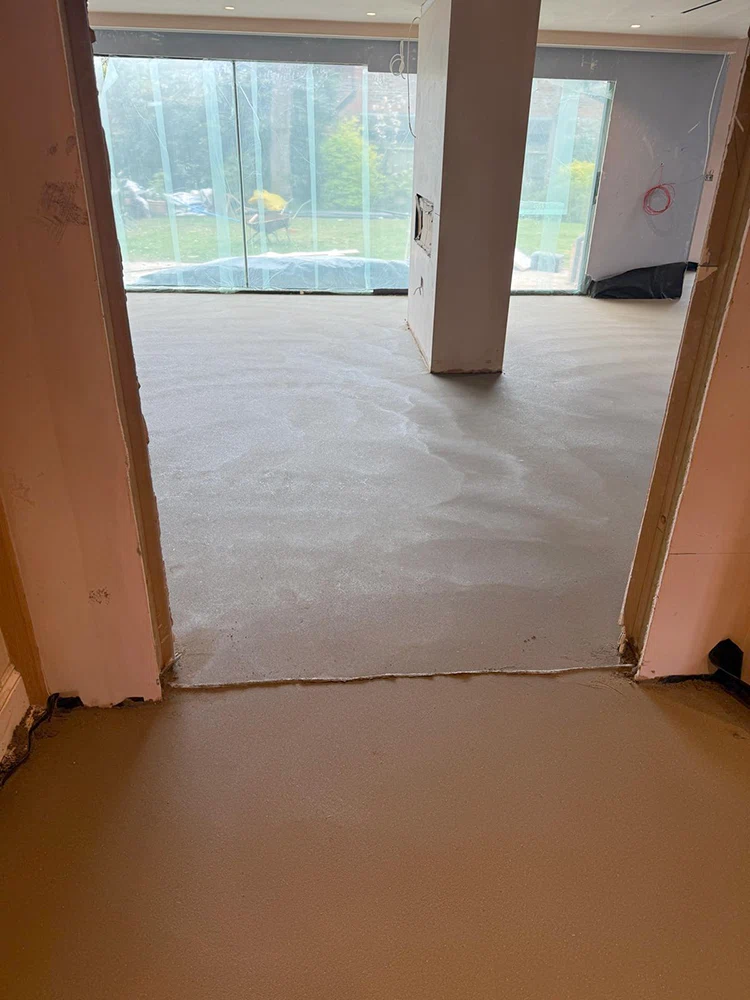
K & B Screeding’s own team, led by director Donatas Bardisevicius. Founded 2019, company 12298780.
See what customers say in our Google reviews and on our testimonials page.
Sand and Cement Screed from Slough to Leatherhead
Leatherhead is about 21.2 miles south-east of our Slough base as the crow flies, with postcodes including KT22 and KT21. The nearest towns to it are Epsom (3.8 miles), Dorking (4.4 miles), Ewell (5.1 miles) and Reigate (6.8 miles).
More on sand & cement screed, part of our screeding services.
