
Relaying Oatlands floors that have no membrane
In Weybridge, 16% of homes were built before 1919, and many of Oatlands' houses date from the 19th century. Floors from that period were often laid straight onto the ground with no membrane, so they can be damp, uneven or breaking up. When a renovation reaches the ground floor, patching rarely lasts.
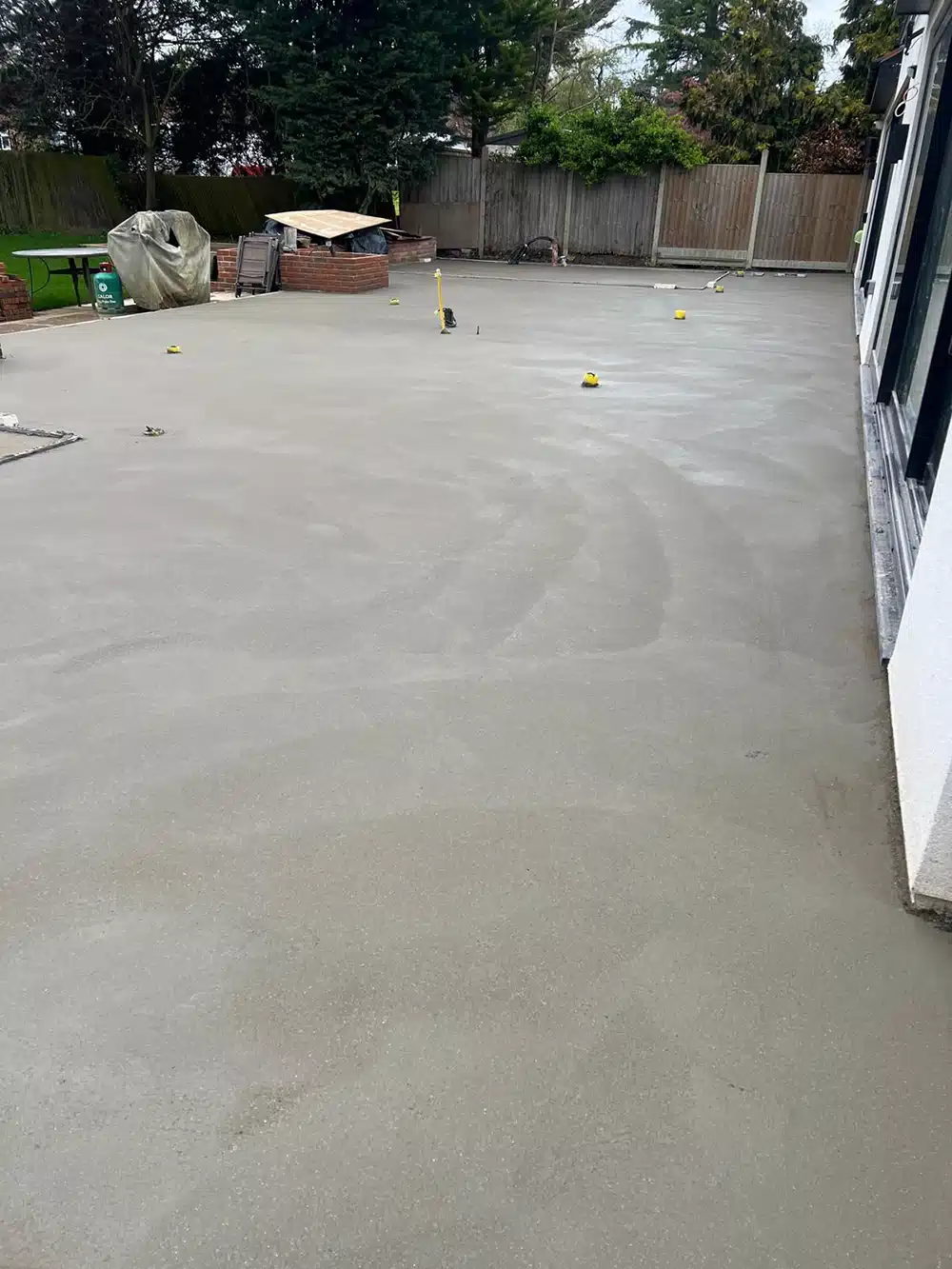
In an Oatlands renovation that tends to mean excavating to depth, putting down insulation with a damp proof membrane, and screeding on top. Hand-mixed sand and cement earns its place in houses like these. Rooms are often small and rarely square, door thresholds and hearths fix the levels, and a hand-laid mix can be built up or thinned to suit each room.
Where it floats over insulation, a house floor gets 65mm. If a decent slab is already there and headroom is short, a bonding agent lets 25 to 40mm of screed sit right on it. Bonded and floating have different rules, so the choice is made once the floor is opened up and the condition of what lies beneath is clear.
The finish is a dense, level base for tiles, stone, timber or a levelling coat. If the old floor needs breaking out and preparing first, see our floor preparation work. For crack control in larger rooms, a fibre reinforced mix adds £1 to £3 per m².
Wet rooms and small rooms in Weybridge houses
Not every room in a large Weybridge house suits a flowing screed. Bathrooms and wet rooms are the main exceptions. We shape the floor of a walk-in shower by hand so it falls to the drain, and because water may sit there, the base has to be cement, never calcium sulphate.
That makes sand and cement the common partner to a pumped screed on bigger projects. The open ground floor may be poured in anhydrite, while the shower rooms, the boot room or a garage are laid by hand.
Small rooms also favour it. Some 10% of homes in Weybridge were built between 1919 and 1944, and in houses of that period a single room renovation is a better fit for an on-site mix than for a pump.
It does dry more slowly than liquid, roughly 24 hours per millimetre while the depth is under 40mm. Going by 2026 UK figures, budget £18 per m² rising to £25. Turning a garage into a room? Read how a garage conversion floor is screeded. For a heated extension rather than a wet room, compare with the Weybridge liquid screed page.
Sand and Cement Screed prices in Weybridge
Sand and cement screed: £18 to £25 per m² supplied and laid (MyJobQuote, August 2026), so £450 to £630 for 25 m². MyJobQuote does not say whether these figures include VAT. See our floor screeding cost guide or screed calculator.
Who lays your sand and cement screed in Weybridge
K & B Screeding’s own team, led by director Donatas Bardisevicius. Founded 2019, company 12298780.
See what customers say in our Google reviews and on our testimonials page.
Sand and Cement Screed from Slough to Weybridge
Weybridge is about 13.6 miles south-east of our Slough base as the crow flies, with postcodes including KT13 and KT15. The nearest towns to it are Addlestone (1.5 miles), Walton-on-Thames (2 miles), Chertsey (2.4 miles) and Sunbury-on-Thames (3.7 miles).
More on sand & cement screed, part of our screeding services.
