
Rebuilding older floors around Lower Sunbury
In Sunbury-on-Thames, 23% of homes were built between 1919 and 1944, and a further 6% before 1919. Lower Sunbury, the riverside village, includes listed buildings alongside its 1930s houses. Floors of that age were often laid without a damp proof membrane or insulation, and over the decades they crack, sink or sweat.
Once a renovation in Lower Sunbury gets down to the ground floor, the old slab usually comes out, then insulation, a membrane and a new screed take its place. That is work for a mix made up on site and laid by hand. It is mixed in small batches on site, so we can follow uneven walls and old thresholds and build up the depth to suit each room. On a listed building, the conservation officer may have a view on what is removed, so check consent before work starts.
Thickness follows the build-up. Over an insulation board we go to 65mm in houses, 75mm in shops and offices. A bonded screed, laid directly onto a sound slab with a bonding agent, can be 25 to 40mm, which helps where a doorway or a staircase fixes the floor height.
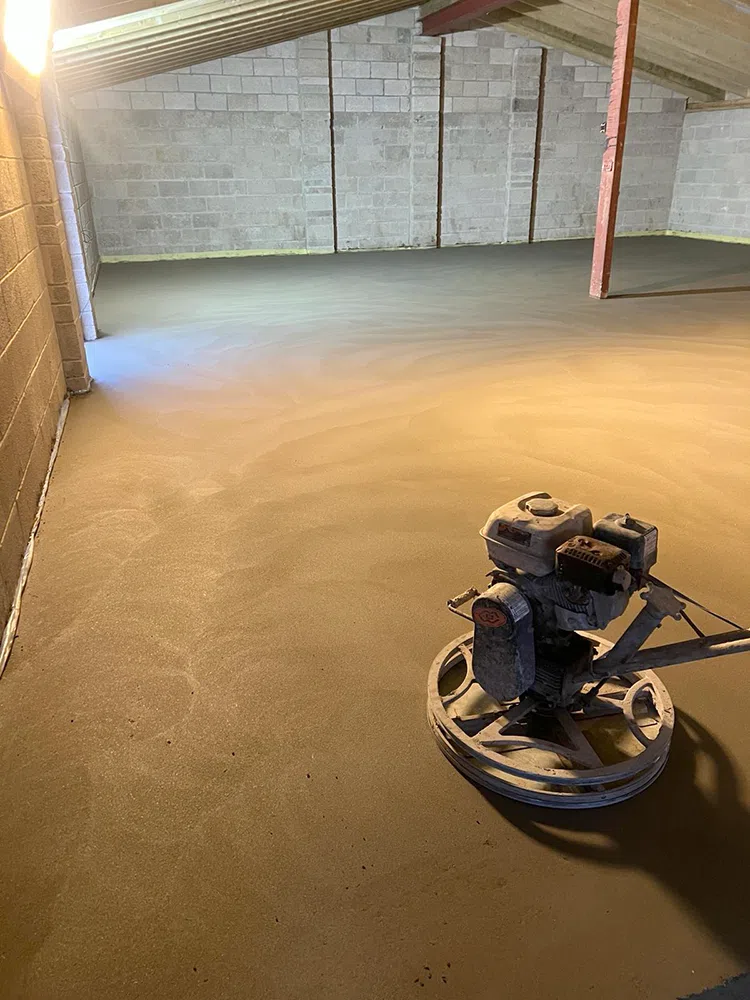
Once compacted, the surface is finished level and dense, ready for tiles, timber or a levelling coat. Fibres stirred into the mix give a fibre reinforced screed that holds out better against cracks, adding £1 up to £3 per m².
Wet rooms and garages in Sunbury-on-Thames homes
Some floors suit sand and cement better than any flowing product. A walk-in shower or wet room only drains if the floor tilts towards the outlet, and we form those falls by hand along a straightedge. A floor that might stay wet needs a cement base, never calcium sulphate.
Garage conversions come up a lot on Sunbury's semis. Converting an integral or attached garage on a semi usually means raising the floor to the house level over new insulation. Sand and cement handles the depth and the step down at the old garage door. Each layer is covered in our garage conversion floor guide.
Sand and cement is slow to dry, though. A 65mm floor gives up its water slowly, at around 24 hours per millimetre to 40mm deep and slower beyond, so wood or vinyl has to wait. When a builder's timetable is squeezed, quick drying additives help.
Price-wise, sand and cement starts at £18 per m² on 2026 UK figures and can reach £25, with bonded screed lower at £12 to £18 (trade2base, June 2026). For a heated extension rather than a wet room, compare with our heated floor screed in Sunbury, where the depth over pipes changes the sums.
Sand and Cement Screed prices in Sunbury-on-Thames
Sand and cement screed: £18 to £25 per m² supplied and laid (MyJobQuote, August 2026), so £450 to £630 for 25 m². MyJobQuote does not say whether these figures include VAT. See our floor screeding cost guide or screed calculator.
Who lays your sand and cement screed in Sunbury-on-Thames
K & B Screeding’s own team, led by director Donatas Bardisevicius. Founded 2019, company 12298780.
See what customers say in our Google reviews and on our testimonials page.
Sand and Cement Screed from Slough to Sunbury-on-Thames
As the crow flies, our yard in Slough is about 12.5 miles from Sunbury-on-Thames, which lies to the south-east. Postcodes here include TW16 and TW17, and Ashford (2.1 miles), Walton-on-Thames (2.3 miles), Weybridge (3.7 miles) and Chertsey (4.1 miles) are close by.
More on sand & cement screed, part of our screeding services.