
Relaying tired solid floors in older Addlestone houses
Addlestone is not a new town. By 1911 it had overtaken Chertsey, its parent parish, in importance, and 10% of its homes date from before 1919.
Floors of that age can fail in several ways. The slab may have cracked or settled, the surface may be breaking up, or damp may be coming through because there is no effective membrane. Loose tiles, a powdery surface or damp patches at the skirting are the usual warning signs. None of these is solved by a new top layer on its own.
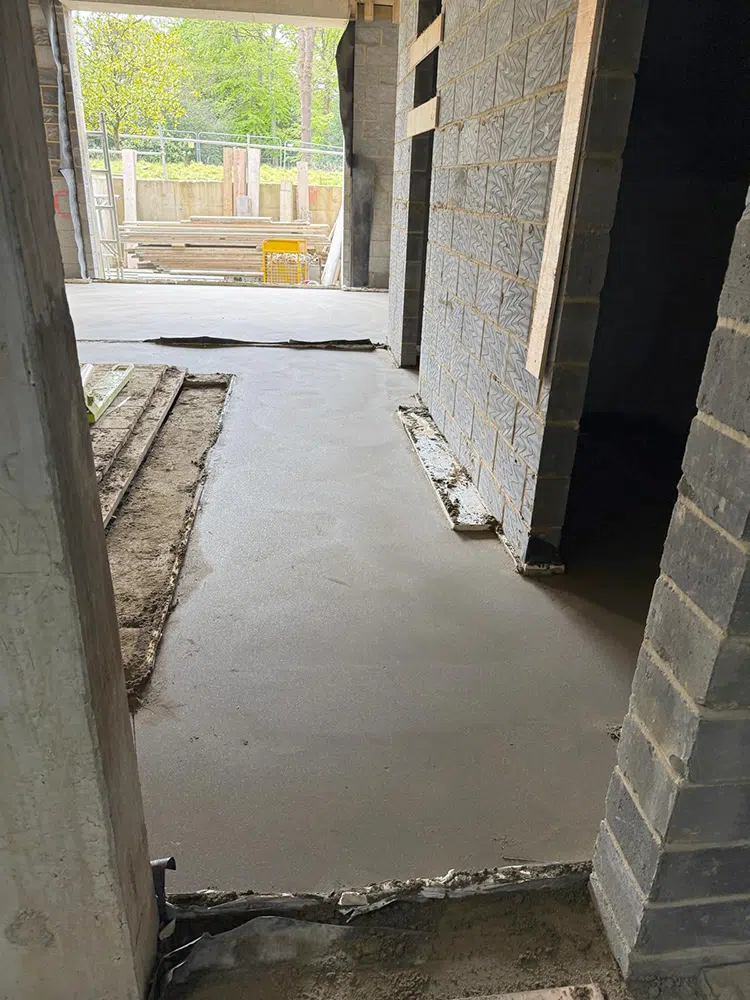
Putting it right normally means taking the floor out and building it back up: a damp proof membrane first, then insulation, then a floating sand and cement screed about 65mm deep in a house. We mix that screed on site, place it, pack it down by hand and finish it to a dense, level face. Because it is hand laid, it works round chimney breasts, bay windows, steps and thresholds whose levels cannot change.
Addlestone's low ground adds a point. Near the Bourne and Addlestone Moor, careful membrane and insulation detailing is worth the extra attention, so we take care with laps and upstands at the walls before any screed is placed. A tear or an unsealed lap here would undo the whole rebuild.
Where a slab is cracked but sound, our concrete floor repair service may be enough. For depth choices across floor types, the screed thickness guide explains the options.
Bonded, floating and wet room screeds in Addlestone
Not every floor is floating. If a new layer goes straight onto a sound, clean concrete base, a bonded sand and cement screed of 25 to 40mm can be used, keyed to the slab with a bonding agent. It is thinner, carries load earlier, and suits a floor where height is tight.
Wet rooms and walk-in showers are another reason to choose traditional screed. Water has to run to a drain, and cement based screed puts up with getting wet where calcium sulphate would suffer. We form those slopes by hand while the screed is laid.
Garages being turned into rooms need a build-up too, lifting the low garage slab to meet the house with insulation and screed. Each layer is described in our guide to garage floor screed.
The main drawback is drying. Give it about a day per millimetre down to 40mm, then longer, which means weeks rather than days before a sensitive finish. If cracking worries you, fibres go into the mix for an extra £1 to £3 per m², and when fibres are worth adding is covered separately.
Sand and Cement Screed prices in Addlestone
Sand and cement screed: £18 to £25 per m² supplied and laid (MyJobQuote, August 2026), so £450 to £630 for 25 m². MyJobQuote does not say whether these figures include VAT. See our floor screeding cost guide or screed calculator.
Who lays your sand and cement screed in Addlestone
K & B Screeding’s own team, led by director Donatas Bardisevicius. Founded 2019, company 12298780.
See what customers say in our Google reviews and on our testimonials page.
Sand and Cement Screed from Slough to Addlestone
On the map, Addlestone sits south-south-east of Slough, about 12.9 miles from our base in a straight line (postcodes including KT15), next to Weybridge (1.5 miles), Chertsey (1.6 miles), Walton-on-Thames (3.4 miles) and Staines-upon-Thames (4.4 miles).
More on sand & cement screed, part of our screeding services.