
Awkward bases in Addlestone kitchens and bathrooms
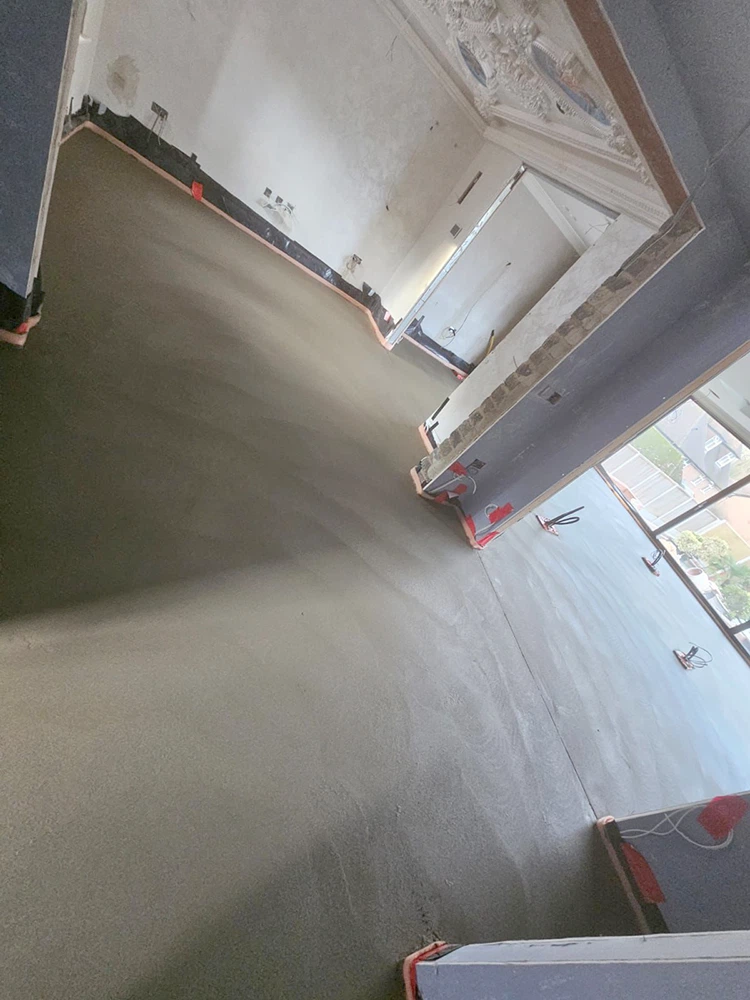
Latex screed gets its name from what goes into it. The powder is cement based, and instead of adding water you add the latex liquid supplied with it. Once mixed, it is spread a few millimetres thick over a sound base and sets to a smooth face that thin floor coverings can be stuck to.
Kitchens and bathrooms are where it usually earns its keep. Rooms like these tend to be small, and a floor changed more than once leaves a different material behind each time. The usual bases are these.
Timber floors. Bare boards are never latexed directly, because they flex and the joints between them open up. Once they are fixed down and overboarded with flooring grade plywood, the ply takes latex well.
Old tiles. Quarry or ceramic tiles that are firmly bonded can stay. Loose or hollow ones come up, the gaps are filled, and the rest are cleaned and primed.
Concrete and old adhesive. Uneven older concrete and sound old adhesive can both be covered once primed.
In a two storey house, a kitchen on a solid ground floor and a bathroom upstairs on timber need different preparation, even though the same latex finishes both.
The coverings that need this most are the thin ones: sheet vinyl, lino, rubber and safety flooring, which show every bump. If you are unsure whether you need latex or a deeper levelling compound, the Addlestone floor levelling page sets out the difference.
Where latex will not work in Addlestone homes
Latex has three clear limits. It does not cure damp. It does not stop a timber floor that bounces. And it cannot rescue a floor that is badly out of level, because a thin layer only follows the shape beneath it.
On the lower ground beside the Bourne and at Addlestone Moor, the membrane under a solid floor deserves extra attention, so damp is the first thing to rule out. Before any latex goes onto a ground floor there, we test for moisture; if it is present, the floor needs a proper membrane and possibly a new screed rather than a skim.
Bouncy timber is fixed at the joists and boards, then overboarded. Big dips or slopes are taken out with a screed or levelling compound first, and the latex follows as the smoothing coat.
Priming ties it all together. Plywood, tiles, concrete and old adhesive each take a matched primer, and a calcium sulphate screed always has its laitance removed and is primed before latex. If coatings or adhesive need to come off first, see concrete floor grinding in Addlestone; for wider stripping work, our floor preparation service covers it.
How we price latex screed in Addlestone
A fixed written price within 24 hours, once we know the area and the base. See our floor screeding cost guide.
Who lays your latex screed in Addlestone
K & B Screeding’s own team, led by director Donatas Bardisevicius. Founded 2019, company 12298780.
See what customers say in our Google reviews and on our testimonials page.
Latex Screed from Slough to Addlestone
On the map, Addlestone sits south-south-east of Slough, about 12.9 miles from our base in a straight line (postcodes including KT15), next to Weybridge (1.5 miles), Chertsey (1.6 miles), Walton-on-Thames (3.4 miles) and Staines-upon-Thames (4.4 miles).
More on latex screed, part of our screeding services.
