
Latex surfacing for flat refits at The Heart of Walton
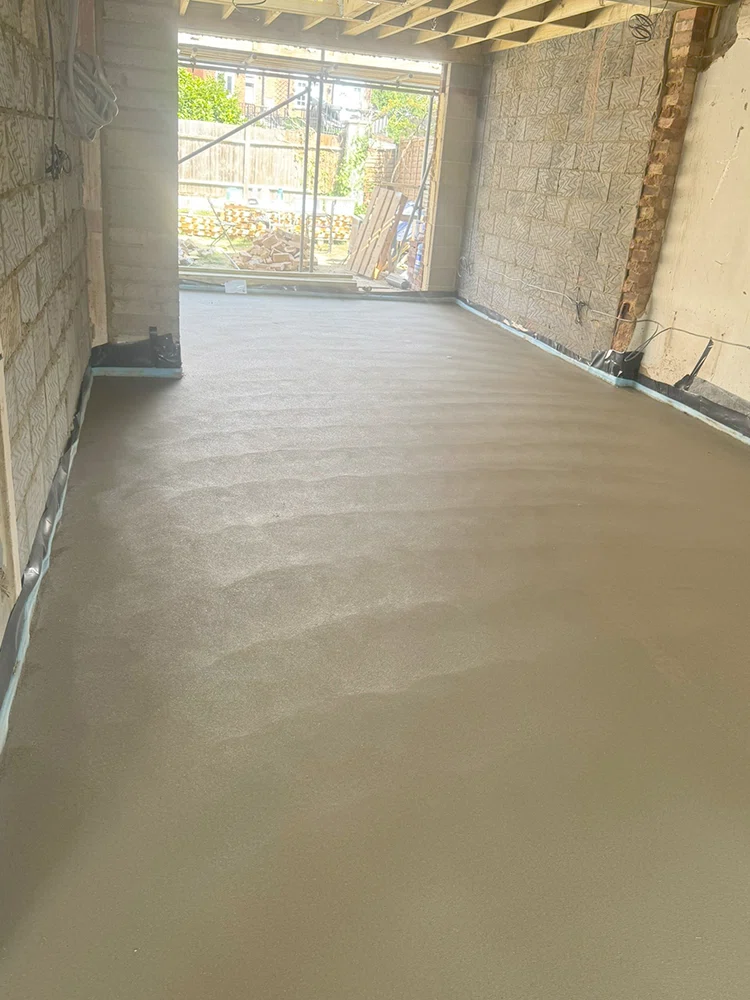
Latex screed comes in two parts: a cement based powder and a latex liquid that replaces the mixing water. The two parts are combined on site and spread to a few millimetres. Because it is so thin, it barely changes the floor height, which matters in a flat where the front door, the kitchen plinths and the bathroom threshold are all fixed.
Once the old covering is lifted in a block like The Heart, one of three bases usually appears. The first is a screed that is sound but pitted, patched where pipes were moved or marked by old fixings. The second is a layer of old vinyl or tile adhesive. The third is ceramic tiling that a previous owner laid over the original floor.
Each can take latex if it is sound. A pitted screed is cleaned, primed and skimmed. Thin, hard adhesive that is firmly stuck may be left and primed with a product made for it, while soft or lifting residue is removed first. Ceramic tiles that are all firmly bonded can be primed and covered, so the grout pattern disappears under the new floor. Any loose tile comes out.
Converted flats are only 2% of Walton's homes, so most flat refits here sit on a screed or slab in a block rather than on timber. The finishes that need latex are the thin ones: sheet vinyl, LVT, lino, rubber and slip resistant safety flooring show every bump beneath them. If the screed under a flat is cracked or loose, it needs screed repairs before any surfacing.
Kitchen and bathroom floors in Walton-on-Thames semis
Houses of the inter-war and post-war years commonly combine a concrete ground floor with timber boards upstairs. Latex can go over both, but not in the same way.
On a slab, the questions are its condition and whether it has a membrane. Concrete without one can let damp through, and latex does nothing to stop it. We test before pricing. A dry slab is primed for concrete and latexed. A damp one needs a membrane or a new floor, and then a rebuilt sand and cement floor may be the honest answer.
Upstairs, latex never goes straight onto floorboards. The boards are fixed down where they move, overboarded with flooring grade plywood, and the latex is laid on the plywood. If the boards still bounce underfoot, the joists or fixings need attention first, because no compound will stop a springy floor.
A floor that is badly out of level is the other limit. Latex is a thin coat, not a way to fill a deep hollow. For wider flatness problems or a step at an extension join, see our floor levelling service in Walton. Neighbouring homeowners can also read about latex screed in Weybridge, about two miles away.
How we price latex screed in Walton-on-Thames
A fixed written price within 24 hours, once we know the area and the base. See our floor screeding cost guide.
Who lays your latex screed in Walton-on-Thames
K & B Screeding’s own team, led by director Donatas Bardisevicius. Founded 2019, company 12298780.
See what customers say in our Google reviews and on our testimonials page.
Latex Screed from Slough to Walton-on-Thames
As the crow flies, our yard in Slough is about 14.1 miles from Walton-on-Thames, which lies to the south-east. Postcodes here include KT12, TW17 and KT10, and Weybridge (2 miles), Sunbury-on-Thames (2.3 miles), Addlestone (3.4 miles) and Chertsey (3.7 miles) are close by.
More on latex screed, part of our screeding services.