
Garage conversions on Walton-on-Thames semis
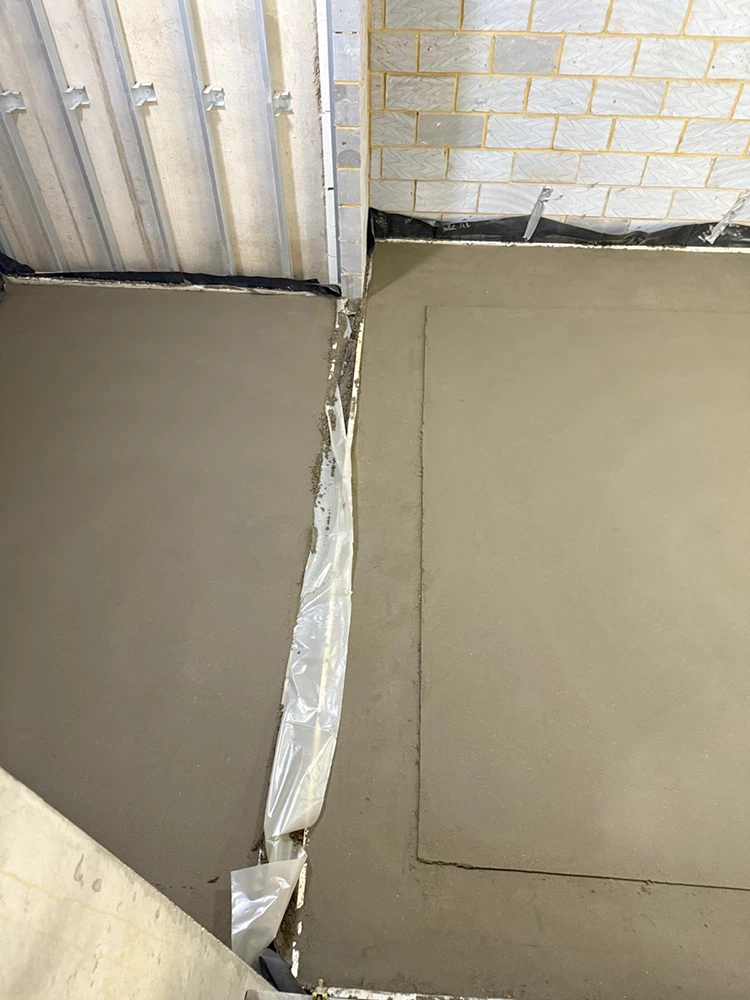
A garage floor is usually a concrete slab sitting below the level of the house. Turning it into a room means adding a membrane, insulation and a screed until the floor lines up with the hall or kitchen next door. Sand and cement is a good match for this. It is mixed on site in the quantities each part of the room needs, so the screed can be built up at the old door opening and kept thinner elsewhere.
Over an insulation layer we lay 65mm for houses, and units on the trading estates get 75mm. Short of height over a sound garage slab? Bond the screed straight to the concrete with a bonding agent and 25 to 40mm will do.
If the converted garage includes a shower room, the floor there is formed by hand to falls towards the drain. That is easier with a hand-laid mix, because the screed is shaped with a straightedge as it is compacted, and it gives the cement base that wet areas need. Keep calcium sulphate products out of any floor that could stay wet.
Every layer of a garage conversion floor is covered in screeding a converted garage. Where the conversion also gets underfloor heating, the pipe cover is around 45mm with sand and cement, so check the heating screed depths for Walton before the floor levels are fixed.
Older floors and hard wearing units around Hersham
Some 9% of homes in Walton-on-Thames were built before 1919, and 20% between 1919 and 1944. In Walton's older houses, solid ground floors frequently went down with no damp proof membrane at all. When a renovation reaches them, a floor that is cracked, sinking or damp is dug out, rebuilt with insulation and a membrane, and finished with a new sand and cement screed.
Expect a slower dry than with liquid screed, around 24 hours per millimetre up to 40mm, and pencil in the flooring date accordingly. Rapid drying additives in the mix bring that date forward.
Industrial units are the other place this screed earns its keep. Units on estates like Hersham Trading Estate and Riverdene Industrial Estate need hard wearing screeds, and a cement screed can be modified for that. Our higher strength screed uses a richer mix for heavier use.
For budgeting, the 2026 UK figures show sand and cement from £18 per m² to £25, and fibres put another £1 to £3 on each m².
Sand and Cement Screed prices in Walton-on-Thames
Sand and cement screed: £18 to £25 per m² supplied and laid (MyJobQuote, August 2026), so £450 to £630 for 25 m². MyJobQuote does not say whether these figures include VAT. See our floor screeding cost guide or screed calculator.
Who lays your sand and cement screed in Walton-on-Thames
K & B Screeding’s own team, led by director Donatas Bardisevicius. Founded 2019, company 12298780.
See what customers say in our Google reviews and on our testimonials page.
Sand and Cement Screed from Slough to Walton-on-Thames
As the crow flies, our yard in Slough is about 14.1 miles from Walton-on-Thames, which lies to the south-east. Postcodes here include KT12, TW17 and KT10, and Weybridge (2 miles), Sunbury-on-Thames (2.3 miles), Addlestone (3.4 miles) and Chertsey (3.7 miles) are close by.
More on sand & cement screed, part of our screeding services.
