
Digging out Victorian floors in Twickenham and St Margarets
Lowering a Victorian ground floor in Twickenham, St Margarets or Richmond usually starts with breaking out whatever is there, whether suspended timber, an old slab or a mix of both. The ground is dug to the depth needed for insulation, a membrane and the new screed, and the finished level is set against the hall and doorways.
Floating over insulation, the screed goes in 65mm thick in a house and 75mm thick under a commercial floor. It is mixed on site, placed between screed rails and compacted by hand, then trowelled flat. That hands-on method goes around chimney breasts, bay windows and awkward alcoves, and it lets the level be matched to the millimetre where the new floor meets the old.
Where the heating goes in, pipe cover rises to about 45mm, which is covered on our screed over underfloor heating page. If the old slab is solid enough to keep and there is little height to play with, a screed bonded onto that slab at 25 to 40mm can be used instead.
Drying takes time. Roughly a day goes by for each millimetre up to 40mm, and the layers below that dry more slowly still, which puts stone or engineered timber on a 65mm floor several weeks out. A quick drying sand and cement mix helps when the programme is tight, and it is worth agreeing the flooring date only once the screed type and depth are settled.
Wet rooms, terraces and conversions in Richmond upon Thames
Terraced houses make up 27% of the borough's homes, and in a terrace, rooms are small and access is through the house. A bathroom, a utility or a hallway is often quicker to screed with a mix carried in than with a pump set up outside and a hose run through the front rooms.
Wet rooms are sand and cement territory. Calcium sulphate is wrong for any floor that could get wet, so a walk in shower gets a cement screed sloped to the drain, set out on rails and checked with a level while it is packed down. Tanking and tiles then follow the fall, so the water runs to the drain.
In this borough, 10% of homes are converted flats. In a conversion, a new bathroom or kitchen floor on an upper storey needs a screed that takes load early and copes with water, and sand and cement does both. Where a section is thin, mixing in fibres adds £1 to £3 per m² and helps stop it cracking. For typical depths across each build up, see the screed thickness guide.
Sand and Cement Screed prices in Richmond upon Thames
Sand and cement screed: £18 to £25 per m² supplied and laid (MyJobQuote, August 2026), so £450 to £630 for 25 m². MyJobQuote does not say whether these figures include VAT. See our floor screeding cost guide or screed calculator.
Who lays your sand and cement screed in Richmond upon Thames
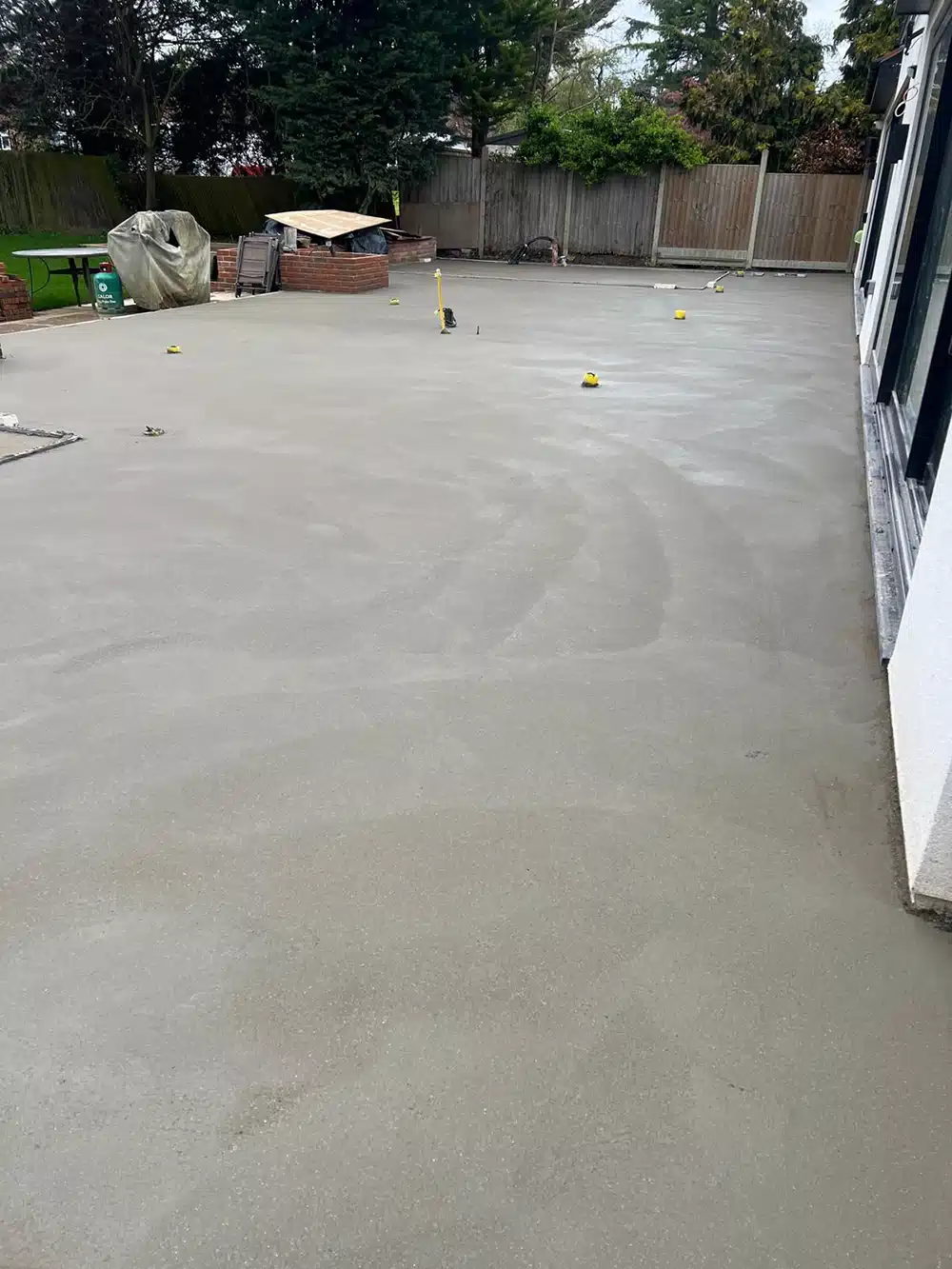
K & B Screeding’s own team, led by director Donatas Bardisevicius. Founded 2019, company 12298780.
See what customers say in our Google reviews and on our testimonials page.
Sand and Cement Screed from Slough to Richmond upon Thames
Richmond upon Thames is about 15.6 miles east-south-east of our Slough base as the crow flies, with postcodes including SW13, SW14, TW10 and TW12. The nearest towns to it are Hounslow (2.5 miles), Kingston upon Thames (4 miles), Ealing (4.9 miles) and Sunbury-on-Thames (5 miles).
More on sand & cement screed, part of our screeding services.