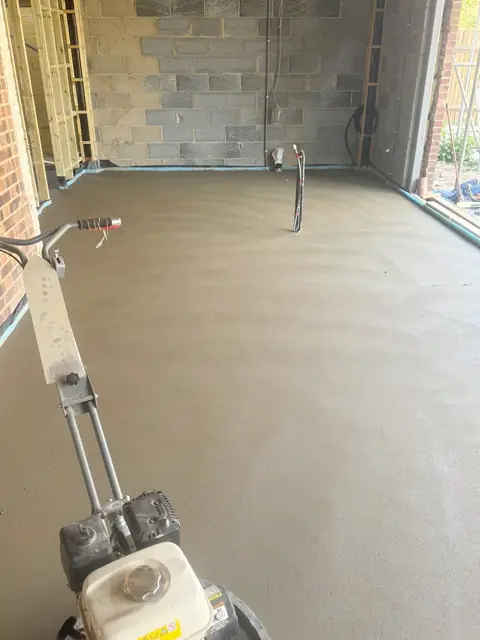
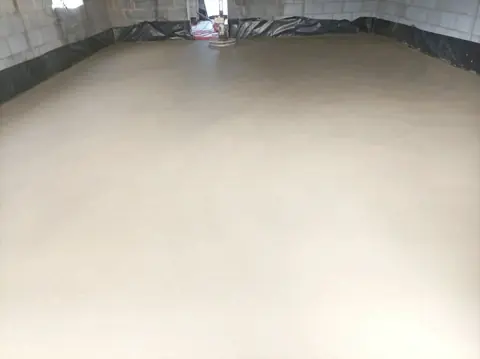
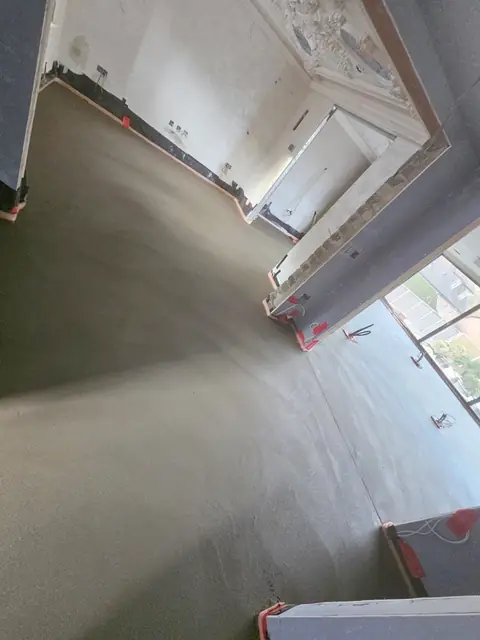
Drying time is the biggest programme risk on most screeding jobs. A traditional 65mm sand and cement screed can need two months or more before it is dry enough for an impermeable floor finish, and that wait comes right at the end of the build, when everyone wants to be finishing. Quick drying screed solves that problem. K & B Screeding lays it when the programme cannot wait.
We lay quick drying screeds across London and the Home Counties for homeowners who want their home back, and for contractors and developers who cannot afford a floor holding up the handover.
How quick drying screed works
In a normal screed, much of the water added for mixing has to evaporate before the floor is ready for flooring. Quick drying screeds use additives or specially formulated binders that change how that water behaves. Some bind the water chemically into the screed as it cures, and some reduce the amount of water needed in the first place. Either way, the screed reaches a dry enough state far sooner.
Depending on the product, depth and site conditions, floor coverings can often go down within days rather than weeks. We will tell you honestly what is realistic for your floor, rather than quoting a best case that only happens in a laboratory.
When quick drying screed is worth it
- Refurbishments and occupied homes, where every extra week of disruption matters.
- Commercial fit-outs with fixed opening dates.
- Phased handovers on developments, where one plot's floor holds up the next trade.
- Late design changes that have squeezed the programme.
- Winter work, when cold, damp conditions slow a traditional screed dramatically.
If the programme is relaxed, a traditional sand and cement screed is usually the more economical choice. If the area is large and open, a liquid screed may give both speed of laying and a fast walk-on time. We will compare them for you.
Laying quick drying screed
Quick drying screed is laid in much the same way as a traditional screed: placed, compacted, ruled off to level and finished. The main difference is working time. Some rapid products set faster, so we plan the pour carefully, keep sections manageable and have enough hands on site to finish each bay before it firms up.
It can also be combined with polypropylene fibres to control cracking, as in our fibre reinforced screed.
Testing before flooring goes down
Fast drying does not mean skipping the checks. Before any impermeable covering such as vinyl, LVT, rubber or wood goes down, the screed should be tested for moisture. The usual method is a hygrometer test that measures the relative humidity of the air trapped above the screed. Most floor finishes need the screed to reach around 75% relative humidity, although some products specify different limits.
Closing a floor up too early is what causes lifting, blistering and mould under floor coverings. We explain the testing process and what your flooring installer should look for. Our guide on how long screed takes to dry covers this in more depth.
Helping any screed dry faster on site
Whatever screed you choose, site conditions make a huge difference to how quickly it dries. These simple steps help:
- Ventilate. After the first day or two, open windows and doors so moist air can escape. A closed, humid building is the biggest cause of slow drying.
- Keep it warm, not hot. Moderate, steady background heat helps. Blasting a new screed with direct heat can cause cracking and curling.
- Use dehumidifiers. In closed or winter conditions, dehumidifiers pull moisture out of the air and speed drying considerably.
- Avoid adding moisture. Wet trades such as plastering add moisture to the building and slow the floor down.
- Do not cover it. Plastic sheeting, boards or stored materials left on the screed trap moisture beneath them.
- Use the heating correctly. Where underfloor heating is fitted, a controlled heat-up schedule helps dry the screed.
We give you practical advice for your site so the floor is ready when you need it.
Quick drying screed near you
We lay fast drying screeds across London and the Home Counties from our base in Slough, including Watford, Reading, Northampton and throughout London.
Quick Drying Screed prices in 2026
Published 2026 UK figures put fast drying screed at about £20 to £28 per m², supplied and laid (MyJobQuote, August 2026). MyJobQuote does not say whether these figures include VAT. Depth, area, access and preparation move the figure either way, so we fix your price in writing within 24 hours. See our floor screeding cost guide or the screed calculator.
“I used K & B for a screeding job at the beginning of the year (Jan 2023), extremely competitive quotation and first class delivery, on time and on budget.”
Part of our screeding and floor screeding services, laid by our own team across London and the Home Counties.