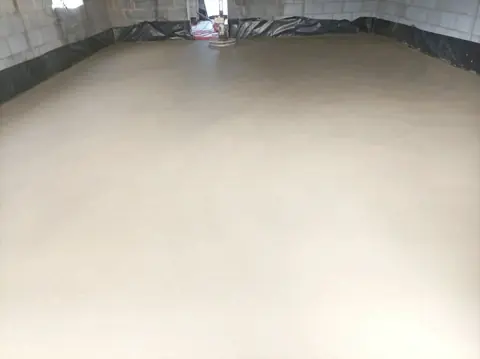
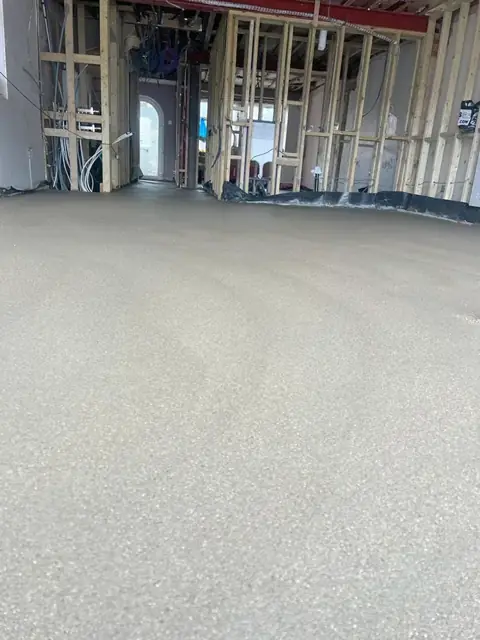
If your drawings or specification call for an anhydrite screed, a flow screed or a CA graded flowing screed, this is the page for you. K & B Screeding supplies the material, prepares the floor, pumps the screed and leaves you with a flat, dense base ready for drying and floor finishes. We work for homeowners, builders, developers and main contractors across London and the Home Counties from our base in Slough.
If you want to understand the material itself before you book, our guide to anhydrite screed explains how calcium sulphate differs from cement, how laitance forms and what your tiler needs to know.
Anhydrite, flow and flowing screed: what we mean
Anhydrite screed and calcium sulphate screed describe the binder. Flow screed and flowing screed describe the way it is laid: pumped as a fluid rather than spread and compacted by hand. In practice most flowing screed laid in homes is calcium sulphate based, but cement based flowing screeds also exist and we lay those too.
Our liquid screed page gives the broader picture of pumped screeds and when they suit a floor. This page is for jobs where the grade and the binder have already been chosen, or where you want help choosing between them.
The screed types we lay
A specification to BS EN 13813 tells you the binder and the strength. "CA" means calcium sulphate, "CT" means cement. The C number is the compressive strength and the F number the flexural strength, both in N/mm². The manufacturer's data sheet for the chosen product always sets the final depths and limits.
| Screed type | Binder | Typical designation | Where it usually suits |
|---|---|---|---|
| Standard anhydrite flow screed | Anhydrite (calcium sulphate) | CA-C20-F4 | Domestic floors, extensions, light foot traffic |
| General purpose anhydrite flow screed | Anhydrite (calcium sulphate) | CA-C25-F5 | Most homes, apartments and offices, the most common grade we are asked for |
| Higher strength calcium sulphate screed | Anhydrite or alpha hemihydrate | CA-C30-F6 | Heavier use areas, thinner sections where the manufacturer allows |
| Alpha hemihydrate flow screed | Alpha hemihydrate (calcium sulphate) | Varies by product | Jobs where faster drying or reduced depth is the priority |
| Cement based flowing screed | Cement | CT graded, varies by product | Areas that may get wet, or where a cement based adhesive system is required |
Swipe the table sideways to see every column.
Alpha hemihydrate is a calcium sulphate binder made by a different process from anhydrite. Products based on it are often chosen when a programme is tight or build height is limited, but each one has its own depth, drying and heating guidance, so we work to the product sheet rather than a general rule.
Anhydrite or cement based flowing screed?
Calcium sulphate flow screed is our usual recommendation over underfloor heating, in open plan rooms and on large floors, because it shrinks very little and can be laid in large bays with few joints. It can also usually be force dried with the heating from about seven days, following the manufacturer's schedule.
A cement based flowing screed is the alternative when the floor may be exposed to water, when the flooring system needs a cement substrate, or when the client would rather avoid laitance removal. It still pumps and self levels, but needs more attention to joints and curing. For small rooms, wet rooms and floors that must take load early, a hand laid sand and cement screed or a quick drying screed may make more sense. We will tell you plainly which we think suits your floor.
What is included when we lay your flow screed
- A fixed price. We quote within 24 hours of receiving areas and depths, and the price is agreed before any work starts.
- The build-up. We can lay the insulation, membranes and edge strip ourselves, so the layers under the screed are compatible and properly sealed.
- Material ordering. We order the grade in your specification, or recommend one, and plan the pour around delivery and pump access.
- Joint and bay layout. Doorways, long narrow rooms and heating zones are planned before the pour, not after it.
- Handover notes. You receive written guidance on ventilation, heating start dates, moisture testing and laitance removal for your flooring installer.
How we lay anhydrite flow screed
- Survey and specification check. We confirm the areas, depths, build-up and product grade, and flag anything in the specification that does not suit the floor.
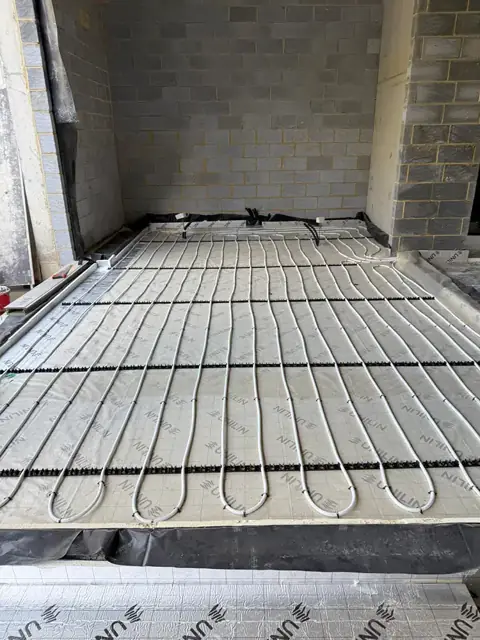
- Preparation. Insulation is laid flat and tight, the slip membrane is lapped and taped, and edge strip goes round every wall, column and upstand.
- Heating pipes and levels. Underfloor heating pipes are checked, clipped and filled with water, and depth markers are set across the floor.
- Pour. The screed is pumped from the truck, spread to the markers and dappled with a bar to release air and help it level.
- Protection. The area is closed off for the first day or two, then ventilated to help it dry.
- Handover. We confirm when the floor can be walked on, when the heating can start and what the flooring installer must do before laying finishes.
Our screed thickness guide sets out typical minimum depths for floating, bonded and heated floors if you are working out build heights.
Drying and floor finishes
Anhydrite screed is usually walkable within 24 to 48 hours, but it must be dry before floor coverings go down, and many flooring manufacturers set a lower moisture limit for calcium sulphate than for cement. Our guide on how long screed takes to dry explains testing. Once dry, the surface laitance is sanded off and the floor primed with a product compatible with the adhesive.
What affects the price
MyJobQuote (August 2026) puts liquid screed at £24 to £31 per m², without saying whether VAT is included. The main factors are the total area, the depth, the grade specified, pump access and whether we are also laying insulation and membrane. Small areas cost more per square metre because a truck, pump and minimum load are needed however small the floor. Our floor screeding cost guide covers this in more detail.
Where we lay anhydrite screed
We work across London and the Home Counties. Near our base we cover liquid screed in Slough and towns such as Maidenhead and Windsor, and we take on extensions, new build plots and apartment floors throughout London.
“They did an excellent job and do hard work, I am really happy with their work. So very happy with the workmanship and highly recommend them.”
Part of our screeding and floor screeding services, laid by our own team across London and the Home Counties.