
Reading an anhydrite specification for Enfield new builds
Calcium sulphate screeds are graded under the British and European screed standard by two numbers. The C figure is compressive strength and the F figure is flexural strength, both in N/mm2. CA-C20-F4 suits domestic floors with light traffic. CA-C25-F5 covers most homes, apartments and offices. CA-C30-F6 is for heavier use. When a drawing for a block of flats or a housing plot names one of these, that is the grade we pour, not a near match.
Some specifications name an alpha hemihydrate product instead. These are chosen where faster drying or a thinner section matters, and each follows its own product data sheet for depth, drying and heating.
The material earns its place on large floors because it shrinks very little. Bays can be much bigger than a cement screed allows, and joints are fewer, but the joint and bay layout is still planned before the pour, especially across doorways and between heated zones.
Apartment floors usually float on an acoustic layer. Where the specification for a block calls for calcium sulphate over one, the acoustic layer, edge strip and membrane all have to be continuous so the screed floats free of the structure.
Calcium sulphate is not for every room. In areas that may get wet, a cement based flowing screed is the alternative, and a sand and cement screed in Enfield remains an option for small wet rooms laid to falls.
Laitance, testing and primers on Enfield anhydrite floors
Every calcium sulphate floor grows a crust as it dries. That crust is laitance, a fine, weak film on top, and it has to come off. When the screed is ready, we sand the film away, vacuum up the dust and seal the surface with a primer made for calcium sulphate. Leave it on and adhesive lets go, tiles come loose and vinyl lifts.
Damp is the other catch. Plenty of flooring makers allow less residual moisture in calcium sulphate than in a cement base, so a number that would be fine on a sand and cement floor can mean this one needs more time. Only a hygrometer settles it, read against the figure your flooring's maker gives. If heating pipes are in, the floor can normally be warmed to speed drying from roughly day 7; the underfloor heating screed page explains the warm-up.
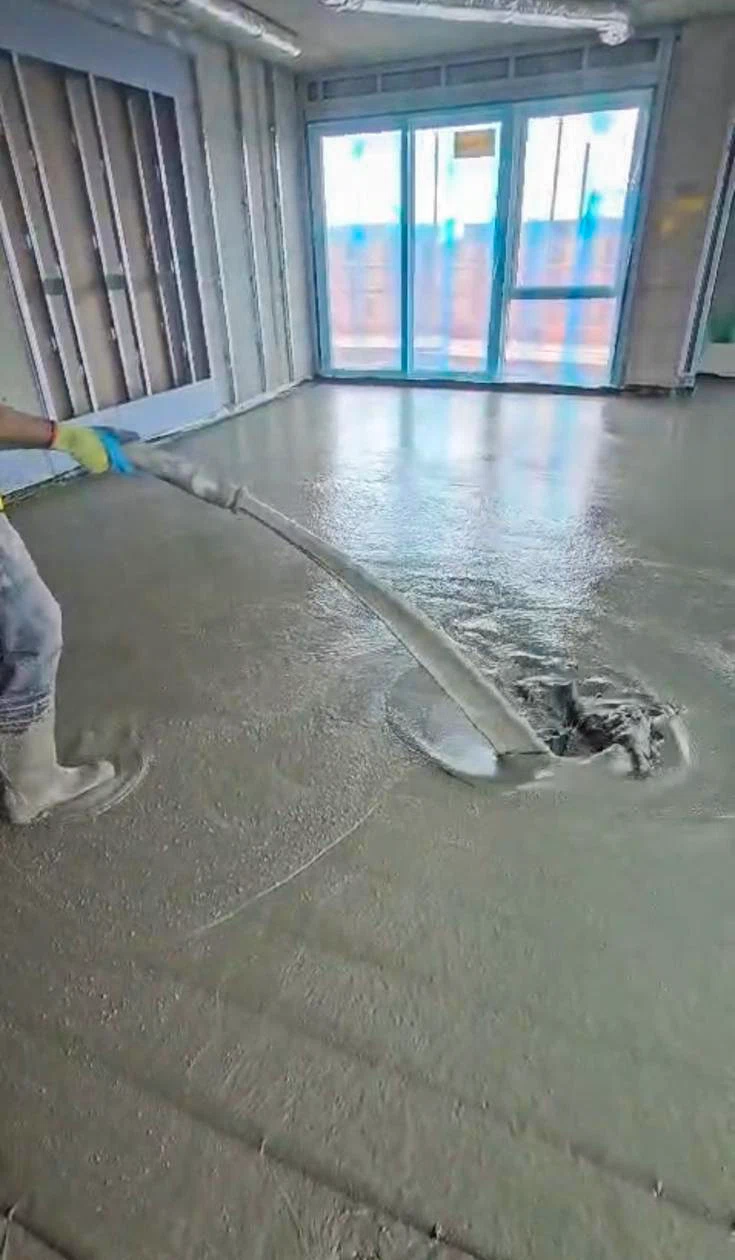
When we finish, you get written notes on drying and laitance to pass to whoever fits the flooring, showing what is done and what is still to do. For the background on the material, the anhydrite screed explained guide is a useful read, and for the pumping side see liquid screed in Enfield.
Anhydrite & Flow Screed prices in Enfield
Liquid flowing screed (which includes anhydrite): £24 to £31 per m² supplied and laid (MyJobQuote, August 2026), so £960 to £1,240 for 40 m². MyJobQuote does not say whether these figures include VAT. See our floor screeding cost guide or screed calculator.
Who lays your anhydrite and flow screed in Enfield
K & B Screeding’s own team, led by director Donatas Bardisevicius. Founded 2019, company 12298780.
See what customers say in our Google reviews and on our testimonials page.
Anhydrite & Flow Screed from Slough to Enfield
On the map, Enfield sits east-north-east of Slough, about 25.5 miles from our base in a straight line (postcodes including EN2, N22, EN3 and EN1), next to Waltham Cross (3.3 miles), Cheshunt (4.1 miles), Haringey (4.5 miles) and Waltham Forest (5 miles).
More on anhydrite screed, part of our screeding services.