
Specifying calcium sulphate for Waltham Forest apartment blocks
On a block's drawings the screed is written as a code from the European screed standard, and that code states the load the floor is built for. Think of C as resistance to crushing and F as resistance to bending, with N/mm2 as the unit for both. Three grades come up again and again. CA-C20-F4 covers floors with light domestic use. Everyday flats, houses and office space usually get CA-C25-F5. Busy communal areas and other hard-working floors call for CA-C30-F6.
On a block like those at the former Walthamstow Stadium or around Blackhorse Lane, the engineer sets the grade and the depth, and we pour what is specified. Now and then a scheme specifies an alpha hemihydrate product in its place. These are chosen where faster drying or a reduced depth matters, which suits a heated apartment floor with little depth to spare. Those products each have their own data sheet from the manufacturer, and its figures override any rule of thumb on our side.
Shrinkage during setting is minimal, so an open-plan flat can go down in wide sections with only a handful of joints. The building still dictates some joints: across door thresholds, between heating zones and above structural movement joints, all marked out on a bay plan before the pour.
If calcium sulphate is new to you, anhydrite screed explained covers how it differs from cement.
Sanding and testing before flooring in Walthamstow flats
Drying calcium sulphate throws up laitance, a thin and weak top skin. Glue or levelling compound put straight onto it grips the skin instead of the screed proper, and the finish may shear away with it. When the floor has dried enough, the laitance gets sanded off and we prime with a product made for calcium sulphate.
Moisture is the next check. We take the reading with a hygrometer, but plenty of flooring makers allow less moisture in calcium sulphate than in cement, so their sheet needs checking too. Where the flat has underfloor heating, switching it on to speed drying is normally possible from around 7 days.
Anywhere that may stay wet needs a different material. Bathrooms with level showers, utility floors and bin stores are better in cement, either a cement based flowing screed or a hand-laid sand and cement screed. On a mixed block, it is common to pour anhydrite through the living areas and cement where water is a risk.
If your scheme is in Newham, see our anhydrite screed page for Newham.
Anhydrite & Flow Screed prices in Waltham Forest
Liquid flowing screed (which includes anhydrite): £24 to £31 per m² supplied and laid (MyJobQuote, August 2026), so £960 to £1,240 for 40 m². MyJobQuote does not say whether these figures include VAT. See our floor screeding cost guide or screed calculator.
Who lays your anhydrite and flow screed in Waltham Forest
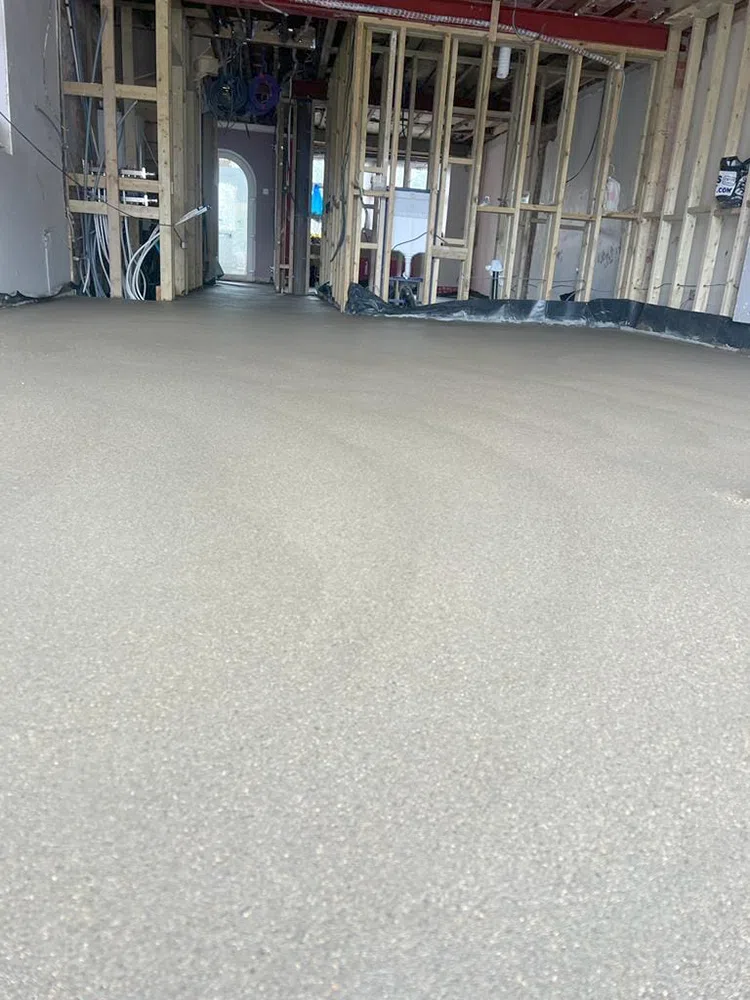
K & B Screeding’s own team, led by director Donatas Bardisevicius. Founded 2019, company 12298780.
See what customers say in our Google reviews and on our testimonials page.
Anhydrite & Flow Screed from Slough to Waltham Forest
As the crow flies, our yard in Slough is about 27.9 miles from Waltham Forest, which lies to the east. Postcodes here include E4, IG8, E17 and E10, and Redbridge (3.2 miles), Chigwell (3.9 miles), Hackney (4 miles) and Haringey (4.8 miles) are close by.
More on anhydrite screed, part of our screeding services.
