
Specifying anhydrite for Tower Hamlets apartment floors
Specifications for the towers at Blackwall, Limehouse or the Isle of Dogs give the calcium sulphate a grade code drawn from the European standard on screeding materials. Its C value is the compressive strength and its F value the flexural strength, in N/mm2. A light-traffic domestic floor can be CA-C20-F4. Most flats, homes and offices are CA-C25-F5, and busier commercial spaces with heavier use move up to CA-C30-F6.
The engineer picks the grade for each tower, and we pour exactly that. In some cases an alpha hemihydrate product is specified because the programme needs it to dry faster or the floor needs less depth. In tall buildings, where every millimetre of floor build-up affects the levels, that thinner section can be the reason for the choice. Each one has a maker's data sheet setting its depth and drying times, and that sheet is what we lay to.
Apartments suit calcium sulphate because it shrinks so little. A whole flat, or a large office floor in a building at Canary Wharf, can go down in big bays with few joints. A few joints remain, across thresholds and where heating zones divide, and their positions are fixed on plan before pouring. Since most of these floors are heated, screeding over underfloor heating explains the pipe cover and first warm-up. Our anhydrite explainer goes into the material at greater length.
Where calcium sulphate is unsuitable, a cement based flowing screed is offered instead.
Laitance and moisture checks in Tower Hamlets flats
While calcium sulphate dries, a weak, papery layer called laitance appears on top. Glue and levelling compound cannot get a grip on that layer, so when drying is far enough along, the crew sands it off and primes the screed to match its calcium sulphate base. Without it, tiles or LVT in the flat may later lift away from the screed.
Moisture testing comes next. Calcium sulphate is often held to a stricter moisture limit by flooring makers than cement screed, so a reading that would let tiles go onto sand and cement may still be too high. No flooring goes down in a Tower Hamlets flat until a hygrometer says so. Underfloor heating, where fitted, can normally help force dry the screed from about 7 days, in line with the heat-up schedule.
Bathrooms and wet rooms are the exception in any flat. Long contact with water weakens calcium sulphate, so those rooms are poured with a flowing screed that has a cement base, or given hand-laid sand and cement for wet areas. If an older slab needs attention first, our concrete floor grinding service prepares it.
Anhydrite & Flow Screed prices in Tower Hamlets
Liquid flowing screed (which includes anhydrite): £24 to £31 per m² supplied and laid (MyJobQuote, August 2026), so £960 to £1,240 for 40 m². MyJobQuote does not say whether these figures include VAT. See our floor screeding cost guide or screed calculator.
Who lays your anhydrite and flow screed in Tower Hamlets
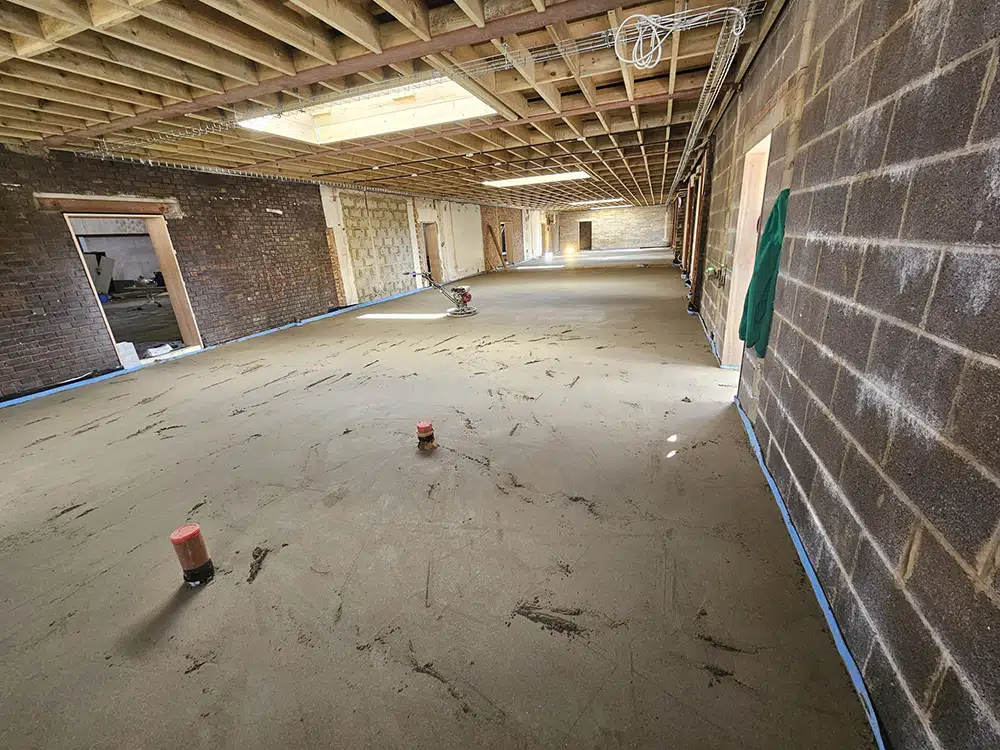
K & B Screeding’s own team, led by director Donatas Bardisevicius. Founded 2019, company 12298780.
See what customers say in our Google reviews and on our testimonials page.
Anhydrite & Flow Screed from Slough to Tower Hamlets
Tower Hamlets is about 26.2 miles east of our Slough base as the crow flies, with postcodes including E2, E14, E3 and E9. The nearest towns to it are Hackney (2.5 miles), Newham (3.2 miles), Southwark (3.5 miles) and Islington (3.6 miles).
More on anhydrite screed, part of our screeding services.