
Renovating older Tower Hamlets houses
Wartime bombing destroyed more than 46,000 houses in Tower Hamlets and damaged thousands more, which is why so little of the borough's pre-1919 housing survives. When one of the surviving older buildings is renovated, the floor can need a new membrane and a fresh screed. Before anything is dug out, the existing floor level, the door thresholds and any damp at the walls are checked, so the new floor finishes at the right height.
The usual approach is to take out the failed floor, lay a membrane and insulation, and screed over it. Floating, it goes in at 65mm for a home or 75mm for commercial use. If the concrete is still sound and only its top has worn, we can prepare the slab and bond a 25 to 40mm screed straight to it. Our thickness guide for screeds shows which depth fits which case, and the layers underneath are covered by our insulation and membrane work.
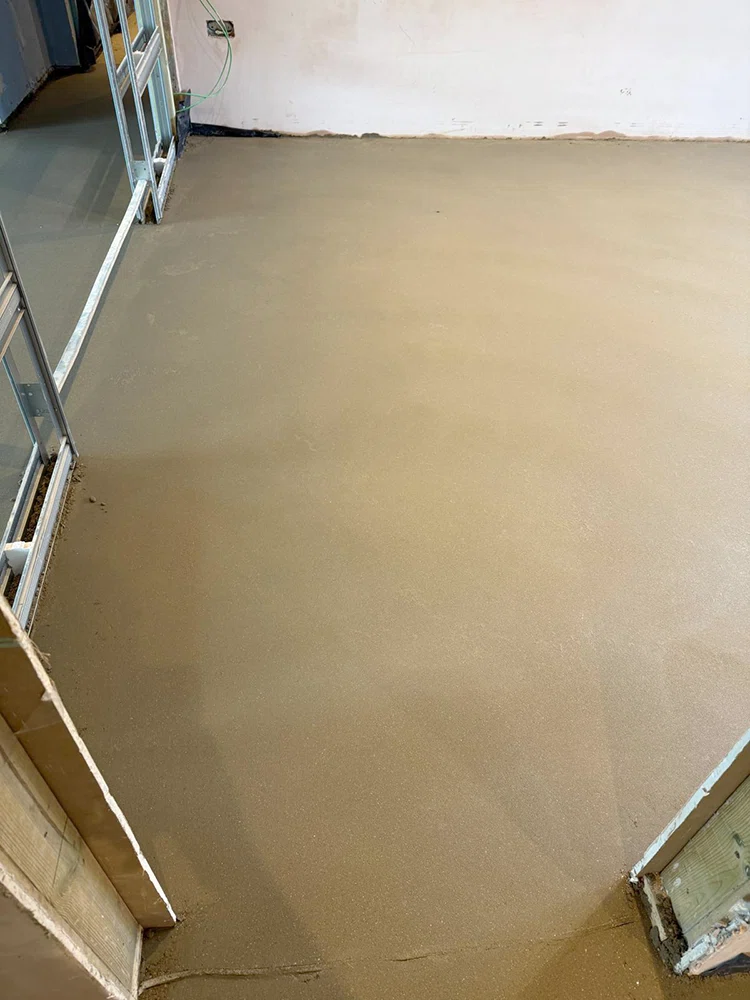
Hand-laid screed fits older houses because it is mixed to the room. Small rooms, stepped floors and narrow hallways can each be laid at their own depth and compacted and finished by hand, without a pump hose snaking through the building.
Drying is slower than with liquid, at about a day for every millimetre in the first 40mm and more after that, so book the flooring off a moisture reading rather than a date on the calendar.
Wet rooms and falls in Tower Hamlets flats
In a borough of flats, a lot of sand and cement work is bathrooms. The floor of a wet room or level-access shower has to slope towards the drain, and it must be cement based, since water weakens calcium sulphate products. Sand and cement is laid and shaped by hand to those falls and takes tiles directly once dry.
Bathroom and kitchen floors in flats are usually small, which suits a hand-laid screed. There is no pump to set up, and the material goes up by lift or stairs and is mixed on site. On floors that must be back in use quickly, quick drying sand and cement screed cuts the wait before tiling. Mixing in fibres to help the screed resist cracking adds £1 to £3 per m².
If the floor around the new wet room is sound but uneven, it may need levelling rather than a new screed, which saves time and depth. Similar work in the neighbouring borough is covered on sand and cement screed in Hackney.
Sand and Cement Screed prices in Tower Hamlets
Sand and cement screed: £18 to £25 per m² supplied and laid (MyJobQuote, August 2026), so £450 to £630 for 25 m². MyJobQuote does not say whether these figures include VAT. See our floor screeding cost guide or screed calculator.
Who lays your sand and cement screed in Tower Hamlets
K & B Screeding’s own team, led by director Donatas Bardisevicius. Founded 2019, company 12298780.
See what customers say in our Google reviews and on our testimonials page.
Sand and Cement Screed from Slough to Tower Hamlets
Tower Hamlets is about 26.2 miles east of our Slough base as the crow flies, with postcodes including E2, E14, E3 and E9. The nearest towns to it are Hackney (2.5 miles), Newham (3.2 miles), Southwark (3.5 miles) and Islington (3.6 miles).
More on sand & cement screed, part of our screeding services.