
Levelling Millwall and Cubitt Town floors before new finishes
A refurbishment usually starts with the old flooring coming up, and that is when the state of the floor underneath shows. After thirty or forty years, a floor can be solid and dry but no longer flat enough for modern finishes. To check flatness, a 2m straightedge goes on the floor and the gap underneath is measured. The BS 8204 classes allow 3mm (SR1), 5mm (SR2) or 10mm (SR3), and a good deal of thin sheet flooring will only be laid on an SR1 floor.
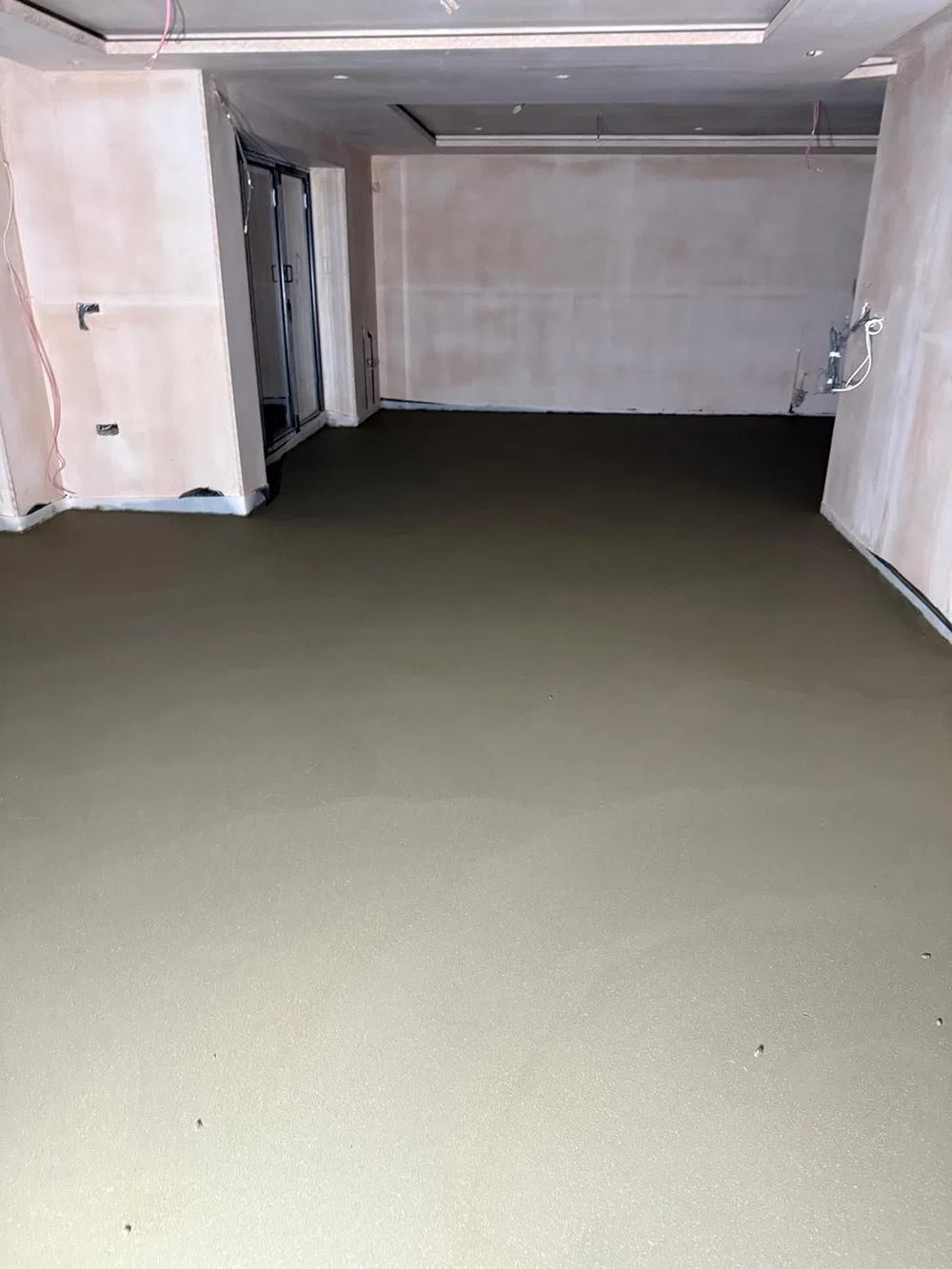
A typical pour of compound in these flats is roughly 2mm to 10mm in depth, and a few products can go on thicker. We clean the base, clear anything loose and apply a primer matched to it, be it concrete, calcium sulphate, sand and cement or a sound old floor. Poured over that, the compound spreads into a smooth, flat finish. On a Millwall flat refit, a fast drying product stops the flooring stage from stalling.
The older concrete floors in post-war estates need the same approach, with more attention to cracks, hollow patches and old repairs before any levelling starts. Small defects can be repaired first through our concrete floor repair service.
Compound is not the answer for a floor that is breaking up or far out of level. Thick pours that cover up a failing base tend to crack and lose their bond. In that case screed repairs or a new screed come first, and levelling follows.
Office and shop refits at Canary Wharf and Whitechapel
Canary Wharf's offices and shops form the borough's main commercial market, with regular floor refits. Each new fit out wants a clean, flat base for carpet tiles, vinyl or LVT, and the programme is usually fixed around an opening date. Fast drying compounds help, taking foot traffic quickly so the flooring contractor can follow on.
Old adhesive, paint and tile residue must come off before priming, or the new compound bonds to the old mess rather than the floor. Normally we grind the concrete until a clean, sound surface is showing.
Smaller commercial and mixed use work comes from Fish Island's converted warehouses, part of a conservation area by the Olympic Park, and from Whitechapel's shops and markets. Converted buildings often have floors with a long history of patches and changes of level, so they need a proper look before anyone promises SR1. If what a unit really needs is a new screed, you will hear that from us, with a price for it. The same service reaches across the river; see floor levelling in Southwark.
How we price floor levelling in Tower Hamlets
A fixed written price within 24 hours, once we know the area and the base. See our floor screeding cost guide.
Who levels your floor in Tower Hamlets
K & B Screeding’s own team, led by director Donatas Bardisevicius. Founded 2019, company 12298780.
See what customers say in our Google reviews and on our testimonials page.
Floor Levelling from Slough to Tower Hamlets
Tower Hamlets is about 26.2 miles east of our Slough base as the crow flies, with postcodes including E2, E14, E3 and E9. The nearest towns to it are Hackney (2.5 miles), Newham (3.2 miles), Southwark (3.5 miles) and Islington (3.6 miles).
More on floor levelling, part of our screeding services. Not sure whether you need a thin compound or a full flowing screed? See self levelling screed explained.
