
Levelling Islington floors before LVT and tiles
Flatness is measured under a 2m straightedge to BS 8204. SR1 allows a gap of 3mm, SR2 allows 5mm and SR3 allows 10mm. SR1 is the class many thin sheet finishes demand, because vinyl and LVT show every ripple underneath. Large tiles need a flat base too, or their edges sit proud of each other.
Another 15% of homes here date from 1973 to 1999. In flats of these decades, and in older buildings, floors typically carry the marks of earlier kitchens, removed walls and patched service runs. A self levelling compound laid from about 2mm up to around 10mm fills those dips and brings the surface into tolerance. Some products go deeper, but a deep pour of compound used to fix a floor that really needs a screed can crack and debond.
The base decides the primer. Screed, concrete, calcium sulphate and some existing tiled floors each need a different product, and a compound laid over the wrong primer can lift. Loose, hollow or contaminated areas are dealt with first, which is where our concrete floor grinding service comes in.
In converted period houses, the join between an old floor and a new extension or a rebuilt section is a common problem. Two floors laid decades apart rarely meet at the same height, and a feathered compound can blend them before the new finish runs through. Where the gap is larger, a thin latex screed of a few mm may be specified.
Shop and office refits at Angel and King's Cross
Commercial floors in Islington sit mostly on the borough's southern edge and around its large redevelopment sites. They include the Angel Central shopping arcade and King's Cross Central, which crosses York Way into Islington. When a unit in either changes tenant or layout, the floor can be left with old adhesive, removed partitions and patched trenches.
For a refit, levelling compound has the advantage of speed. Fast drying products keep the programme moving, so a unit can often be levelled and handed back to the flooring contractor within a short window. Work can be planned outside trading hours where a landlord needs it.
Compound is not always the answer, though. If the existing screed is breaking up, badly out of level or hollow over a large area, it is cheaper in the long run to take it up and lay a new one. Our honest advice is to test the floor first; if it needs replacing, a new sand and cement screed is laid and levelled instead. For similar refit work east of the borough, see floor levelling in Hackney.
How we price floor levelling in Islington
A fixed written price within 24 hours, once we know the area and the base. See our floor screeding cost guide.
Who levels your floor in Islington
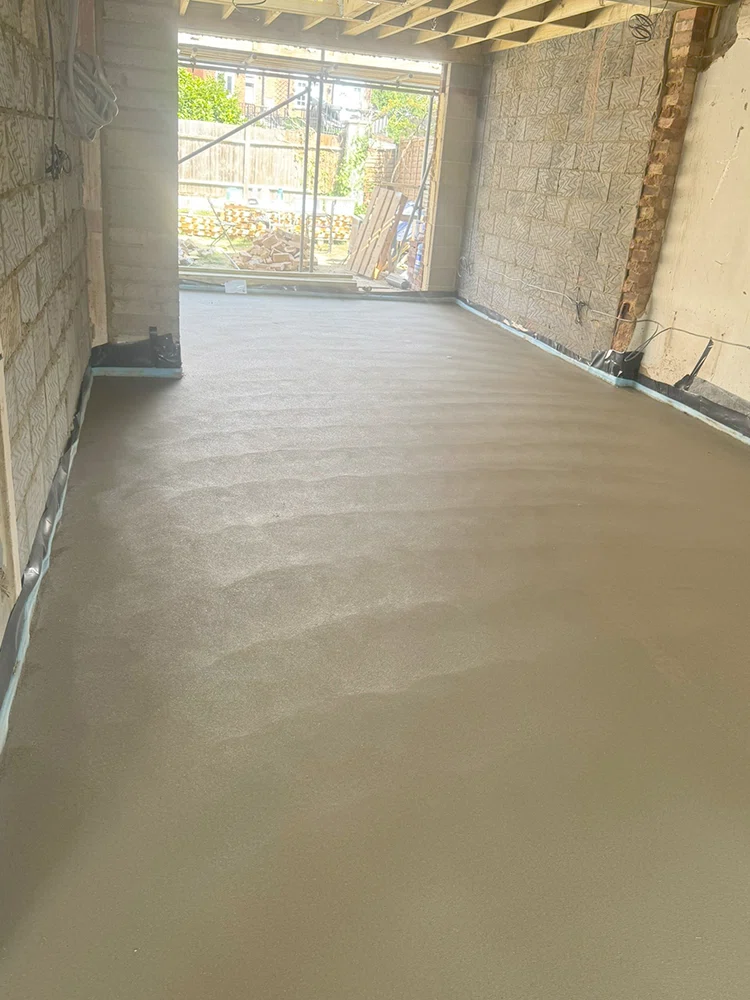
K & B Screeding’s own team, led by director Donatas Bardisevicius. Founded 2019, company 12298780.
See what customers say in our Google reviews and on our testimonials page.
Floor Levelling from Slough to Islington
On the map, Islington sits east of Slough, about 23 miles from our base in a straight line (postcodes including N1, EC1R, WC1X and N4), next to Camden (1.7 miles), Hackney (2.1 miles), Westminster (3 miles) and Haringey (3.1 miles).
More on floor levelling, part of our screeding services. Not sure whether you need a thin compound or a full flowing screed? See self levelling screed explained.
