
Levelling Rotherhithe refits and older Southwark floors
To test a floor, a 2m straightedge is rested on it and the deepest gap underneath is measured. BS 8204 sets the allowed gap by class: SR1 is 3mm, SR2 is 5mm and SR3 is 10mm. Plenty of thin sheet floorings need SR1, and a floor that only makes SR3 will show its dips through LVT or big tiles. A decades-old floor in a Rotherhithe house or flat can be sound and dry and still sit outside those tolerances after years of wear and earlier flooring.
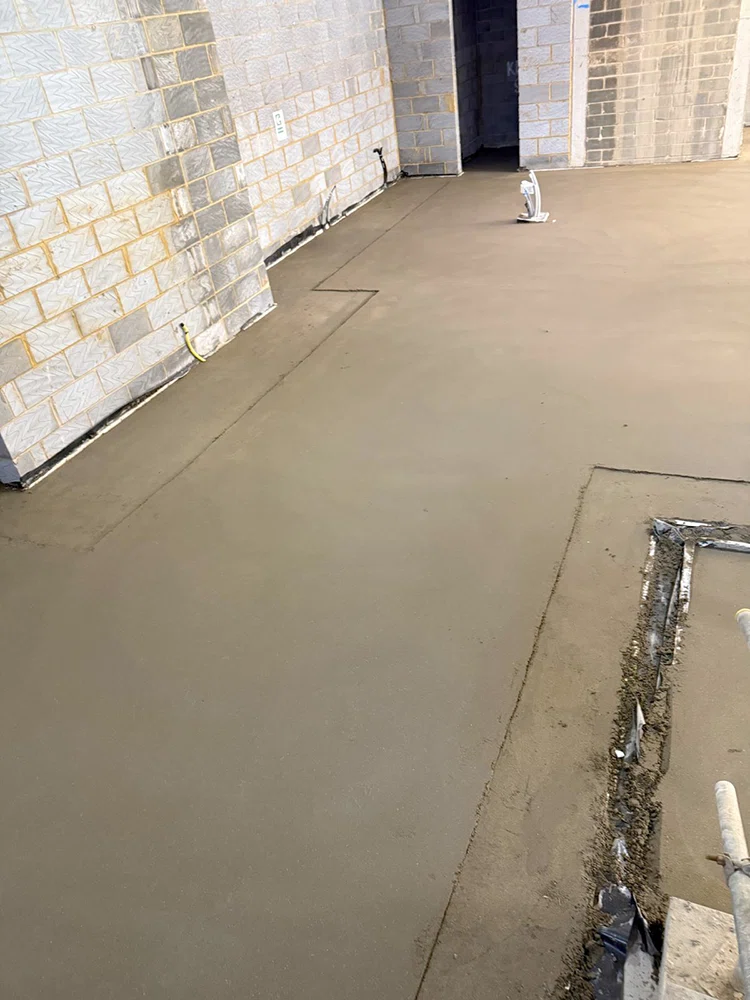
On a worn Rotherhithe floor the compound is usually somewhere from 2mm to 10mm deep, though particular products will build up thicker. First the floor is cleaned, then primed to suit what it is made of, be that concrete, calcium sulphate, sand and cement or a sound old floor covering. The compound then flows out to a smooth, flat surface, and fast drying products keep the flooring programme moving.
The joins between an old house and a new extension are another common case, including the side return extensions going onto Victorian terraces in Peckham and Nunhead. Where the extension meets the original house there is often a slight step or slope, and compound can taper it out so the new flooring runs straight across.
There are limits, though. Pouring compound thick to rescue a floor that should have been rescreeded risks cracking and debonding. When the base itself is crumbling, the right fix is repairing the screed or relaying it in hand-laid sand and cement.
Shop and office floors from More London to Peckham
Southwark's commercial floors are concentrated in a few places: the London Bridge City and More London offices, the Canada Water and Surrey Quays redevelopment, and the shops of Elephant and Castle, Walworth Road, the Old Kent Road and central Peckham. When an office or shop unit there is refitted, the new fit out wants a flat base for its carpet tiles, vinyl or LVT.
A refit floor often carries the old tenant's adhesive, paint or tile residue. All of that must be removed before priming, usually by grinding the concrete back to a clean, sound face. Once the base is clean and primed, a fast drying levelling compound can take foot traffic quickly and be ready for the flooring contractor soon after, which matters when a unit has to reopen on a set date.
Sometimes compound simply isn't right for a Southwark unit, and we will tell you so. A floor that is out by more than a compound can safely take needs a new screed first, and very thin smoothing work under sheet finishes may suit a latex levelling screed instead. Tell us the finish, the floor area and the programme, and we will price the right method for it.
How we price floor levelling in Southwark
A fixed written price within 24 hours, once we know the area and the base. See our floor screeding cost guide.
Who levels your floor in Southwark
K & B Screeding’s own team, led by director Donatas Bardisevicius. Founded 2019, company 12298780.
See what customers say in our Google reviews and on our testimonials page.
Floor Levelling from Slough to Southwark
Southwark is about 24.7 miles east of our Slough base as the crow flies, with postcodes including SE1, SE5, SE21 and SE22. The nearest towns to it are Lambeth (2.1 miles), Lewisham (3.2 miles), Tower Hamlets (3.5 miles) and Westminster (4.2 miles).
More on floor levelling, part of our screeding services. Not sure whether you need a thin compound or a full flowing screed? See self levelling screed explained.