
Rebuilding old floors in Peckham and East Dulwich terraces
Victorian terrace renovations and side return extensions in Dulwich, East Dulwich, Peckham and Nunhead often uncover original floors with no damp proof membrane. A floor like that may look fine under carpet, then turn out to be damp, cracked or crumbling once the kitchen units come out. Patching it rarely lasts.
In a Peckham or Nunhead terrace, the repair that lasts means lifting that floor completely and building a new one from below, laying insulation, then a membrane against damp, then fresh screed. Domestic floating screeds of this type go down 65mm thick, and commercial ones 75mm. If the concrete underneath turns out to be solid and just needs resurfacing, a 25 to 40mm bonded screed can go directly onto it once prepared. Our guide to screed depths sets out which thickness fits which floor.
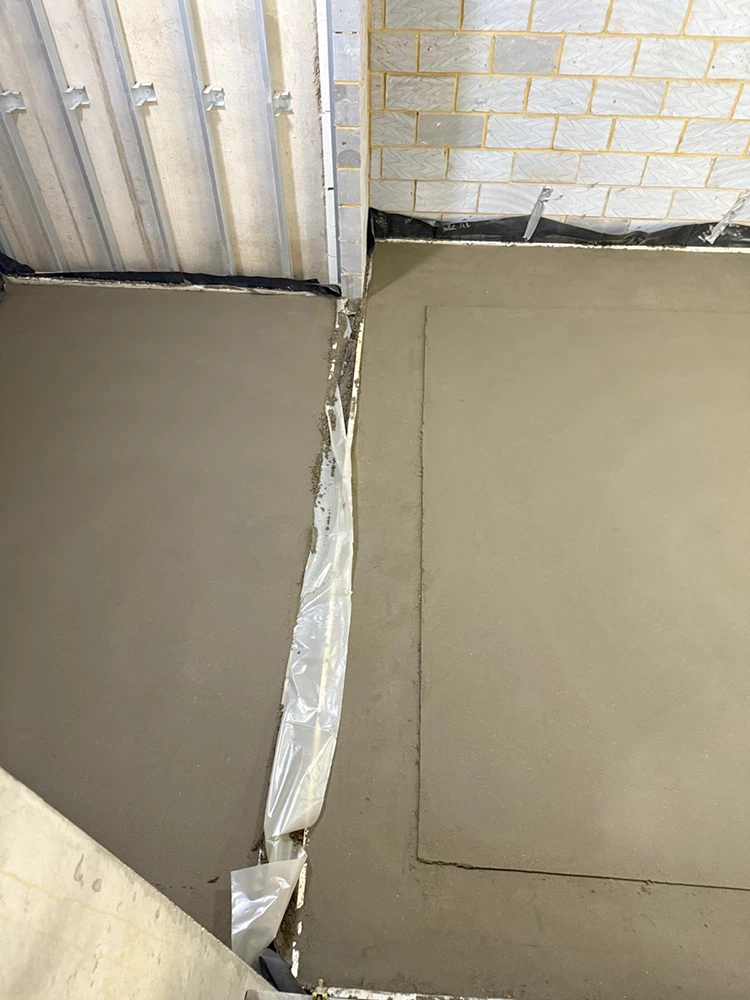
Laying by hand works well in these terraces, since every batch can be mixed for the room it is going into. The long, narrow ground floors of a terrace, a small back addition and a step down into the side return can all be laid in one visit, with each area mixed and compacted to its own depth. The insulation and membrane are part of the same job, and you can read more about them on our insulation and membranes service.
The trade-off is drying: roughly a day for each millimetre up to 40mm and slower past that, which is longer than liquid screed takes. Leave room for it in the build schedule before you book a floor fitter.
Wet rooms, garages and conversions in Southwark
Old house or new flat, certain rooms in Southwark have to have a cement based screed. A wet room or level-access shower needs the screed sloped so water drains away, and calcium sulphate products are ruled out on any floor that will get wet. Sand and cement can, and it takes tiles directly once dry.
Flats in converted buildings account for 12% of Southwark's homes. Refitting a bathroom or kitchen in a conversion often means a small, awkward floor on an upper storey, reached only by a shared staircase, where a pump makes little sense. A barrowed, hand-laid screed is the practical choice there: it is cost effective on small jobs and leaves no hose across a neighbour's landing.
Garages being turned into rooms need the floor raised, insulated and levelled to meet the house, and our garage floor screed guide covers how that is done. Short on time? A faster drying cement screed mix brings the flooring date forward, and adding fibres for crack resistance costs £1 to £3 more per m².
Sand and Cement Screed prices in Southwark
Sand and cement screed: £18 to £25 per m² supplied and laid (MyJobQuote, August 2026), so £450 to £630 for 25 m². MyJobQuote does not say whether these figures include VAT. See our floor screeding cost guide or screed calculator.
Who lays your sand and cement screed in Southwark
K & B Screeding’s own team, led by director Donatas Bardisevicius. Founded 2019, company 12298780.
See what customers say in our Google reviews and on our testimonials page.
Sand and Cement Screed from Slough to Southwark
Southwark is about 24.7 miles east of our Slough base as the crow flies, with postcodes including SE1, SE5, SE21 and SE22. The nearest towns to it are Lambeth (2.1 miles), Lewisham (3.2 miles), Tower Hamlets (3.5 miles) and Westminster (4.2 miles).
More on sand & cement screed, part of our screeding services.