
Wet rooms and bathrooms in Westminster conversions
When a Victorian house is converted into flats, each new flat gets its own bathroom, and often a shower room too. Those floors cannot be calcium sulphate, which weakens when it stays wet. They need cement.
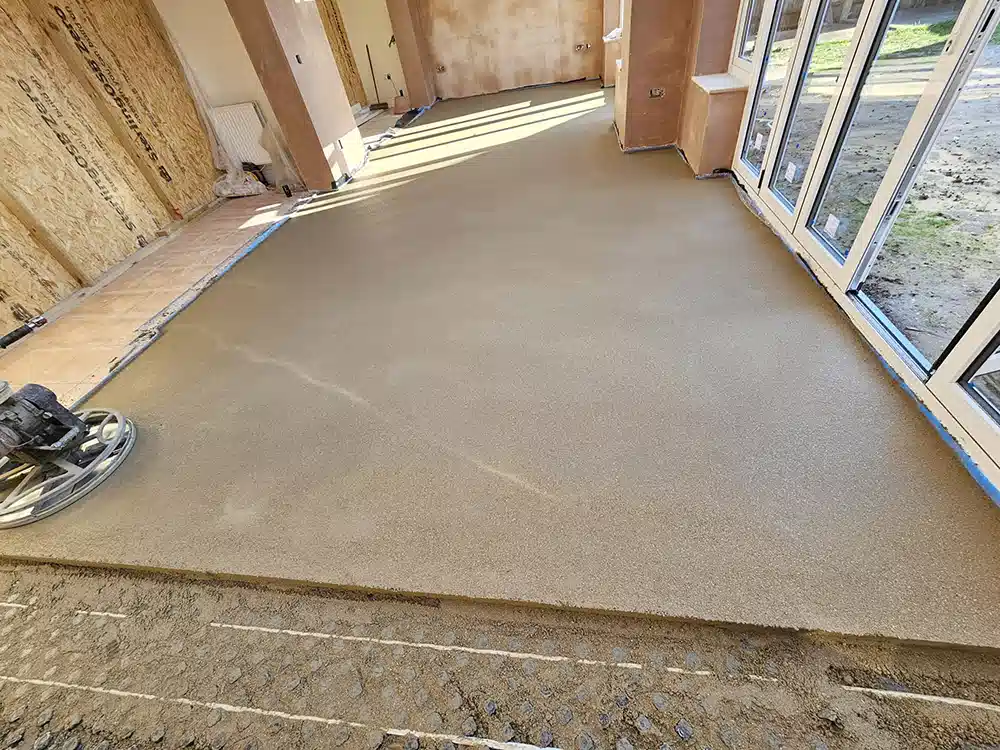
Make it a wet room and there is a second rule: the whole floor slopes to the drain, so water never sits in puddles. Hand-laid sand and cement can be formed to a fall; a self-levelling screed, by definition, cannot. The screed is compacted by hand, the fall is checked with a level, and the surface is finished ready for tanking and tiles.
Small rooms suit the method too. A bathroom of a few square metres needs little material, and mixing on site avoids the cost and parking of a pump lorry, which in central London can be the harder thing to arrange. The mix is adjusted for each area and depth, and fibres can be added where a thinner section needs extra crack control.
Most conversions combine methods. The living rooms may take a lightweight screed that helps meet sound insulation rules, while bathrooms and kitchens get sand and cement. The two need to finish at the same level, so the depths are planned together. Our insulation and membranes page covers the layers under the screed, and our floor preparation service covers taking up the old floors first.
Bonded and floating floors in Westminster flats
There are two ways to lay sand and cement, and height usually decides between them. A floating screed on insulation or an acoustic layer is laid at 65mm in a home and 75mm commercially, because it has nothing below to hold it together. Bond it to solid concrete underneath instead and 25 to 40mm will do. In a flat where the finished floor must meet a landing or a lift threshold, the bonded option saves valuable millimetres.
It is also what we use when a floor has to carry weight soon after laying, or when the finish going on top needs cement under it. A restaurant kitchen is a good example: it is washed down daily and needs a cement floor. Garages and plant rooms under blocks are similar: a cement screed stands up to wheels, water and heavy kit.
Drying takes longer than with a liquid pour: allow a day for each millimetre up to 40mm, and more beyond. A bonded topping is the cheaper of the two on published 2026 prices, £12 to £18 (trade2base, June 2026) per square metre, where an ordinary sand and cement build-up runs from £18 to £25. How thick each type should be is covered in our guide to screed depths.
Sand and Cement Screed prices in Westminster
Sand and cement screed: £18 to £25 per m² supplied and laid (MyJobQuote, August 2026), so £450 to £630 for 25 m². MyJobQuote does not say whether these figures include VAT. See our floor screeding cost guide or screed calculator.
Who lays your sand and cement screed in Westminster
K & B Screeding’s own team, led by director Donatas Bardisevicius. Founded 2019, company 12298780.
See what customers say in our Google reviews and on our testimonials page.
Sand and Cement Screed from Slough to Westminster
As the crow flies, our yard in Slough is about 21 miles from Westminster, which lies to the east. Postcodes here include W2, SW1W, SW1X and SW7, and Kensington and Chelsea (1.6 miles), Camden (2.1 miles), Hammersmith and Fulham (2.8 miles) and Islington (3 miles) are close by.
More on sand & cement screed, part of our screeding services.
